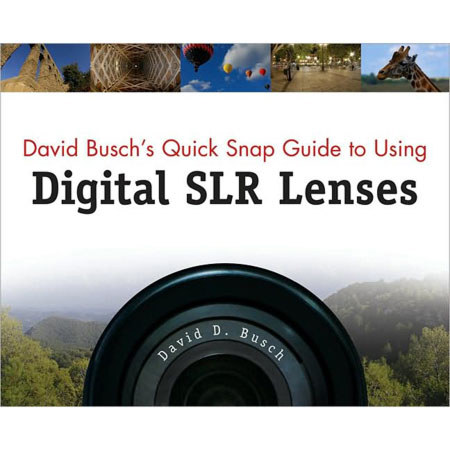
David Busch's Quick Snap Guide to Using Digital SLR Lenses Softcover Book by David Busch, 192 Pages, 4-Color
Ways to Save
Why Adorama?
Easy Returns, Fast Shipping, Trusted for over 35 years.Need help? Call 800-223-2500 / 212-741-0052
Get the best value shopping our selection of used gear.
Shop UsedWe Pay top dollar for your used photo & video equipment.
Get A QuoteNeed help? Call 800-223-2500 / 212-741-0052
Are you ready to go beyond the basics with your digital SLR camera but are unsure which interchangeable lens or two to buy and more importantly, how and when to use each lens?
"David Busch's Quick Snap Guide to Using Digital SLR Lenses" offers focused, concise information and techniques on how to use different lenses to take great photographs. You'll begin with a quick overview of how lenses work and the types of lenses available, including normal, telephoto, wide-angle, prime and zoom.
Then you'll explore typical lens controls and features such as focus rings, depth-of-field scales and image stabilization and how particular settings can help improve your photography. Once you have the basics down you'll learn how to create cool effects using lens filters and accessories and how to select the best lens aperture for particular types of photos.
Finally, you'll go in-depth with telephoto, wide-angle and macro lenses. Each topic or concept is explained using a clear, two- or four page spread and beautiful, full-color images illustrate the results of photographing with each setting, technique, or lens. A mini-glossary will help you define unfamiliar terms as you go. Get ready to enhance your photographs using the versatility of interchangeable lenses on your digital SLR!
| Chapter 1: A World of Lenses | How a lens works What "normal" lenses do What telephoto lenses do What wide-angle lenses do Zooming with multi-focal-length lenses Prime lenses How F/stops work Variable and Constant f/stops Sharpness, Resolution and Acutance The Need for Speed The Ubiquitous Crop Factor |
| Chapter 2:Typical Lens Controls/Features | Focus rings Focus limiters Depth-of-field scales Hyperfocal indicators Zoom controls Filter threads and why you need them Do filters "protect" your lens? Lens hoods and why you must use them Vibration Reduction/Image Stabilization controls |
| Chapter 3: Filters and Lens Attachments | Using Polarizing Filters Using Neutral Density Filters Working with Color Correction Filters Special Effects filters Split Density Filters Close-Up Filters Fish-eye Attachments |
| Chapter 4: Raising the Bar on Quality | Your lens best aperture Depth-of-field tradeoffs Diffraction Testing your lens for sharpness Shutter speed and lens sharpness Testing for motion blur Tripods and monopods to optimize lens sharpness Optimizing your lens focus Focus modes Autofocus assist Mirror lockup Backfocus/front focus |
| Chapter 5: Using Telephoto Lenses | Long lenses vs. true telephotos What's magnification? Importance of telephoto aperture range Autofocus glitches Using selective focus Avoiding telephoto distortion Pincushion distortion Compressing distances Zoom or prime? What's bokeh? |
| Chapter 6: Using Wide Angle Lenses | Telephotos vs. wide angles How wide angles work Choosing a wide angle Chromatic aberration Barrel distortion Perspective distortion Making size distortion work for you Emphasizing the foreground Wide angles and flash Wide angle depth-of-field Wide angles and polarizer's Avoid vignetting Zoom or prime? |
| Chapter 7: Zoom, Zoom, Zoom | Pros and cons of zooms Typical zoom ranges Using wide angle zooms Using long telephoto zooms Superzooms Varifocal vs. true zoom |
| Chapter 8: Macro Lenses and Prime Lenses | Magnification vs. focal length Choosing a prime lens Perspective considerations Depth-of-field up close Specialized macro lenses vs. general purpose lenses Close-Up Attachments Using extension tubes Using a bellows Using a reversing ring |
| Ends with | Mini-Glossary Index |
| Author | David D. Busch |