


This item is no longer available.
Bower T-mount 800mm F/8 Mirror Lens, Requires T-Mount
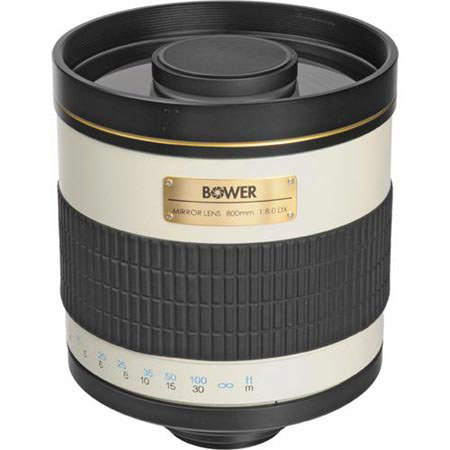
The Bower T-mount 800mm F/8 Mirror Lens is designed for use with a T-mount to fit your camera system works on both 35mm/Full Frame Sensors, as well as the "APS-C" style digital SLR cameras. T-Mounts are available for all the digital SLR systems, as well as for C-mount systems, or for nearly any film camera. However, in every case the fixed f/8.0 aperture is not always communicated to the camera body, in which case you would use the camera in the "M" manual exposure mode or the "A" aperture-priority mode. This lens has a broad diameter and stocky build, at 4.4 x 5.2" and just over 2 pounds. This makes it easier to handle than a normal 800mm refractor lens. As a super-telephoto lens it requires the use a tripod/monopod for best results. It also delivers a different rendering of out of focus areas than a normal lens, where highlights will be doughnut-shaped rings with more saturation and contrast on the edge of the ring than on the center. The T-Mount 800mm F/8 mirror lens from Bower is an ideal candidate for astrophotography use when mounted to a motorized equatorial telescope mount. The lens is offered in new condition only with free shipping!
Product Highlights
From the Manufacturer
The Bower 800mm f/8 Manual Focus Lens is a catadioptric mirror T-mount lens. When combined with the T-mount to fit your camera system, this mirror lens mounts to camera and works on both "full frame" cameras as well as the "APS-C" style digital SLR cameras. However, in every case the fixed f/8.0 aperture is not communicated to the camera body. As such, you can use the camera in the "M" manual exposure mode or the "A" aperture-priority mode (if your camera is so equipped).
This lens, at 4.4 x 5.2" and just over 2 pounds, has a broad diameter and stocky build. It is a bit easier to handle than a normal 800mm refractor lens, but it is still a super-telephoto in any case. It also has a much different rendering of out of focus areas than a normal lens; highlights will be doughnut-shaped rings with more saturation and contrast on the edge of the ring than on the center.