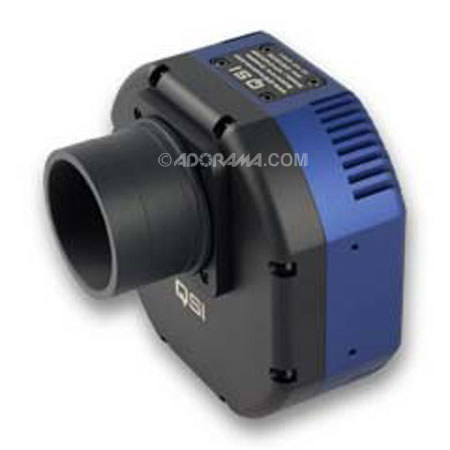
Quantum Scientific Imaging QSI 520cs Cooled Interline RGB Bayer Filter, Single Shot Color CCD Camera, 4.2MP KAI-2020CM Image Sensor with Microlens Technology, Mechanical Shutter
SKU: QSI520CS
This item is no longer available.
Share:
Overview
Compare
Specs
Protection
About QSI 520CS Cooled Interline RGB Bayer Filter CCD Camera
The standard 520cs model camera employs a Kodak KAI-2020CM 2 megapixel interline transfer CCD image sensor with microlens technology. The integral RGB Bayer color filter mask allows Single-Shot color imaging. The KAI-2020CM sensor has a photoactive array of 1600W x 1200H pixels. Low dark current and high pixel charge capacity result in a dynamic range exceeding 74db. The sensor employs a vertical overflow drain that provides both antiblooming protection and a fast electronic shutter.
Micro lenses cover the surface of the CCD to focus the light into each pixel to increase optical response. The 520cs utilizes the electronic shutter built into the KAI-2020CM CCD image sensor to control exposures. Shutter timing is very precise and can range from as short as 100 microseconds up to 240 minutes. The very fast acting shutter is possible due to two key features of the interline transfer architecture.
Any existing electrons can be removed from the pixels instantly with a single electronic pulse, beginning the exposure. After the specified exposure duration, the entire image field can be instantaneously moved into a light-shielded holding area on the CCD. The image is then read out at the normal rate without being contaminated by any light still illuminating the CCD surface.
The QSI 520cs camera incorporates the optional internal mechanical shutter in the 'mid-size' camera body configuration. When operating with an interline transfer CCD, a mechanical shutter is not used to actually make the exposure. This is still the responsibility of the electronic shutter. The mechanical shutter is employed to cover the CCD and simplify the creation of Dark and Bias frames for subsequent image processing.
Single-Shot color imaging is made possible by overlaying the pixels on the CCD with an alternating red, green and blue color filter matrix at the time of manufacture. This is also how the vast majority of color video and still cameras create color images. The raw image from the camera requires further processing to extract the color and luminance information and create a final image.