
This item is no longer available.
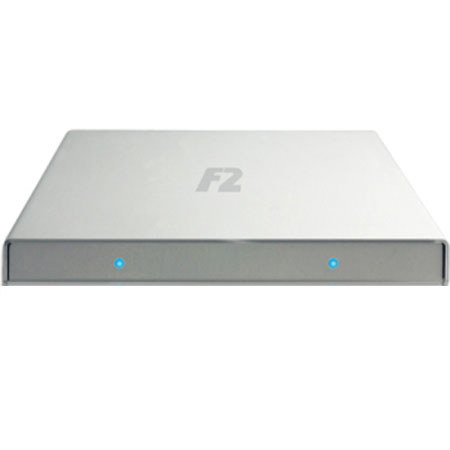
Speed, reliability, ruggedness and convenience-these are the essential qualities of a storage system for on-location video capture. When you need to travel light, choose a Sonnet Fusion F2 portable SATA RAID storage system. Providing 1.5TB of storage in a small enclosure, Fusion F2 uses two eSATA connections to deliver the fastest performance yet from a 2-drive portable storage system, with data transfer rates up to twice as fast as FireWire.
By connecting Fusion F2 through a SATA host adapter like Sonnet's Tempo SATA Pro ExpressCard/34, or to Sonnet's Qio Professional Universal Media Reader, your notebook's FireWire 800 port is left open for use by an AJA Video Systems ioHD, which requires dedicated use of FireWire bandwidth. Fusion F2 is cool, quiet and energy-efficient: side-by-side placement of its drives increases the metal case's cooling surface area, thereby eliminating the need for a fan and allowing it to be bus-powered so it can be used even when no grid power is available.
Fusion F2 features two 3 Gb/s eSATA data ports. By connecting via a direct SATA interface with no bridge chip between the F2's case and SATA drives, there is no resulting communication slowdown, just the fastest data transfers possible.
Fusion F2 can be powered by your computer through a spare FireWire port using an included adapter cable. Alternatively, you can power the F2 by connecting it directly to Sonnet's Qio with an included 15cm (6") power cable. For longer field work, the F2 is also compatible with all models of myPower ALL batteries from Tekkeon at an 8-19V setting. Sonnet recommends model MP3450i, which at a 56 Watt-hour capacity, should provide up to 9 hours of F2 run time. Other power options include another FireWire device, powered hub, or Sonnet's optional World Travel Power Adapter.
Fusion F2 was devised as a high-performance, high-reliability alternative to existing portable drive solutions. Encased inside a thick aluminum shell, each of Fusion F2's drives is individually shock-isolated, not only protecting the drives during transport, but also virtually eliminating cross-coupled vibration-a potential source of soft-error-induced skipped frames.