It all comes down to aligning your camera into the exact position you want, repeatedly, with ease, accuracy, and precision. Not a small task. We’re talking about Tripod Heads here. Some are designed to hold a camera rock-steady; others allow fluid movement through a smooth arc. There’s at least one that will satisfy your specific needs.
But my tripod already has a head
The vast majority of tripods are sold with a functional and very useful head atop its three legs. It’s also possible to purchase a set of legs and center column assembly as a unit, and add a tripod head that exactly matches your personal requirements.
Certain applications, especially those involving video production, require very specific types of tripod heads. These are generally fluid heads that are capable of delivering silky-smooth pans and tilts. Other applications have different requirements. As it is with every other photographic accessory, it’s best to determine your needs before searching for solutions.

BALL HEADS
Ball heads can be maneuvered into a very wide range of positions, and generally can solve the problem of aiming the camera lens in exactly the right direction without a lot of fuss. Theoretically, a ball joint can move in a 360-degree circle, thus delivering the upper limit of adjustability. However, most ball heads are relatively simple assemblies that do not include true pan or tilt adjustment capabilities.

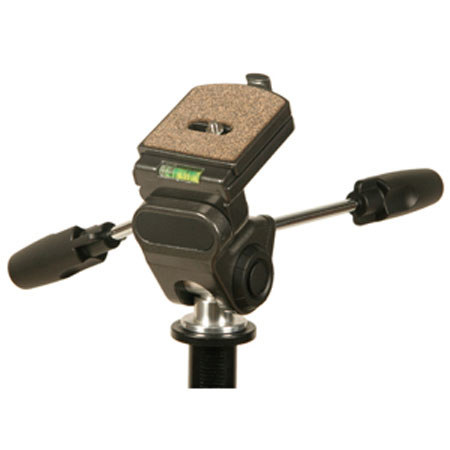
For most photographers, this type is the best choice. The movements that are typically available from a pan/tilt head provide a very high level of control. They are also the most affordable solution in most cases (although some can be found at prices higher than many digital cameras). Grip-action type heads utilize a one-handed control to provide a new and easier way to make adjustments. This is useful when you’re working quickly or when you must make a large number of small adjustments.

GIMBAL HEADS
If you place a large, heavy camera and lens on a typical ballhead or other kind of tripod head, the laws of gravity take over and the camera will want to tip over. But you want it to stay straight, and a monumental battle against gravity ensues. A gimbal head balances your camera and lens at its natural center of gravity. Designed to work with lenses that have a built-in tripod mount collar, Gimbal heads let you easily pan by rotating the base, and do up/down tilts, without fear of the camera tipping over in its mount. Because of the engineering behind a Gimbal, there’s very little friction, so your tilts and pans can be smooth.
FLUID HEADS
Some pan/tilt heads are also classified as fluid heads. As the name implies, fluid heads use a sealed liquid to create a miniature hydraulic damping system that enables smooth, steady motion when moved through a given space. If you shoot video with a compact camcorder you’ll find a fluid head to be exceptionally useful. Prices vary depending on the level of sophistication but there are many fine units that are quite affordable, including the Smith-Victor Pro 4 – Professional Fluid Effect Three Way Pan Head with Quick Release, which sells for just $72.95.

VIDEO HEADS
Video Heads are generally specialized combination pan/tilt fluid heads that incorporate additional features, such as geared rotation adjustments, heavy-duty load capacity, bubble levels, and greater adjustment lock options. Some models have adjustable counterbalance springs so they can be fine tuned to the exact balance point with a wide range of cameras of various weights. There are video heads that allow full adjustment of the fluid drag so that motion can be more precisely controlled, regardless what kind of video equipment is being used. Prices range from around $25 to as much as $13,000 for pro video heads, depending on features.

CAMERA ROTATORS
Many pan/tilt heads have adjustable platforms that allow digital or 35mm cameras to smoothly shift between horizontal and vertical orientation. Camera rotators perform the same function when used with heavier medium format cameras. Of course, they also work well with smaller cameras. Stroboframe’s Vertaflip PHD On-Tripod Camera Rotator ($29.99 at Adorama) allows you to rotate the camera without changing the lens axis. Neat trick. It also keeps the camera weight balanced over the tripod center, something that is especially important if you use heavy medium format cameras.

MOTORIZED TRIPOD HEADS
Now that DSLRs offer panorama stitching and more time-lapse features, there’s a building demand for a more automated approach to moving a camera to match the precise needs of each kind of photography. Theses pan heads attach to the tripod and, using a battery-powered motor will move the camera as needed. Some companies have made automated heads for specific camcorders, while others are highly specialized pro tools. Prices range from about $100 to over $15,000.

PISTOL GRIP
A pistol grip head (also called a Joystick Head) lets a photographer work quickly and efficiently. Squeeze the handle and you can reposition the camera. The range of motion is similar to that fro a ball head. Some photographers find a pistol grip awkward when photographing moving subjects, since you can’t simultaneously focus, press the pistol grip and the shutter release. A pistol grip tends to be taller than other tripod heads, raising the camera by 3-5 inches. This may be a good thing, depending on the tripod.
Related:
- Buying Guide: What’s the Best Travel Tripod?
- Ready, Steady, Go: Why Monopods are a Great Solution for Travel Photography
- New Line of 3Pod Tripods by Flashpoint: First Look
What kind of tripod head do you use? Leave a comment!