

This item is no longer available.
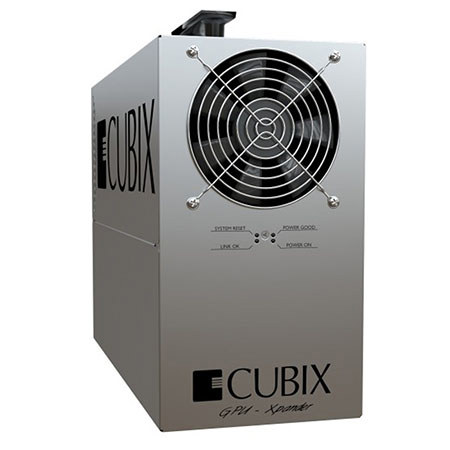
Cubix xPDT-x16-4-OSV GPU-xpander 4 enables you to add four slots to your watt- and slot-limited computer so you don't have to buy a new one. Cubix GPU-xpander 4 is a desktop computer expansion enclosure that connects to a host computer using an adapter in a PCI Express (PCIe) x16 slot and a X16 cable. GPU-xpander 4 provides four Gen 2 x16 slots (x16 electrical) slots that support four double-wide controllers such as GPUs or multi-function / multi-port cards, including audio, FireWire, Gbit Ethernet and USB 2.0. GPU-xpander 4 provides its own power supply and cooling.
Add four NVIDIA Quadro FX 1800 / 3800 /4800 /5800, GeForce GTx 465 / 470 / 480, Tesla C1060 / C2050 / C2070 graphics or other controllers to any computer that has an available PCIe x16 expansion slot using GPU-xpander 4. Install the host adapter in the computer's PCIe x16 slot, connect it to the GPU-xpander 4 and voila! You have just added four powerful GPUs for graphics or HPC without buying a new computer.
Give your operators the graphical rendering or HPC power they demand with Cubix GPU-xpander 4. When your operators return for their next shift, they'll find their desktop space unchanged, their desktop screen configuration the same as usual, but what a difference in performance! With as many as four GPUs for rendering 3D graphics or mathematical calculations in their system, their applications and renderings will leave their expectations in the dust with fast, eye-popping performance. For example, you can upgrade to or add four NVIDIA Quadro FX 4800 or 5800 graphics controllers, four GeForce Fermi GTx 470 / 480 or four NVIDIA Tesla C1060 / 2050 / 2070 GPUs for each operator, giving them the performance they demand without the usual interruption that a new system causes.