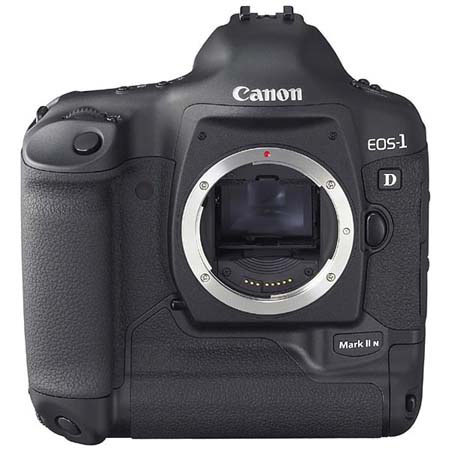
Canon EOS-1D Mark IIN Digital SLR Camera Kit, 8.20 Megapixel, Interchangeable Lens - Refurbished
SKU: ICA1DM2NR
This item is no longer available.
Share:
Overview
Compare
Accessories
Specs
Protection








About Canon EOS-1D Mark IIN Digital SLR Camera Kit, 8.20 Megapixel, Interchangeable Lens - Refurbished
The Canon EOS-1D Mark II N digital SLR, preserves the speed, responsiveness, image quality & reliability of the popular EOS-1D Mark II model while incorporating refined features that make the camera easier & more precise to use. Firing at 8.5 frames per second for up to 48 full-resolution JPEG images in a burst, the Canon EOS-1D Mark II N camera ups the ante while retaining the superb CMOS Sensor of the 1D Mark II model, with its convenient 1.3x lens conversion factor.
The 1D Mark II N digital SLR adds a 2.5", wide-angle view LCD/TFT monitor with 230,000 pixels of resolution that offers crisp image playback. Start-uptime on the new camera has also dropped to 0.2 seconds with the help of Canon's DIGIC II Image Processor. Its total viewing area is more than 50 percent larger & its backlight is brighter with 6 LED modules. The improved display enables viewing angles up to a remarkable 170 degrees from any direction.
The user can have a magnified view (15 steps) from any selected AF point. Another new feature on the camera is magnified view during Quick Review. When an image is displayed on the LCD monitor immediately after capture, the user can immediately magnify the view to check focus right away. Other improved playback functions include a last displayed image remembered feature & a more complete INFO display that now shows file size & includes notations for monochrome (B/W) & color (R/G/B) when the RGB histogram is enabled.
An improved image processing sequence & better memory management method in the EOS-1D Mark II N digital SLR has ramped up its burst capability with the camera now able to shoot up to 22 RAW frames & up to 48 full-resolution JPEGs in burst. The camera can also shoot 19 frames of RAW+JPEG (JPEG quality: 8, Picture Style: Standard, ISO 100); & at 59 frames or better at the JPEG Middle setting, 77 frames or better at JPEG Middle 2, & 135 or better at JPEG small, a substantial increase.
The camera now creates new folders automatically when file numbers reach 9999, making it more responsive in fast-moving news & sports photography. You can customize the first 4 characters in file names, enabling superior image organization & camera identification capabilities.
The EOS-1D Mark II N digital SLR lets the user save the same image simultaneously in both the CompactFlash (CF) & SD memory card slots, a highly effective backup mechanism, & can also record to slot 1 until it is full & then go to slot 2 reserve. Now, it's also possible to save the RAW & JPEG images separately in each memory card. The RAW images can be saved in slot 1 & the JPEGs, in any of ten quality levels, in slot 2, or vice versa.
A new feature called Picture Styles combines processing parameters & color matrix settings into easy settings designed to obtain the desired effect, almost like choosing a type of film to obtain a specific result. This eliminates confusing the effects settings have on the image in the digital era.
Canon EOS-1D Mark IIN Digital SLR Camera Kit, 8.20 Megapixel, Interchangeable Lens - Refurbished Features
- Portrait mode, for softer, more natural skin tones; Landscape, for vivid blues and greens and overall sharpness, plus Neutral, Faithful and Monochrome, which can be customized to emulate color filters with black and white film.
- Moreover, extensive noise reduction ensures an extremely high S/N ratio. Framingis natural because the sensor's 3:2 aspect ratio is the same as in 35mm cameras,and the sensor's large size realizes an effective angle of view that's just 1.3 times the focal length indicated on Canon EF lenses.
- Record-Breaking Speed.
World's fastest digital SLR*: 8.5 fps for up to 48 full-resolution JPEGs in a burst. - With its continuous shooting speed of approximately 8.5 frames-per-second, the EOS-1D Mark II N is the world's fastest Digital SLR camera (as of August, 2005).This record-breaking speed is achieved even when recording in the Large JPEG setting (approx. 3,504 x 2,336 pixels) - a major triumph.
- 8.5 fps are maintained during maximum bursts of 48 shots (22 shots in RAW). Bursts are first recorded to the cameras internal memory to ensure maximum speedand then transferred to memory cards for storage. The number of shots remaining during a burst is displayed on the right side of the viewfinder.
- Photographers can expect an exceptional degree of performance and reliability onpar with any film camera they've ever used. Speedy shooting is achieved with lightning-fast 45-point AF, sophisticated tracking and predictive AF technology combined with precise, instant metering, no matter the setting.
- Shutter lag is a paltry 55 milliseconds. Starting up in 0.2 sec., the EOS-1D Mark II N demonstrates its speed immediately.
- An unprecedented combination of speed and power.
8.2 Megapixel CMOS Sensor with a convenient 1.3x lens conversion factor, combined with DIGIC II Image Processor for outstanding image quality. - Canon's in-house designed single-plate CMOS sensor with 8-channel reading technology delivers exceptional image quality & accelerated continuous shooting. Large & extremely sensitive, with approximately 8.2 million effective pixels (8.5 million total pixels) & a generous 28.7 x 19.1mm image size, it faithfully captures every nuance of your scene
- The revolutionary DIGIC II Image Processor complements the EOS-1D Mark II N 's speed in capturing images by processing and saving them with similar speed and precision. Compatible with DDR SDRAM, the DIGIC II processor achieves super highspeed processing that results not only in fast shooting, but also accurate processing.
- This single-chip image processor employs original Canon algorithms to accuratelyconvert signals from the CMOS sensor into crisp, high-quality images with natural color and rich gradation.
- By handling larger volumes of image data, DIGIC II even contributes to lower power consumption: approximately 1,200 shots can be taken on a full battery at 68° F/20° C, or around 800 shots at 32° F/0° C.
- Rugged, Robust Build Quality.
Superb body design and strength - all-metal body and chassis, weather-resistant construction and shutter durability - tested to 200,000 exposures. - Designed as a serious tool for professionals, the EOS-1D Mark II N performs reliably in the most demanding shooting conditions. Its handsome body offers thesame high durability as the EOS-1Ds Mark II, thanks to rigid magnesium alloy in the chassis and external covers (top, front, rear and memory card slot cover).
- The magnesium alloy also contributes to effective electromagnetic shielding, a long-lasting luxurious finish, and extremely low body weight that photographers will surely appreciate.
- Exceptional durability extends to the inner mechanisms as well, which are shielded from dust and water by protective sealing on all exposed moving parts. Shutter durability of up to 200,000 shutter cycles, ensures the 1D Mark II N will survive almost any situation, for years to come.
- Bigger image for playback and wide viewing.
New larger 2.5 inch LCD screen can be viewed even at extreme angles up to 170°. - The EOS-1D Mark II N features a newly-designed 230,000 pixel, 2.5 inch LCD screen which provides a bigger image for playback and can be viewed 170° from all angles. Advances in playback include zooming from any AF point, an improved magnified view, and more shot information in the display.
- New features addressing user requests.
Many new user-requested features, including RAW + JPEG recording on separate memory cards, easy switching between memory cards and user-set file prefixes. - The EOS-1D Mark II N incorporates a number of user-requested improvements such as an interchangeable matte focusing screen for critical focus in low light. ISOvalues can now be changed in the viewfinder, allowing the photographer to changesettings without taking the camera from their eye.
- The1D Mark II N has two memory card slots, one for CompactFlash (CF) and one forSecure Digital (SD) memory, and has the ability to record JPEG and RAW images ondifferent memory cards, simultaneously.
- These improvements, plus all the shooting modes of the EOS 1 line and shutter speeds from 1/8000 to 30 sec. and bulb make it clear that the1D Mark II N is an incredibly adaptable photographic tool.
- New feature to make your photos more creative.
New "Picture Style" function for greater control of color rendition and in-camera sharpening. - The EOS-1D Mark II N is one of the easiest cameras to customize to a photographer's personal style of shooting. Six new "Picture Style" settings simulate the characteristics of different film styles, including Snapshot mode, for punchy, print-from-the-camera color,
- By selecting different sharpening parameters, photographers can further ensure that their images will look exactly as they like, right out of the camera, expediting time-sensitive projects where post-processing is unnecessary or inconvenient.