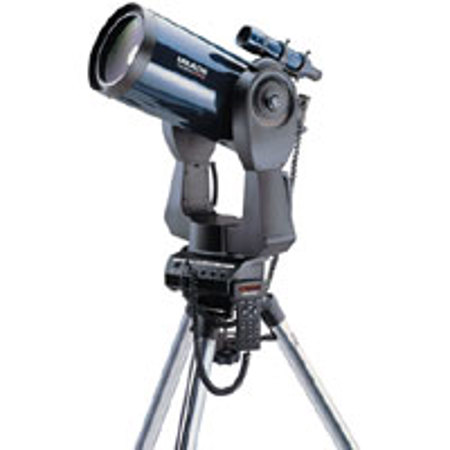
Meade 7" LX200GPS-SMT 2670mm f/15 Maksutov-Cassegrain Telescope, with UHTC Coatings, Computerized Altazimuth Fork Mount, Autostar II Computerized Hand Controller & Tripod
SKU: MDLX2007U
This item is no longer available.
Share:
Overview
Compare
Specs
Protection
About Meade 7" LX200GPS-SMT 2670mm f/15 Maksutov-Cassegrain Telescope, with UHTC Coatings, Computerized Altazimuth Fork Mount, Autostar II Computerized Hand Controller & Tripod
Most users find that observing through the 7" LX200GPS-SMT is a new experience, with lunar, planetary, & deep-space images approaching those normally obtained, at higher cost, only through a fine apochromatic refractor. Under favorable atmospheric conditions, the surface of Jupiter resolves into a treasury of extremely fine detail, with many of the planet's belts showing structure, color, & discontinuities, & internal structure of the Red Spot readily visible; cloud belts on the surface of Saturn take on clear variations of color & form, with shading differences among the rings now observable; the lunar landscape becomes a field of almost unlimited detail. In deep-space galaxies, nebulae, & star clusters are seen in high contrast against a deep-black backdrop.
The Maksutov-Cassegrain optical design has long been favored by lunar, planetary, & deep-space observers for the richly detailed, high-resolution images that it presents. And, in the Meade 7" LX200GPS-SMT the design has perhaps achieved the embodiment of its fullest potential. No other telescope offers this combination of state-of-the-art features:
Exquisite f/15 Maksutov-Cassegrain Optical System: Hand-figured by master opticians, the optics of the 7" LX200GPS-SMT easily pass, under favorable seeing conditions, all of the test criteria for optics of their aperture. The double-sided spherical meniscus correcting lens is manufactured of Grade-A crownBK7 optical glass free of striations & imperfections that otherwise degrade optical performance.
Virtually alone among large-aperture commercial Maksutov telescopes, the 7" LX200GPS-SMT includes an oversize, 8.25"-diameter primary mirror that results in a significantly wider fully illuminated field of view than would otherwise be possible. The result is that stars of equal magnitude appear of equal brightness throughout the field, from center to edge.
The aspheric figure of the 7" LX200GPS-SMT's fast f/2.5 primary mirror yields field corrections of a level rarely observed in commercial Maksutov-Cassegrains of this aperture. Meade 7" LX200GPS-SMT owners often exclaim about the sharpness of stellar diffraction images, a sharpness owed to the optical corrections enabled by the telescope's aspheric primary mirror.
Essential to the performance of the 7" LX200GPS-SMT, the telescope's series of internal light baffles & field stops greatly inhibits the passage of unwanted, off-axis light rays to the prime focus. A conical baffle attached to the correcting lens in combination with the cylindrical baffle tube projecting from the primary mirror serve to reject virtually all of these rays.
In addition a series of field stops, common to the primary baffle tubes of all Meade Cassegrain telescopes, effectively eliminates undesirable light which might reflect from the inside surface of the baffle tube. The result of these baffle systems is extremely high-contrast images observed against an unusually dark-sky background.