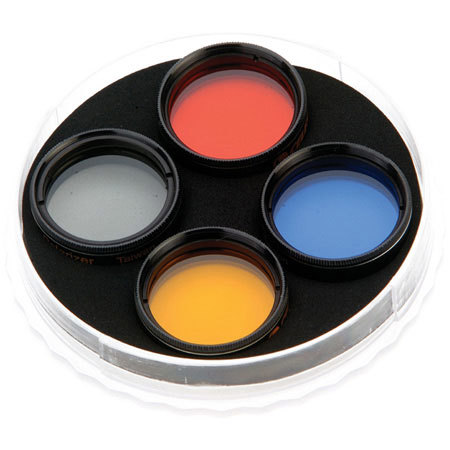
Celestron Filter Set #4 (1.25"), Light Yellow #8, Violet #47, Pale Blue #82A, ND-13% T., 0.9 Density #96.
SKU: CNFS4
This item is no longer available.
Share:
Overview
Compare
Learn
Specs
Protection
About Celestron Filtr Set #4 (1.25), LtYlw#8,Vlt#47,PBlu#82A
Celestron offers four convenient filter sets, which contain four different filters per set. Not only are these highly useful filter combinations, but they also offer an economical way to add versatility to your filter collection.
Celestron's filters are made of high quality, solid plane parallel glass with excellent homogeneity. They're anti-reflection coated to prevent glaring and ghosting. All eyepiece filters are threaded to fit Celestron's, and most other manufacturer's, 1¼" eyepieces, and offer a full 26mm clear aperture.
#15 Deep Yellow 67% T [Series 4] Moon - Enhance lunar features. Jupiter - Penetrate and darken atmospheric currents containing low-hue blue tones. Enhance orange and red features of the belts and zones. Useful for studies of the polar regions. Mars - Reduce light from the blue and green areas which darken the maria, oases and canal markings, while lightening the orange-hued desert regions. Also sharpen the boundaries of yellow dust clouds. Neptune - Improve detail in larger telescopes (11" and larger apertures). Saturn - Penetrate and darken atmospheric currents containing low-hue blue tones. Enhance orange and red features of the belts and zones. Uranus - Improve detail in larger telescopes (11" and larger apertures). Venus - Reveal low-contrast surface features. Comets - Enhance definition in comet tails.
#8 Yellow 83% T [Series 4] All observing information for this filter is the same as that given for the #12 and #15 Deep Yellow filters, with the exception of the following: Mars - Improves the Martian maria by reducing scattered light from blue areas, while allowing passage of more green light for studying yellow dust clouds. Comets - Brings out highlights in yellowish dust tails and enhances appearance of comet heads.
#82A Pale Blue 73% T [Series 4] Moon - Enhance lunar detail. Jupiter - Enhance the boundaries between the reddish belts and adjacent bright zones. Useful for viewing the Great Red Spot. Mars - Very useful during the violet clearing. Helpful in studying surface features and polar caps. Mercury - Improve observation of dusky surface markings at twilight, when the planet is near the horizon. Saturn - Enhance low-contrast features between the belts and zones. Venus - Useful for increased contrast of dark shadings in upper Venusian clouds. Comets - Bring out the best definition in comet gas tails.#47 Violet 3% T [Series 4] Mars - Useful for detecting high clouds and haze over the Martian polar caps. Very useful during the violet clearing. Mercury - Helpful in detecting faint features. Saturn - Good for ring structure studies. Venus - Increases contrast of dark shading in upper Venusian clouds. Comets - Useful for observing brighter comets.