This item is no longer available.
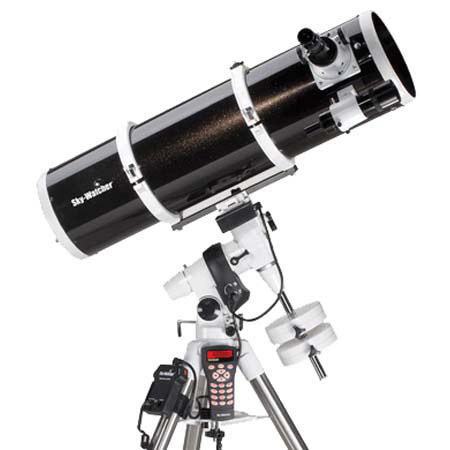
The Sky-Watcher EQ5 PRO Newtonian reflectors offer modestly large apertures that provide tremendous light gathering capability and reasonable portability. They deliver excellent imaging quality suitable for viewing the solar-system or deep-space. Their large apertures are superbly capable of capturing faint deep-space phenomenon like galaxies, nebulae and star clusters which require considerable resolution to discern fine detail. GO TO operation makes it easy to automatically locate and track over 30,000 sky objects.
With the acquisition of this superb telescope, an observer joins the ranks of serious amateur astronomers. Scan the Moon's surface along the lunar terminator during the Moon's first quarter phase and be prepared for a spacewalk-like experience. Rich, razor-sharp surface detail is so abundant that the Moon alone offers the potential for many years of rewarding study. Planets will reveal a treasure-trove of interesting surface phenomenon. The resolution discerned in Saturn's rings and Jupiter's cloud belts is presented just like you would expect in a quality large aperture telescope.
In the summertime sky, the gaseous, glowing Lagoon Nebula, fire red in astrophotographs and the smaller Trifid Nebula, beautiful blue and light-red in astrophotographs, are examples of prominent emission nebulae revealing bright cores and delicate, wispy detail in their outer extensions. The faster focal ratio of the SW 200N is also perfectly adapted for viewing and photographing faint, distant galaxies like the Sombrero (M104), the Pinwheel (M101) and Spiral Galaxy (M81).
Globular star clusters like Omega Centauri (NGC 5139) yield thousands upon thousands of discreet star points aggregating toward the central core. Any instrument that uses a primary mirror to gather light is a form of reflector. Numerous reflector designs exist, but this discussion will be limited to the more popular classic Newtonian and mirror-lens (catadioptric) designs. While resolving power is a function of aperture alone, there are differences, however subtle, attributable to these designs which merit at least a brief discussion.