

See Options
Need help? Ask our experts.
The Coma Corrector eliminates coma across the full photographic field, ensuring clear and precise images. It also features a Phantom Group wideband multicoating for maximum light transmission and minimal scatter, enhancing your astrophotography experience.
The Coma Corrector operates across a wide spectral range, from ultraviolet (UV) to near-infrared (NIR), enabling you to capture high-quality images in various light conditions.
Yes, the Coma Corrector's base-element is ready for use with a DSLR and a standard T-ring. For cameras with larger sensors, such as full-format DSLRs, the T-2 thread can be removed to free up an M48 thread.
This enables you to fully illuminate large sensors, ensuring sharp stars across your entire image and enhancing the overall quality of your astrophotography.
Review Summary
2020-12-13T13:06:16
The overview said: The new Mark III however works exceptionally well even down to f3.5. I have a Skywatcher Quattro f/4 Imaging Newtonian. The coma has been reduced but there is still coma in the corners. My collimation is pretty good so I don't think that is the problem. I have recently ordered the Skywatcher coma corrector and I'm hoping that will do the trick.
Monty G.
Accidents happen where life happens. Protect your favorite Adorama products and purchase a protection plan to stay covered from accidental damage, mechanical or electrical failure, and more.
If we can’t fix it, we’ll replace it at no additional cost.
Protect your product from drops, spills, and more.
Enjoy your gear without fear. We have you covered!
When regular use of your product over time results in mechanical or electrical failure.
We will never charge you a deductible after the purchase of a plan.
Our claims process is simple & easy and our customer service team is happy to help.
Adorama Protect powered by Extend is available for purchase to customers in the United States. Not available for purchase Internationally or in U.S. Territories.
Browse our FAQ
Newton
Thread, M48
Barrel, 2" (50,8mm)
Clamp, screw clamps
Thread, T-2 (M42 x 0,75), M48
Phantom Coating Group
F/3.5 - F/6
1:1
0.98
44mm
Virtually eliminates the entire coma on Newton telescopes without altering the focal length
2" / 1.25" & 2"
Coma Corrector
759270086572
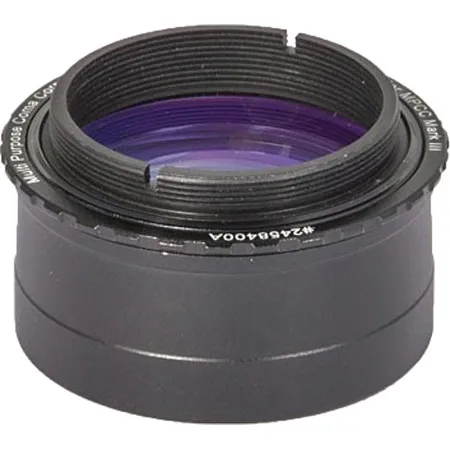
Overcome the challenges of astrophotography with the 2" Mark III Multi-Purpose Photographic Coma Corrector, specifically designed for Newton Telescopes. This advanced tool effectively eradicates coma across the entire photographic field, ensuring your celestial images are captured with the utmost clarity and precision.
The Mark III Coma Corrector boasts a proprietary lens design, featuring our Phantom Group wideband multicoating on all air-to-glass surfaces. This innovative coating ensures the highest level of light transmission while minimizing scatter and reflections. It operates across an impressively wide spectral range, from ultraviolet (UV) to near-infrared (NIR), enhancing your astrophotography experience.
While the original MPCC was designed for an f/ratio of f4.5 to f6, the new and improved Mark III model excels even at f3.5. This means that stars remain pinpoints across the field, making visual use much more straightforward. The 2" (M48) male filter thread on the eyepiece-facing side further enhances this ease of use.
For photographers using a DSLR and a standard T-ring, the base-element 2858400A is ready for action. It can be used over the T-2 thread on all standard T-rings. However, if you're using a camera with a larger sensor, such as a full-format DSLR, the T-2 thread can be removed to free up an M48 thread, increasing the free aperture from 38 to 44 mm.
The M48 spacer ring for MPCC III / Protective EOS T-ring can be directly connected to the Protective CANON DSLR T-ring. This means that not only will you have sharp stars across your entire image, but you'll also be able to fully illuminate large sensors.
With the 2" Mark III Multi-Purpose Photographic Coma Corrector, your astrophotography will reach new heights of clarity and precision. This tool is a must-have for any serious astrophotographer using Newton Telescopes.