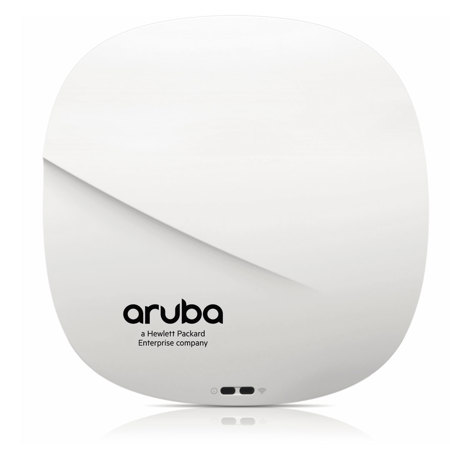
Aruba 310 Series Instant IAP-315 Indoor Dual-Radio Wireless Access Point with Integrated Antennas
SKU: ABJW813A
This item is no longer available.
Share:
Overview
Compare
Specs
Protection







About Aruba IAP-315
The Aruba 310 Series access points deliver high performance and superb user experience for mobile devices, Internet of Things (IoT) devices, and applications in dense office environments. Featuring the 4x4:4SS MU-MIMO capability, advanced Aruba ClientMatch radio management, and Aruba Beacon technologies, the 310 Series enables an all-wireless digital work environment in a cost-effective manner.
With a maximum concurrent data rate of 1,733 Mbps in the 5 GHz band and 300 Mbps in the 2.4 GHz band (for an aggregate peak data rate of 2.0 Gbps), the 310 Series Access Points can quickly add required capacities to your existing or new wireless networks. The mid-range 310 Series, with its single gigabit Ethernet uplink, is ideal for high device density environments, such as schools, retail branches, hotels and enterprise offices, where the organization is cost sensitive.
The high performance and high density 802.11ac 310 Series supports 160 MHz channel bandwidth (VHT160), multi-user MIMO (MU-MIMO) and 4 spatial streams (4SS). It provides simultaneous data transmission to multiple devices, maximizing data throughput and improving network efficiency.
The 310 Series includes the enhanced ClientMatch technology that extends the client steering technology with MU-MIMO client awareness. It automatically identifies MU-MIMO capable mobile devices and steers those devices to the closest MU-MIMO capable Aruba access point. By grouping MU-MIMO capable mobile devices together, the network starts taking advantage of the simultaneous transmission to these devices, increasing its overall capacity. These dynamic roaming policies that are based on device types, help users achieve the best WLAN performance in a mixed device environment during the technology transition period.
The 310 Series also has an integrated Bluetooth Aruba Beacon that simplifies the remote management of a network of large-scale battery-powered Aruba beacons while also providing advanced location and indoor way finding, and proximity-based push notification capabilities. It enables businesses to leverage mobility context to develop applications that will deliver an enhanced user experience and increase the value of the wireless network for organizations.
Benefits
Dual Radio 802.11ac access point with Multi-User MIMO
• Supports up to 1,733Mbps in the 5GHz band (with 4SS/VHT80 or 2SS/VHT160 clients) and up to 300 Mbps in the 2.4 GHz band (with 2SS/HT40 clients)
Built-in Bluetooth Low-Energy (BLE) radio
• Enables location based services with BLE-enabled mobile devices receiving signals from multiple Aruba Beacons at the same time.
Advanced Cellular Coexistence (ACC)
• Minimizes interference from 3G/4G cellular networks, distributed antenna systems, and commercial small cell/femtocell equipment.
Quality of service for unified communication apps
• Supports priority handling and policy enforcement for unified communication apps, including Microsoft Skype for Business with encrypted videoconferencing, voice, chat, and desktop sharing.
RF Management
• Adaptive Radio Management (ARM) technology automatically assigns channel and power settings, provides airtime fairness, and ensures that APs stay clear of all sources of RF interference to deliver reliable, high-performance WLANs.
• The Aruba 310 Series Access Points can be configured to provide part-time or dedicated air monitoring for spectrum analysis and wireless intrusion protection, VPN tunnels to extend remote locations to corporate resources, and wireless mesh connections where Ethernet drops are not available.
Intelligent app visibility and control
• AppRF technology leverages deep packet inspection to classify and block, prioritize, or limit bandwidth for thousands of applications in a range of categories
Security
• Integrated wireless intrusion protection offers threat protection and mitigation, and eliminates the need for separate RF sensors and security appliances.
• IP reputation and security services identify, classify, and block malicious files, URLs and IPs, providing comprehensive protection against advanced online threats.
• Integrated Trusted Platform Module (TPM) for secure storage of credentials and keys.
Intelligent Power Monitoring (IPM)
• Enables the AP to continuously monitor and report its actual power consumption and optionally make autonomous decisions to disable certain capabilities
• For the 310 Series Access Points, the IPM power-save feature applies when the unit is powered by an 802.3a PoE source. By default, the USB interface will be the first feature to turn off if AP power consumption will exceed the available power budget. In rare cases it may be necessary to take additional power saving measures, but in most cases, the 310 Series Access Points will operate in unrestricted mode.
Choose your operating mode
Aruba 310 Series Access Points offer a choice of operating modes to meet your unique management and deployment requirements.
• Controller-managed mode - When managed by Aruba Mobility Controllers, Aruba 310 Series Access Points offer centralized configuration, data encryption, policy enforcement and network services, as well as distributed and centralized traffic forwarding.
• Aruba Instant mode - In Aruba Instant mode, a single AP automatically distributes the network configuration to other Instant APs in the WLAN. Simply power-up one Instant AP, configure it over the air, and plug in the other APs - the entire process takes about five minutes. If WLAN requirements change, a built-in migration path allows 310 Series instant APs to become part of a WLAN that is managed by a Mobility Controller.
• Remote AP (RAP) for branch deployments
• Air monitor (AM) for wireless IDS, rogue detection and containment
• Spectrum analyzer, dedicated or hybrid, for identifying sources of RF interference
• Secure enterprise mesh
For large installations across multiple sites, the Aruba Activate service significantly reduces deployment time by automating device provisioning, firmware upgrades, and inventory management. With Aruba Activate, Instant APs are factory-shipped to any site and configure themselves when powered up.
Aruba IAP-315 Features
- High performance and high density 802.11ac Wave 2 supports multi-user MIMO (MU-MIMO) and 4 spatial access point streams (4SS)
- Boost performance with Aruba ClientMatch, grouping 802.11ac Wave 2 clients to the Wave 2 APs
- Maximum concurrent data rate of 1,733 Mbps in the 5 GHz band and 300 Mbps in the 2.4 GHz band (for an aggregate peak data rate of 2.0 Gbps)
- Mid-range 310 Series ideal for environments, such as schools, retail branches, hotels and enterprise offices, where the organization is cost sensitive.
- Includes integrated Bluetooth Low Energy (BLE) radio, for advanced location and indoor wayfinding
- Unified wired and wireless policy with Dynamic Segmentation