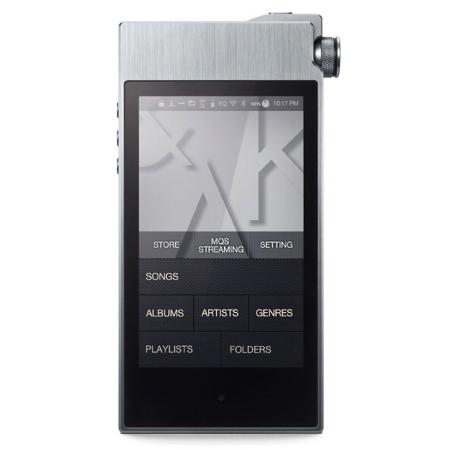
Astell&Kern AK100 II Portable High Definition Sound System, Smoky Blue
SKU: AK1002
This item is no longer available.
Share:
Overview
Compare
Specs
Protection
About Astell&Kern AK100 II
A New Standard
A new standard for listening to music was proposed while developing the AK100. Astell&Kern recognized that certain aspects of the AK100 needed improvement during research and development for a successor.
While considering how to improve the AK100, they realized that there was a difference between measured audio specifications and what they felt sounded good. After much deliberation, their development efforts were focused on making the AK100 2nd Generation "feel" right to their senses rather than mechanically boosting technical specs. The original AK100 was developed according to audio specification standards, but development of the next-generation AK100 was developed to the "New Standard" of how the music sounds.
They present "A New Standard in Listening to Music" with the AK100 2nd Generation.
Single DAC and Balanced Out
Although the dramatic depth in sound quality delivered by the Balanced Out was proven in their flagship model, they wondered if the same benefit could be gained by implementing the Balanced Out with a Single DAC. The newly designed demo board delivered the ear-pleasing sound quality they needed. The value of a Balanced Out with a Single DAC is confirmed with every musical note.
The AK100 2nd Generation provides a rich, warm sound experience through the re-tuned A-amp designed specifically for the CS4398 Single DAC.
Unbalanced vs. Balanced Output
The unbalanced method is the most commonly used basic method which consists of "left and right signals + ground line". This setup includes a ground line which blocks out external noises from the outside. However, since the ground line cannot block out all of the external noises completely, external noises can be mixed into the signals that are transmitted, which then result in changes to the sound. The longer the signals travel, the more external noises that will be mixed into the sound which is why it is used within a short distance of 1 to 2 meters.
Unlike the unbalanced method, the balanced method has an additional cold signal to compliment the hot signal which reduces the external noises. The balanced method has a few advantages over the unbalanced method. The first advantage is that the hot signal and the cold signal will remove the external noises received. The second advantage is increased output due to the 2 transmitted signals.
Since the ground line cannot block out 100% of the external noises, noise will appear on both the hot and cold signals. The alignment of the 2 signals allows the noise to usually appear at similar points where they will eventually be removed as the signals are transmitted.
5.6 MHz DSD Support
They realized DSD playback through a firmware upgrade for the AK100. However, only 2.8 MHz DSD was supported (88.1kHz PCM conversion/down sampling) due to hardware limitations. Now, 5.6 MHz DSD is supported via 'DSD to PCM' by utilizing a Dual Core CPU.
- The AK100 2nd Generation is capable of 5.6 MHz DSD playback by converting/down sampling to 176 kHz PCM.
USB DAC
The AK100 2nd Generation fully supports USB DAC. The AK100 2nd Generation also functions as an external DAC (sound card) when connected to a PC or Mac via USB. The AK100 2nd Generation's sound quality is available for stored music on any PC or Mac as it serves as a built-in sound card.
- The AK100 2nd Generation supports up to UAC 1.0 (USB Audio Class 1.0) Output (24 bit, 96 kHz) via USB DAC and EQ settings are not applied.
Network Playback
MQS Streaming
With the next-generation AK100, it's no longer necessary to turn on the PC, search for music, connect a device and transfer files. Simply connect the AK100 2nd Generation to your PC or Mac via Wi-Fi on the same network and download or stream music wirelessly.
- "Astell&Kern MQS Streaming Server" software must be installed on your PC or MAC with a shared folder saved for MQS Streaming to work.
OTA (Over-The-Air) Upgrade
It has been 14 years since iriver has used the term: firmware. It already has been 14 years since when their customers had to check their email or look for notifications on the iriver website to look for new firmware. Now, as long as you are connected to Wi-Fi, they notify you of firmware updates as soon as they launch and from wherever you are. Their users receive firmware updates immediately.
Full Touch Screen
The new AK100 2nd Generation utilizes a 3.31" AMOLED screen, an 82% increase over the previous screen's size. Now, users have access to more on-screen information than ever before. In addition, a full touchscreen means convenient, smartphone-style control. The Album View screen has been completely overhauled.
The larger screen offers a view of six albums compared to the previous version's four and the album art view offers intuitive search functionality. Long titles that were limited by a single line are now displayed with two lines in the music list for easier navigation. Music on the MQS Server can be searched during MQS Streaming in addition to the songs in internal storage. Now, the songs you desire can be found more easily.
A More Detailed 10-Band 0.5 dB Step EQ
A more accurate EQ setting is available by doubling the bands (from 5 to 10) and halving the dB steps (from 1 dB to 0.5 dB). In addition, multiple user EQs are supported so that users may create custom EQs to fit each music genre and change them whenever desired.
64GB + microSD 128GB
The AK100 2nd Generation includes 64GB of internal flash storage. With the addition of a 128GB microSD card, the AK100 2nd Generation supports up to a total memory of 192GB. With 64GB of internal memory, the AK120 2nd Generation can store about 625 MQS (24bit/96kHz, 4 minute-long, 90MB) songs.
A perfect harmony of engineering and design
With the AK100 2nd Generation, they aimed for the perfect harmony of engineering and design. From beginning to end, they re-examined the PCB layout, the form factor, the materials and the post-manufacturing process.
Re-examination of the volume wheel's position
They relocated the volume wheel to the top to maximize the space for the battery. They also redesigned the volume wheel for further convenience and easier usability even when you hold the product with both hands.
Redesign of the volume wheel and guard
The AK100 2nd Generation's volume wheel consists of two parts: the head and the root. The head is the knurled part and control the volume wheel by holding it securely. The root is the base of the volume wheel and wrapped in a guard that's directly connected to the hardware. This division into two parts enhances the usability and stability of the AK100 2nd Generation, while the distinguished parts also provide further protection for external damage.
Two layers, two meanings
The AK100 2nd Generation's aluminum body and protector appear like overlapping layers. For the first layer, they used a luxurious hairline and diamond cut finish for the aluminum body. These two finishing processes add weight to the material while also symbolizing the signature weighty sound provided by Astell&Kern.
The second layer acts as the protector and represents the delicacy of sound provided by Astell&Kern. The three delicate lines that are carved into the protector are reminiscent of string instruments. The AK100 2nd Generation's design embodies the signature weighty yet delicate sounds of Astell&Kern.