As a landscape, street, and portrait photographer, and after teaching photography for nearly two decades, it is clear that beginner photographers often overlook the importance of prime lenses altogether in their pursuit of convenience. They instead opt for the flexibility of zoom lenses. Indeed, zoom lenses offer options, but prime lenses with their fixed focal lengths challenge creativity by encouraging photographers to think more critically about composition and framing. The 50mm lens is one of the most useful primes in my kit.
Why a 50mm Prime Lens?
With fewer moving parts compared to zoom lenses, prime lenses are renowned for their exceptional sharpness, beautiful bokeh (background blur), and remarkable performance, particularly in terms of fast focusing speeds. They also excel in low-light situations due to their wider maximum apertures, such as f/1.2, f/1.4, or f/1.8. Look around, and you will see the use of prime lenses in the work of famous photographers and blockbuster Hollywood movies. Even if you own a cheap prime lens, do not despair or feel held back in your photography journey. Not until you have explored the full range of capabilities and appreciated the strengths of a fixed focal length lens do you need to stretch yourself to buy the more expensive zoom lenses. And these advantages are many, especially with my favourite prime lens, the 50mm. It is a workhorse and a basic must-have for a starter.
I use full-frame Sony camera bodies for both video and photography, and own a 50mm Sigma f/1.4 DG Art for Sony E-mount, which delivers exceptional performance at a somewhat smaller budget than the Sony equivalent, the FE 50mm f/1.4 GM, a great choice without a doubt. Similarly, Canon users continue to boast about their 50mm RF lenses for the outstanding results they produce. There are numerous nifty-fifty options for each brand, as the lens is fondly known as, suitable for both low and high-budget photographers.
The Lens Perspective
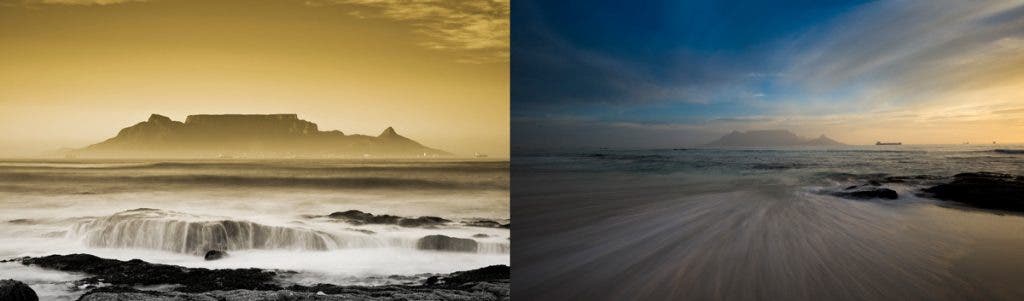
When you look through a 50mm lens, objects tend to appear at a comparable size and with similar relative distances as they do to your naked eye. It offers a field of view that is neither too wide nor too narrow. In contrast, wide-angle lenses, such as those with focal lengths of 16mm or 24mm, make distant objects appear smaller and farther away than they truly are. These lenses also tend to exaggerate the perspective of nearby objects.
For example, consider two images of Table Mountain taken from the same beach: while a 50mm lens captures a lifelike view of the scene on the left, a wide-angle 16mm lens has made the mountain appear far smaller and the foreground bigger.
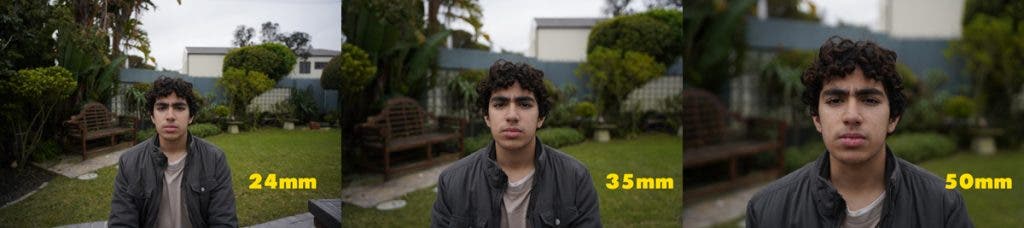
In the following series of images, you will notice that while the 24mm and 35mm focal lengths effectively capture the environment, the background elements, such as the bench and the trees, appear smaller due to the wider angle of view. In contrast, the 50mm lens offers a more realistic perspective, making these elements seem more proportional and realistic. This point will become clearer as we touch on some photography genres later that are best suited for a 50mm lens; you’ll understand the advantages of its narrower but true-to-life field of view compared to the 16mm, 24mm, or 35mm options.
Sometimes, a specialised lens like a wide-angle or fish-eye offers gimmicky appeal, rather than focusing on sound composition, whereas your normal (50mm) lens forces you to utilise your skills.
The Shooting Space and Context
No single lens is a universal solution, which is why I carry a multitude of lenses in my professional kit. Every location dictates its unique lens requirement. However, for me, in the challenging confines of tight spaces, the 50mm prime lens emerges as an indispensable tool, striking a perfect balance between a 35mm lens that might be overly wide and an 85mm lens that is too restrictive. The 50mm’s focal length offers a versatile middle ground that excels in a multitude of environments. For instance, have a look at the image below.
I photographed a traditional Balinese fabric weaver in a village and chose a 50mm lens in a compact shop, despite my usual preference for using an 85mm lens for portraits. A 50mm lens allowed me to capture her within her small, bustling workspace, providing environmental context. When my goal shifted to more intimate portraits or a close-up of her hands, a simple step or two forward transformed the frame, allowing me to tightly focus on the weaver’s face without needing to swap lenses.

Where your 50mm can be Useful
Portrait Photography
As mentioned earlier, the 50mm offers a natural perspective that closely mimics human vision, making it ideal for flattering portraits. At the same time, you can capture full-body, half-body, and head-and-shoulder shots by simply adjusting your distance to the subject by taking a step or two backwards or forward, without potential compromise on sharpness that a zoom lens might bring. The two portraits of the tuk-tuk driver in Jakarta not only demonstrate this aspect but also highlight the low-light performance of the 50mm f/1.4 lens and the sharp bokeh it offers.

Street Photography
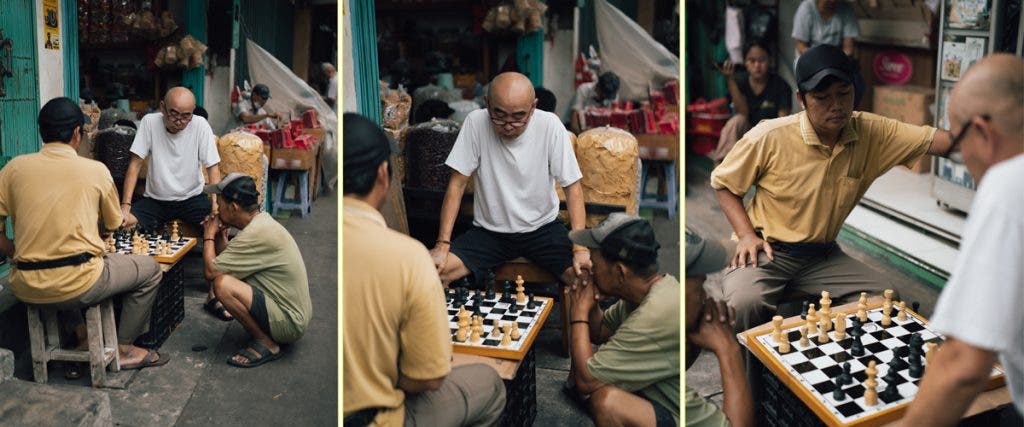
The 50mm is perfect for candid street photography. Its compact size allows you to capture scenes naturally without drawing excessive attention, and its performance in various lighting conditions is a bonus. The relative lack of “choice” of a zoom forces quicker composition choices that suit the on-the-go style of street work. The following images were captured using a 50mm lens. The gentlemen were absorbed in an intense game of chess. I captured them from a distance and then zoomed in “with my feet” to get a close-up.
Everyday/Documentary Photography
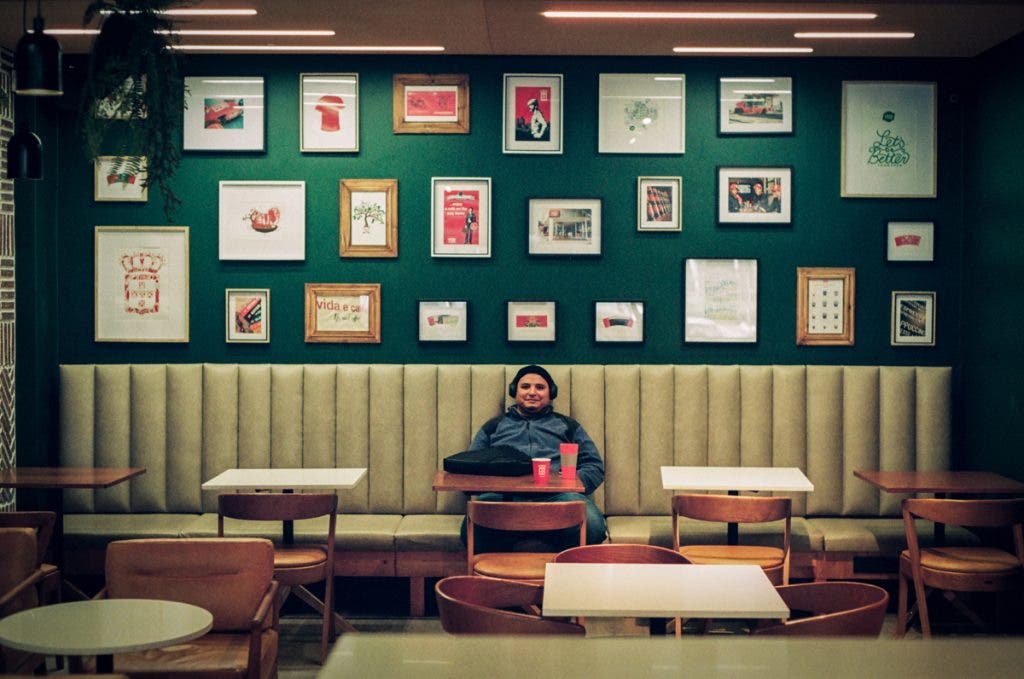
There have been times when I carried a film camera with a manual focus 50mm lens for months. For capturing daily life, events, friends, or family, the 50mm’s versatility shines. It’s an excellent “walk-around” lens that can adapt to various situations, from wide environmental shots to more focused details at close range.
Travel and Holidays Photography
It’s a practical option for on-the-go shooting, helping photographers and holidaymakers to capture the essence of a location. Where weight and space are limitations, where you cannot lug around bulk, with its many advantages discussed above, the 50mm prime makes an excellent travel companion.

Indoor and Outdoor Model Shoots
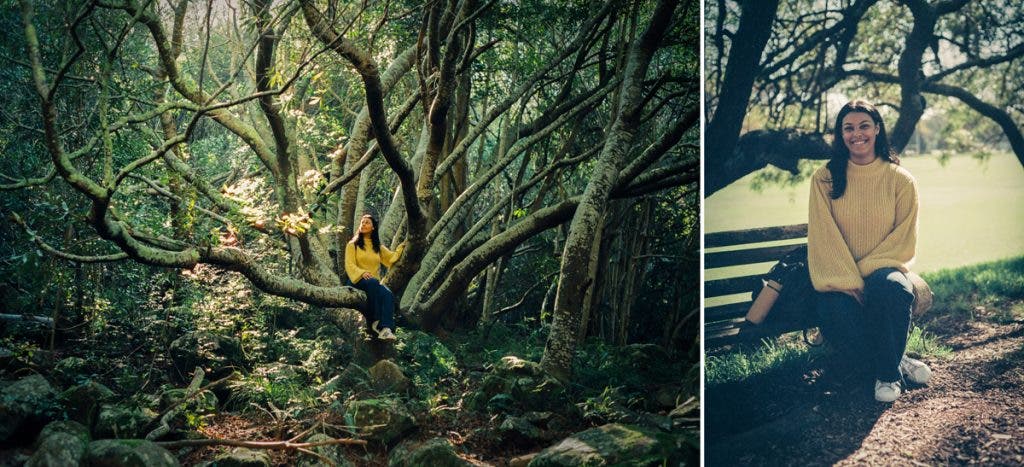
I have conducted model shoots exclusively with a 50mm lens, taking advantage of its natural perspective, as well as its bokeh and performance in low light. On the left is a shot of my model in the shaded forest, with a wide aperture of f1.8, whereas on the right is a close-up of her in vertical orientation with a narrow depth of field. These were shot using the manual focusing of my lens, which also helps slow down the process and allows one to be more intentional with composing.
Conclusion
Beginner or professional, the 50mm prime is prime. It is the quintessential basic in your kit that every photographer should own. It is a classic that remains timeless in its use and value.