What if the best gear decision you ever made was the one you didn’t buy? Before you click ‘add to cart,’ let’s talk. You’re a photographer who loves gear, but maybe a little too much. You’ve felt the unboxing excitement, followed by the guilt of wondering if you really needed it. You’re here because you want to make smarter decisions. You might be asking, “What Gear pays for itself?”
This article won’t tell you to stop buying gear. It will give you a system to know for sure before you swipe your card, whether that lens, light, or body will pay for itself.
If you’ve ever bought gear that is now collecting dust, please continue reading.
Firstly, Who Am I To Talk About This?
I am a close-to-50 female, non-visual creative. The headshot on my profile is three years old, taken by my then-nine-year-old on a beat-up Samsung phone. So, for all intents and purposes, you and I could not be more different.
But here’s what I bring to the table: I have years of experience as a Thinking Partner for solo creators, helping creators cut through the noise and ask better questions so that they can make better decisions. My job is to help you distinguish between what you need and what the marketing machine tells you to want.
Here’s What We’ll Cover:
- Why your first question shouldn’t be about the gear at all
- Two practical frameworks: The Vetting Spreadsheet and Break-Even Calculator
- The skill upgrade you should try before making any purchase
- How insurance and tax strategy protect your investment
- A buyer’s checklist to use before every gear purchase decision
Step 1: Who?
The first question isn’t ‘What lens should I buy?’ It’s actually Who? Who are you as a photographer? And who are you creating for?
Those answers lead to the next question: What problem do they have? Which leads to the final question: How will this gear solve it?
Let’s get specific about you first. Which category do you fall into?
- Enthusiast: Photography is not your primary income, but gear still needs to justify itself.
- Semi-Pro: You’re making money some of the time, and every purchase enables growth or eats into margins.
- Pro: Photography is your livelihood, and gear is infrastructure for paying clients.
E.g., You’re a pro wedding photographer in California. Your couples come to you because they want those dreamy golden hour portraits, warm, soft, magical shots just after sunset.
Who you are and who you serve = your filter. Now let’s run that gear purchase through three questions that separate investments from regrets.
Step 2: The Three Questions That Ensure You Buy Gear that Pays for Itself
After you have determined who you are, answer these three questions honestly. You’ll know whether that gear is a smart investment or an expense you won’t recoup.
1. WHO is your customer?
Be specific. “Wedding couples with budgets over $8k.” “Local small businesses who need product photos.” “My own creative fulfilment.” Write it down.
What this tells you:
If you can name a real person, you’re building for someone who exists and pays you. If you can’t, you’re building for a fantasy.
2. WHAT problem of theirs are you solving?
Not “they need photos.” Go deeper.
Your couples want golden hour portraits. Your f/4 lens struggles when the light drops. You miss shots, and they’re disappointed.
What this tells you:
The real problem is that they want a look that your current gear can’t deliver in low light.
3. HOW will this gear help you solve it?
That f/1.2 lens opens up the light. Lets you shoot clean, sharp images after sunset. Your couples get their golden hour shots.
What this tells you:
If gear solves a problem clients pay for, it pays for itself. If you can’t explain how it helps them, the gear is for you.
The bottom line:
Gear that serves a real customer with a real problem pays for itself. Enthusiasts and Semi-pros: swap “customer” for “your creative goals.”
But before you jump to the spreadsheets, let’s put your answers through a lie detector test.
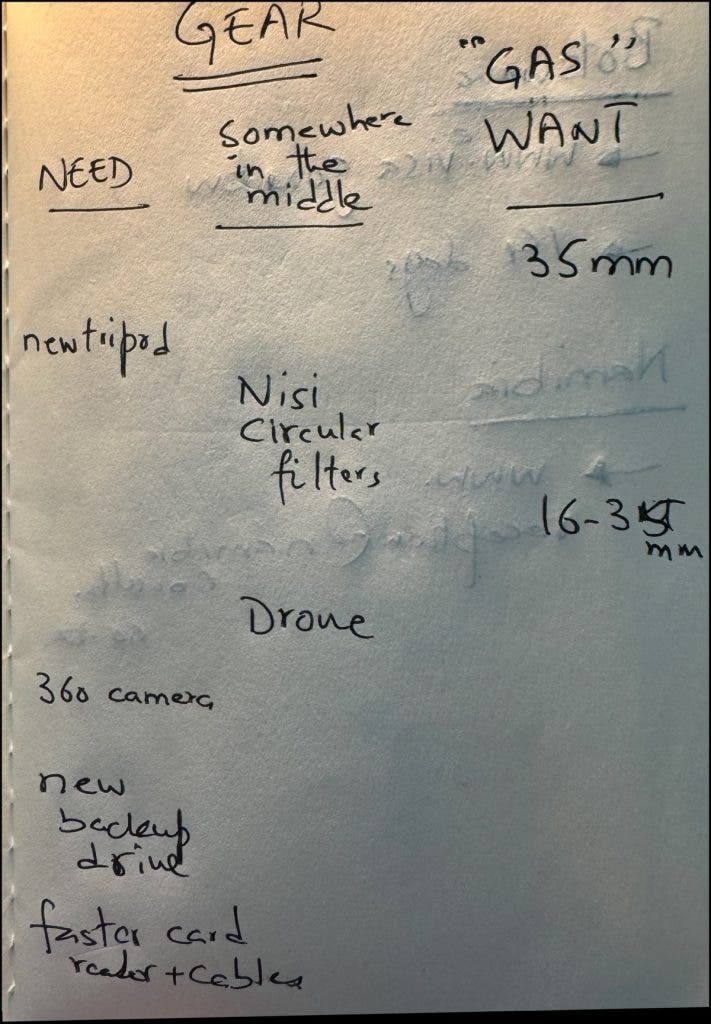
Step 3: A Deeper Test: Separating Honest Needs from Expensive Wants
You’ve answered Who, What, and How. Now let’s pressure-test your answers.
Ask yourself:
- What specific limitations does my current gear have?
- What exactly will change in my images or workflow?
- How will I measure that improvement? (More clients? Larger prints? Less stress?)
- Is this purchase the smallest, most targeted upgrade that solves the problem?
These questions catch the subtle ways we justify wants as needs. If your answers wobble, you just saved yourself from another regrettable purchase.
One last step before you buy: The Reality Check
If your answers survived the Deeper Test, ask yourself one last uncomfortable question:
Could I achieve 80% of this result by improving my technique?
“I need a sharper lens” often means we need a better focus technique. “I need better low-light performance” often means learning to work with available light.
Gear is easier to buy than skill is to build. So we buy, and the skill level stays the same. Have you actually hit your current gear’s ceiling? If it’s truly gear you need, head to the spreadsheets.
Framework One: The Vetting Spreadsheet
Now take your answers to Who, What, and How and put them into a format with no room for self-deception.
| Criteria | What to Ask Yourself |
| Customer | Name them. If you can’t, you’re building for a fantasy. |
| Their Problem | What keeps them up at night? Name the real problem. |
| Gear | The item you’re considering. |
| How It Helps | Connect the gear back to their problem. Be specific. |
| Direct Revenue | What new income does this enable? Zero is useful. |
| Indirect Value | Time saved, stress reduced. Assign a dollar value. |
| Cost | Full price including tax, shipping, and accessories. |
| Verdict | Asset serves real customers. Expense serves your ego. |
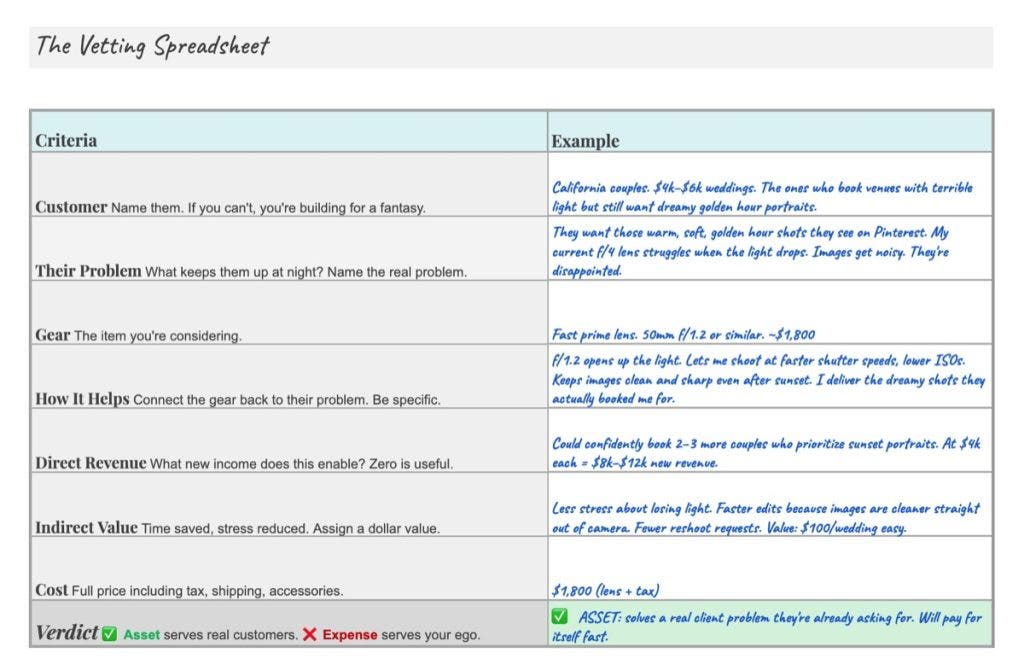
Now download the template below and follow along with the examples.
Download Vetting Spreadsheet Template
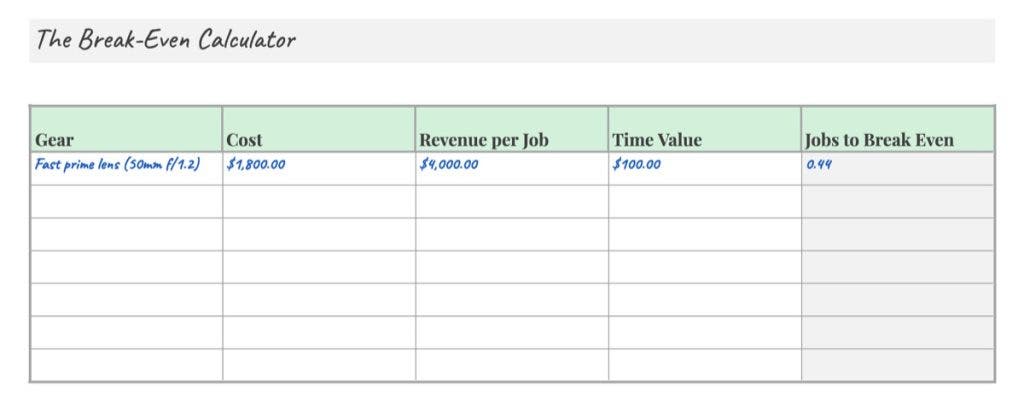
Framework Two: The Break-Even Calculator
The vetting spreadsheet tells you whether the gear serves a real customer. The break-even calculator tells you how long it will take to pay for itself.
The Formula:
Cost ÷ (Revenue Per Job + Time Value Per Job) = Jobs to Break Even
Let’s break that down:
- Cost: What you pay for the gear
- Revenue Per Job: What clients pay you for work this gear enables
- Time Value Per Job: The dollar value of hours saved (Indirect Value from the spreadsheet)
- Jobs to Break Even: How many times do you need to use the gear for paying clients before it stops costing you and starts making you money?
The result is a concrete number. Not a vague “this feels like a good investment”, but “this pays for itself after X weddings, X product shoots, X sessions.“
Protecting Your Investment
You’ve run the spreadsheets, and the math works.
Now protect the investment with insurance and a tax strategy. They won’t turn a bad purchase into a good one, but they make good purchases even better.
Insurance: What It Costs (US Readers)
For Enthusiasts (Personal Articles Policy)
- Added to homeowners/renters insurance
- Covers theft, loss, and accidental damage
- Cost: $100–$300/year for $10k–$15k coverage
For Semi-Pros & Pros (Business Insurance)
- General Liability: $200–$420/year
- Equipment: $250–$550/year
- Professional Liability: $400–$500/year
Why it matters:
A stolen $2,000 lens before your first paid gig wipes out your investment. Insurance protects it.
Note: Costs are estimates. Rates vary by location, gear value, and coverage limits.
Tax Depreciation (US Readers)
Tax savings don’t justify a bad purchase, but they change the math on a good one.
How it works: Section 179 of the tax code lets you deduct the full cost in the purchase year. Cameras, lenses, and lighting qualify if used >50% for business.
What this means for your break-even math: For e.g.
- Without tax deduction: $1,800 lens ÷ $4,000 wedding = 0.45 weddings to break even
- With deduction (assuming 25% bracket): Lens effectively costs $1,350 → 0.34 weddings
The lens pays for itself faster, but only if you actually need it.
Disclaimer: Tax laws differ by location and change frequently. Please check with your accountant.
The Buyer’s Checklist: Your Final Filter
Download this Excel file and run every potential purchase through it.
Your answers will tell you what to buy and what to walk away from.
[Insert Screenshot of Buyer’s Checklist Spreadsheet]
[Download Link: Buyer’s Checklist Template]
Where Adorama Fits In
You’ve done the hard part, and you now know what gear you need and why. Here’s how Adorama helps you act on that clarity.
- Rent before you commit: Adorama Rental lets you test gear on real clients. That $100 rental may prove to be the cheapest market research you’ll ever do.
- Trade up strategically: Adorama Trade turns unused gear into budget for what you actually need.
- Talk to a human: NYC store experts and online pros match gear to real client needs, not fantasies.
- Protect your investment: Adorama protection plans mean an accident doesn’t derail your break-even math.
The bottom line:
You now have a system for knowing whether gear pays for itself. Use it and next time the gear itch returns, ask: Who is this for?
Now go create something worth shooting, for someone real.