
Every January, long before year-end lists and retrospectives flood our screens, the process of selecting and curating Getty Images’ top photos of the year quietly begins. “It’s like painting a large bridge. It seems to be a never-ending process,” says Ken Mainardis, Senior Vice President of Editorial at Getty Images. But that’s a good thing!
Just in time before the cycle starts all over again, we caught up with Mainardis. We wanted to gain insight into how he and his editorial team at Getty Images pulled together the Top 100 curations in Global Sports, Global News, and Global Entertainment for 2025.
A Good Curation Takes Time
Getty Images’ editorial team chose from thousands of images across more than 160,000 events. These are captured across news, entertainment, and sports to distill three distinct collections that define 2025 visually. The results, says Mainardis, aren’t just highlights from headlines. Rather, they are a carefully curated portrait of how the world felt during the year. Its urgency, beauty, contradictions, and fleeting pauses.
The year-long editorial conversation involves around 20 team members. Discussions focus on the best images of the moment—the last week, the last month, the last quarter. But as the year unfolds, the lens widens. Individual images begin to form a collective narrative. “What we’re really thinking about,” he explains, “is how those images start to represent the best of the entire year. Reviewing work constantly allows the editorial team to take small steps forward—incremental innovation rather than sweeping reinvention. In a creative world, those steps matter.”
Getty Images’ Editorial DNA
In a crowded landscape of end-of-year roundups, Getty Images isn’t trying to show everything. Instead, the goal is to surface something “quintessentially Getty Images.” Work that reflects the core of its editorial mission. That mission is anchored in four key pillars that guide every selection. Mainardis outlines each below:
1. Moments
These are the images that capture history as it tilts—decisive moments when something shifts, often irrevocably. The kinds of photographs that don’t just document events but define how they will be remembered.
2. Heightened Creativity
Getty Images invests deeply in photographers and videographers who push the boundaries of visual storytelling. “The goal,” Mainardis explains, “is to show audiences something they might not have seen elsewhere—or might not have noticed while scrolling past a screen that morning. A different angle. A more cinematic frame. A moment elevated by craft.”
3. Specialism
Unlike many agencies, Getty Images continues to invest in specialized photographers. Not just broadly across news, sports, and entertainment, but also in niches within those categories. For instance, golf, fashion, motorsports, White House politics, and so on. “That depth of knowledge brings value that’s immediately visible,” says Mainardis. “When a photographer truly understands their subject, they can see moments others miss.
4. Access
Years of relationships have earned Getty Images rare access to events, particularly in sports and entertainment. That access—often invisible to the viewer—is what allows certain images to exist at all. Mainardis says that together, these four elements create a perspective on the year that feels both authoritative and distinct.
Some of the Most Talked About Photos of the Year
When Mainardis assembled his own short list from the final Top 100 selections in Sports, News, and Entertainment for this interview, certain images stood out for their visual power, their deep resonance, their composition, and their surrealness.
Trump
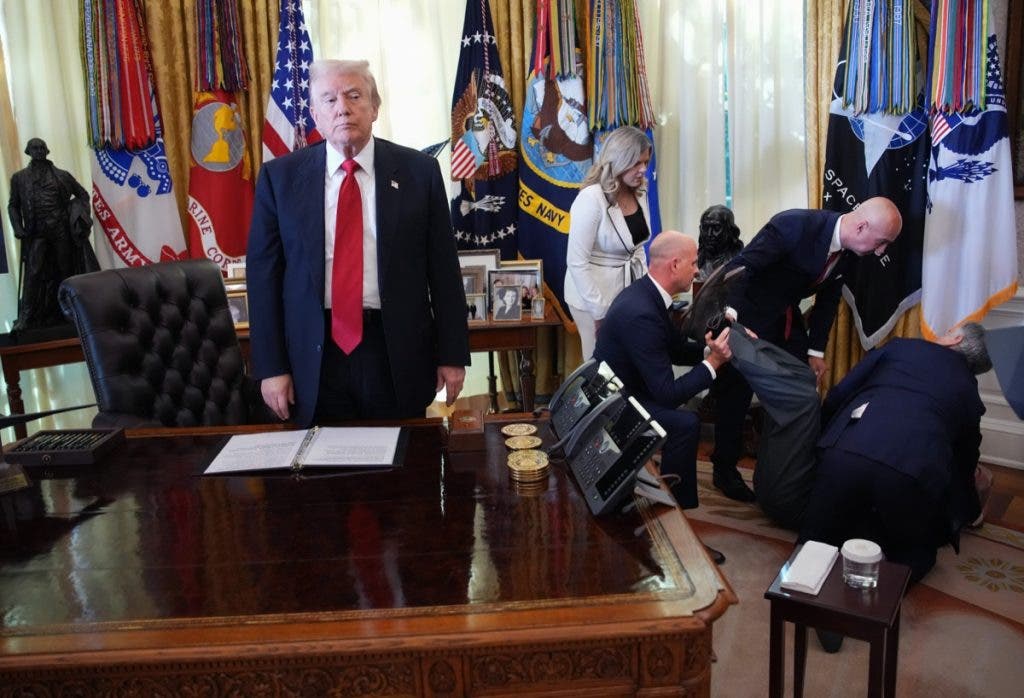
One of the most talked-about images of the year was taken by photographer Andrew Harnik in the Oval Office during an event on lowering drug prices. President Trump stands frozen, seemingly unaffected by the guest who collapsed and the activity around him. Mainardis describes the image as completely surreal, appearing almost as if split in half. “It’s a perfect metaphor for polarization,” he explains, “not just in the U.S., but globally.”
Says Harnik, “This image is a good example of being in the right position for a remarkable moment. Entering the Oval Office can be a chaotic scramble. It’s a small space, and all members of the media funnel through a single door, each trying to secure the best position for photos, video, and the opportunity to ask the President questions.”
Sometimes it’s Where you Stand
The photographer says that, in this case, he was able to quietly and deliberately move to the far side of the room, lining up President Trump, seated at his desk, with a list of scheduled speakers at a lectern next to the desk. “I noticed the room was quite warm, and soon it became apparent that the President himself was beginning to nod off. I thought that might be the defining moment of the event—until a guest standing behind the President and the speaker at the lectern began to stumble and then faint.”
As soon as the man collapsed, the Trump administration staff quickly began moving the press out of the room. The President stood, looked toward the man, and then stood straight ahead at the desk. “Because I had positioned myself so far to the side before this all happened, I was among the last to exit and continued photographing as I moved,” says Harnik. “The result is the image you see. As always, people interpreted the image in countless ways, generating hundreds of comments, memes, and opinions. I’ll leave those interpretations to others. Our role as photojournalists is simply to fairly and accurately document what unfolds in front of us.”
Benson Boone
On the other end of the photo spectrum is an image by Kevin Mazur that captures musician Benson Boone mid-performance, frozen in his physical extension. For Mainardis, whose background is in sports photography, the image immediately recalled the pursuit of “peak action, which you typically see more in sports images. That’s rare in entertainment photography,” he notes. “Boone’s performance style allows the photographer to shoot almost as if it were a sporting event, and executing that kind of image requires extraordinary timing and skill.”
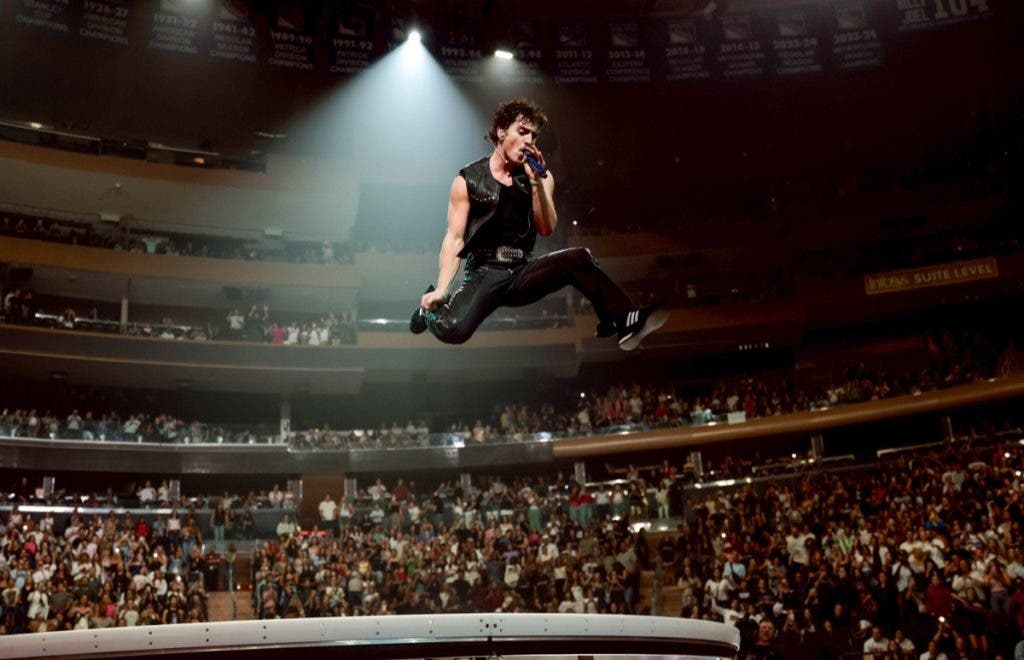
Adds photographer Kevin Mazur: “The first time I photographed Benson Boone was when he was performing at the 2024 MTV VMAs, and I was blown away by him flipping off his piano and on stage. He is an incredibly talented musician, but also very athletic, so photographing him is like shooting sports. Never take your eye off the subject to capture the action. He typically doesn’t allow photography on his tour, but they made an exception for me to cover this show at Madison Square Garden, and I was determined to do the best job I could. I knew I wanted to capture him flying through the air, and I was glad this shot showcased the stage, the fans, and the arena all in one frame.”
When Specialism Matters Most
Nowhere is it more critical for a photographer to have expertise than in dangerous environments. Getty Images’ coverage of the Los Angeles wildfires is a powerful example of specialization at work, says Mainardis.
“These events are incredibly dangerous,” he explains. “They’re flooded with media of all kinds, from very high quality to people without the same experience.”
Getty Images deploys photographers in these situations who are deeply experienced in forest fire coverage. Professionals trained to work alongside first responders. They understand rapidly changing conditions, and still produce technically exceptional images.
An image here shows flames encroaching on the Hollywood Hills, with the lights of Los Angeles glowing below. It feels almost impossible—fire and city pressing up against each other.
“It’s almost too close,” Mainardis says. “And that proximity is precisely what makes the image so unsettling and powerful.”
Hollywood Hills Fire
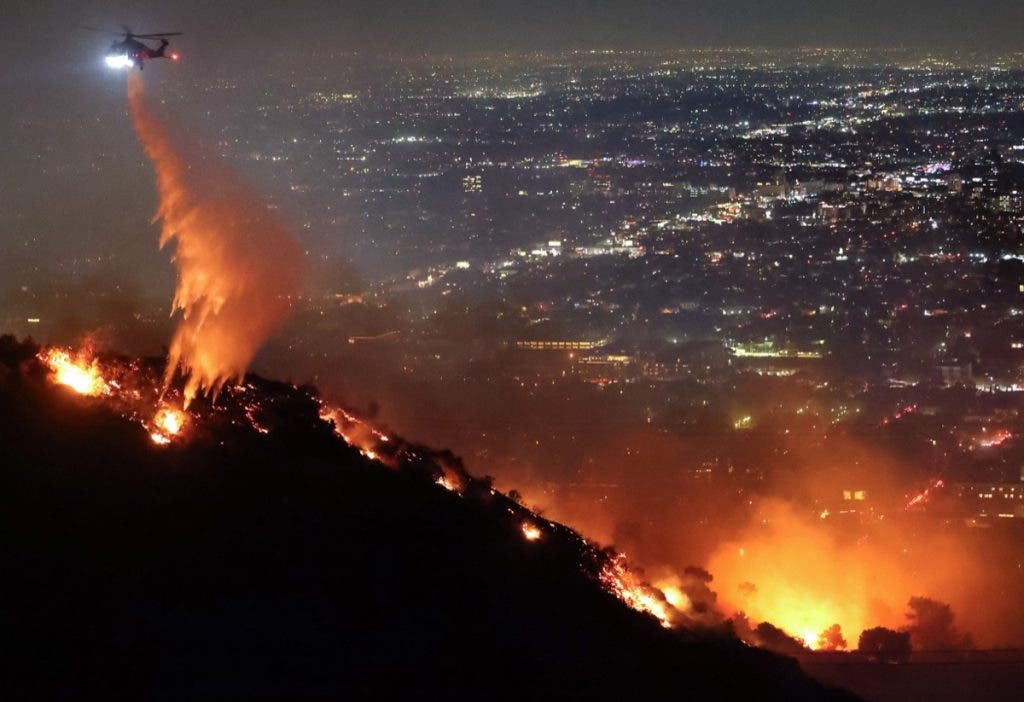
Says photographer Mario Tama, who took the image, “To capture this photo, I was standing on an overlook near the top of the Hollywood Hills, which provided a clear view of the fire burning on the hillside with the lights of Los Angeles stretched out behind it. People have asked whether this was captured with a drone, but it wasn’t. Civilian drone use is prohibited in active wildfire zones as drones pose a serious hazard to firefighting aircraft.”
He continues: “As a photojournalist, safety must always come first—for you and for everyone around you. Never impede the work of first responders or the evacuation efforts of survivors. Properly utilize PPE while maintaining constant situational awareness. Stay in regular contact with your editors and keep them updated on your location and movements. Whenever possible, work with at least one other photographer. Starlink has become an invaluable tool to remain connected and informed when cell signals are out or nonexistent. It is essential to remember that you may encounter survivors who are living through the worst day of their lives, so this work must always be approached with sensitivity, empathy, and compassion.”
Man Lying in Field
Of course, in a world of relentless breaking news, Mainardis says it’s important that Getty Images’ editorial coverage also makes space for what he refers to as “the in between moments—images that allow viewers to pause and breathe, capturing a fleeting, human moment of stillness. Something increasingly rare and deeply needed.”
Take, for example, Dan Kitwood’s photograph of a man lying in a field of yellow daffodils in St. James Park in London. It’s one of Mainardis’ personal favorites, and it reflects a deliberate editorial choice.
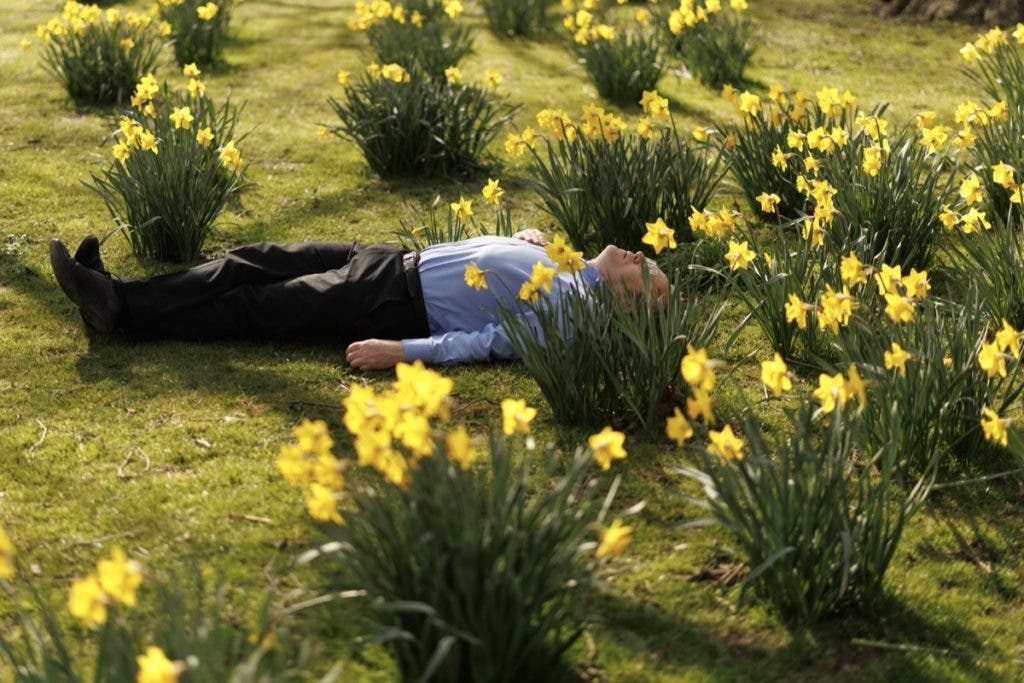
“I stumbled upon this very British scene between jobs, wandering through the park on the day of the spring equinox,” the photographer explains. “The British are famously preoccupied with the weather, too hot, too cold, too wet, too windy, an endless source of small talk. The best pictures are the ones that find you, and like spring daffodils in the sunshine, they are fleeting. I don’t know who this man was, but he looked serene, adrift among the flowers, quietly enjoying his moment in the sunshine.”
Hockey Player Alex Ovechkin
Another Top 100 selection seemingly shatters that serenity, with an image of Washington Capitals hockey player Alex Ovechkin sliding across the ice on his stomach as he celebrates after scoring his record-breaking 895th career goal during the second period against the New York Islanders. The photograph was taken by Bruce Bennett, who Mainardis says recently became the first photographer ever inducted into the U.S. Hockey Hall of Fame—a fitting honor for an image that collapses decades of achievement into a single, childlike moment of joy.
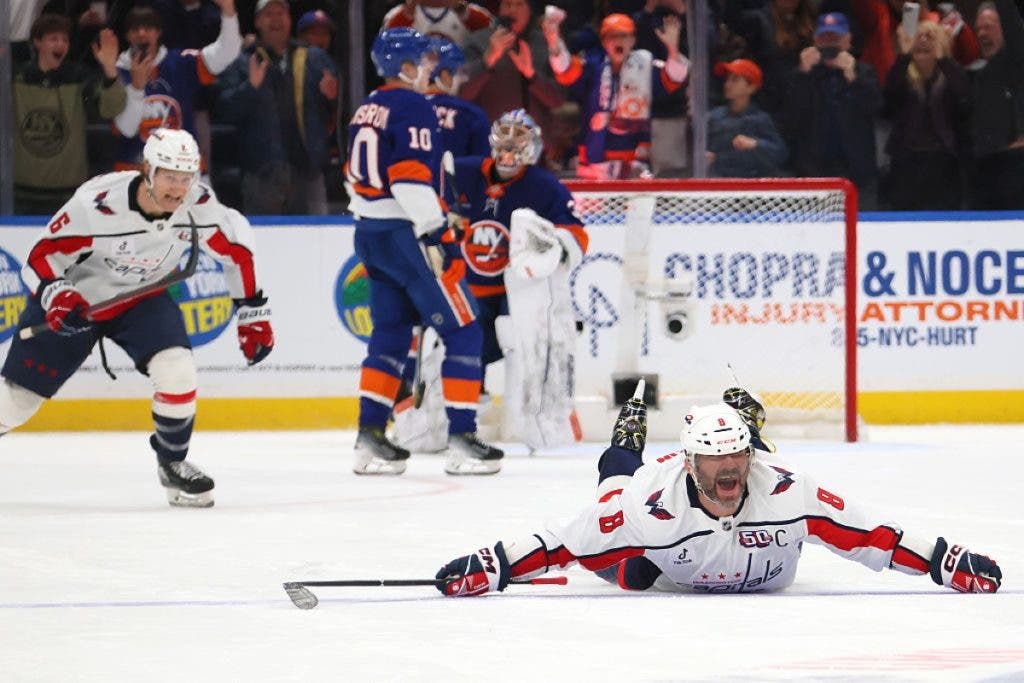
Says Bennett, “Everyone in hockey knew that Alex Ovechkin was headed towards Wayne Gretzky’s NHL goal-scoring record, and it was just a matter of time until it happened. I picked up the trail late and started with the Friday night in Washington, where he tied the record. And then two days later, back to one of my ‘home’ arenas in New York. There really is no place like home when it comes to covering sports.
Planning for the Unpredictable
As is common in professional sports, he continues, all the planning helps, but the nature of the business can be summed up in one word: unpredictable. “I placed three cameras in the rafters, which all ended up being at the wrong end of the ice for the big moment. And the sole camera at the record-breaking end was the hockey netcam, and Ovechkin shot from too far away.”
Bennett says that the remotes were not a factor in this instance, that he relied on his handheld camera to document the moment. “And if Ovechkin had scored at my end of the ice, I would have been blocked by a bunch of bodies, and he would have spun, jumped, and slid away from me.”
But he didn’t. Instead, he scored, turned, and skated towards Bennett while diving on the ice. “I shot a sequence of this historic moment from my 4”x5” photo hole 120’ away. I paced myself shooting the celebration as his teammates flooded the ice, then moved quickly to the Capitals’ team runway and out on the ice to capture the moment with his family, Wayne Gretzky, and dignitaries. And in a flash, I then had a new favorite image from my 50+ years of ice hockey photography.”
More Powerful Images and Stories of 2025, with Commentary
What’s interesting about many of these standout photos of the year is hearing the photographer’s point of view. How they got the image or why, and what made it special for them.
Here are a few more images that resonated with Mainardis, as well as with me, and commentary from the imagemakers who captured them:
Harrison Ford
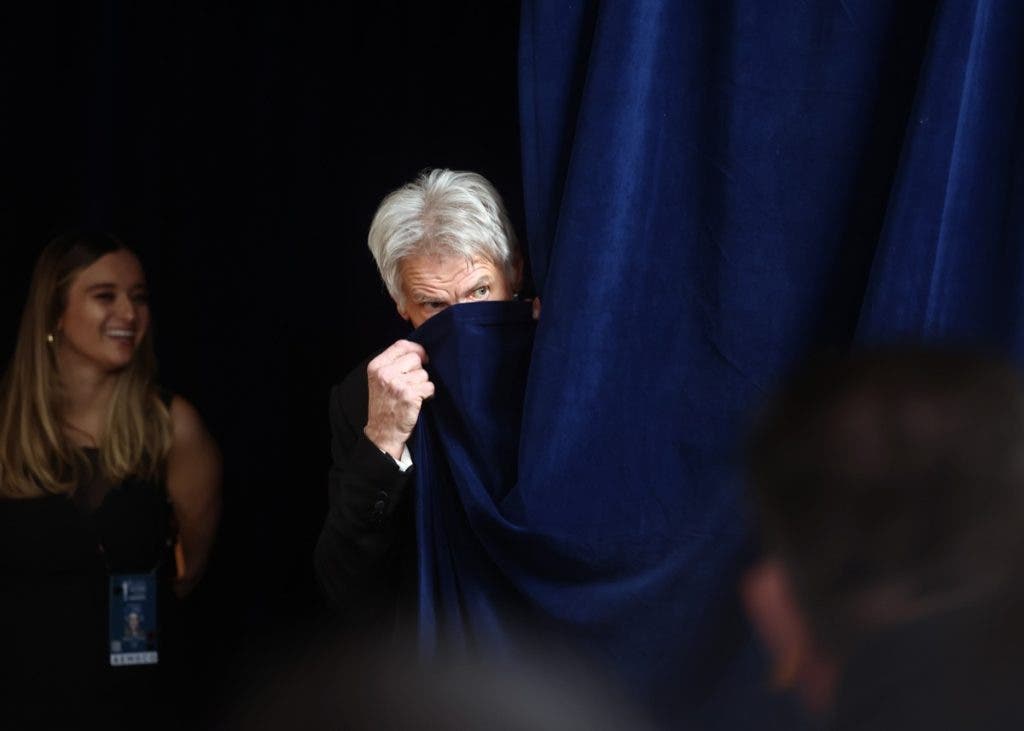
This image of Harrison Ford, taken at the SAG Awards by Emma McIntyre, was captured as she was positioned in the press pit. “Moments like this serve as a reminder to always be scanning the environment to see what might be happening on the sidelines,” she explains. “Harrison Ford was being playful with the press, and once our lenses turned towards him, he pretended to hide behind the curtain.”
Chloe Kelly
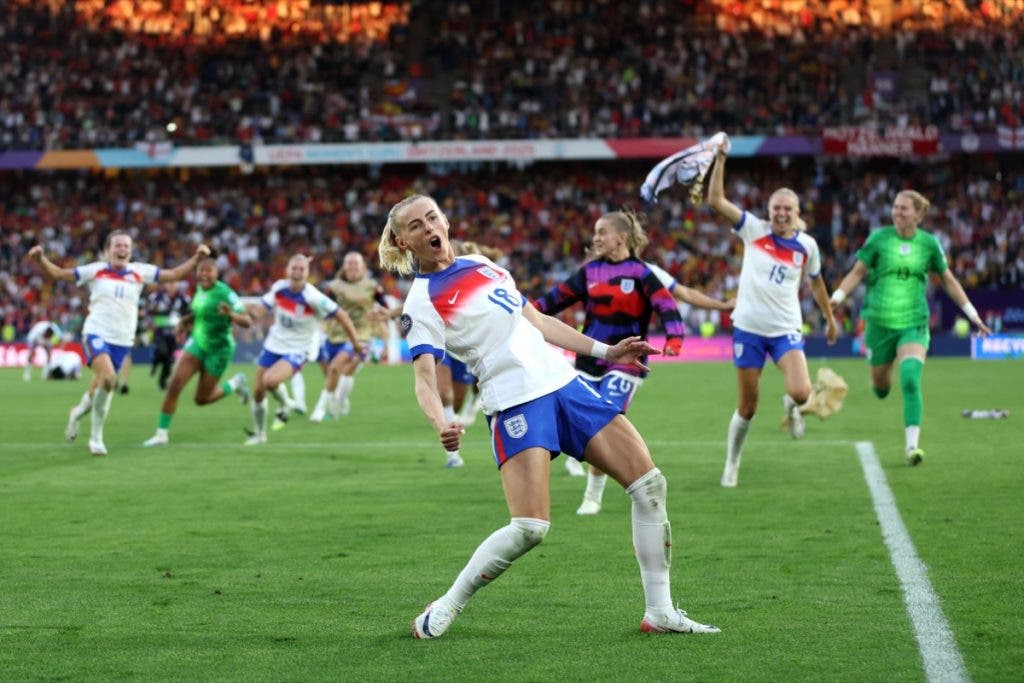
“This photograph [of England’s Chloe Kelly] is special to me,” says Florencia Tan Jun, “especially because during the penalty shootout I moved from my usual position during the match and decided to get a bit closer due to the possibility that the referee might block my view. Penalties in a final shootout feel completely different from a penalty during regular play. They make me nervous, especially because the players’ reactions and celebrations are so much more intense, and as photographers, we still have to make split-second decisions when everything happens at once.”
The photographer continues: “I saw that she was going to celebrate in the opposite direction from me. At that moment, I decided to focus on the reactions happening near me. Then, suddenly, I saw her cross over, so I immediately changed focus, and she was celebrating with her teammates behind her. I think I sent that photo before the penalty itself. Personally, I like the photo because it captures the purest, most unpremeditated, and historic reaction in women’s football. Happiness at 100km/h.”
Silhouette of Surfer Aelan Vaast
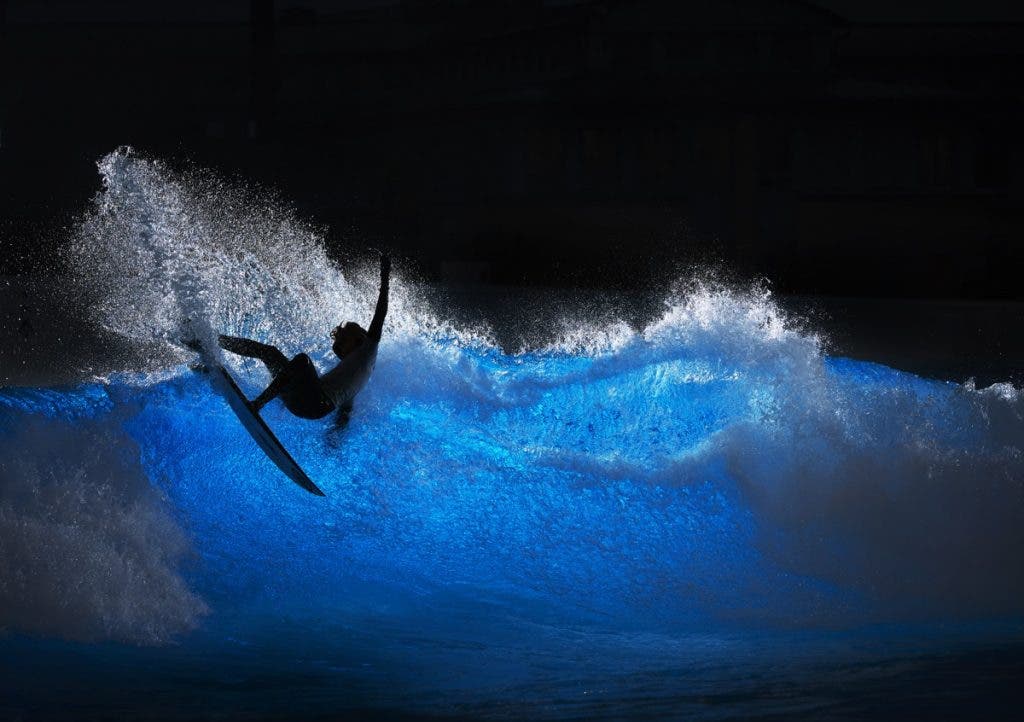
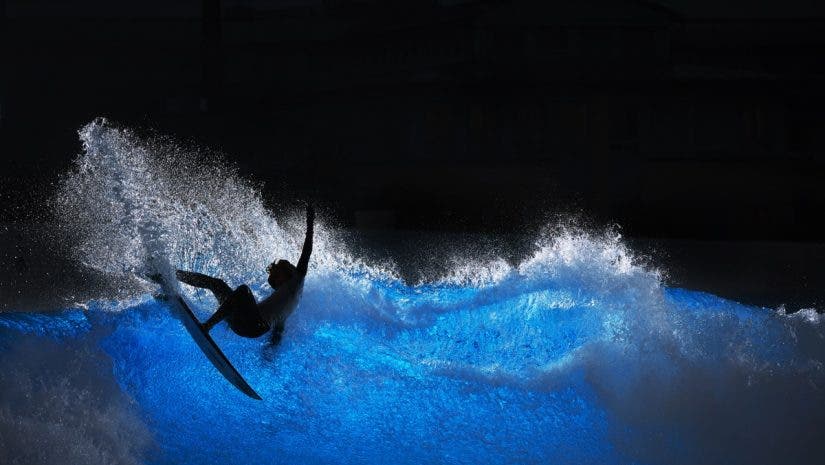
Photographer Adam Pretty was given the opportunity to photograph some French Polynesian athletes training at 02 Surftown in Munich. “I wanted to try and create a picture that was slightly different, using some artificial lighting to produce something clean and graphic with no distractions.”
Watching the Wave
To capture a perfect silhouette of Surfer Aelan Vaast, Pretty watched the wave a few times and set up his lights in the best place to capture her critical maneuver on the final section of the wave. “I positioned myself just in the water to get my camera as close to the surface as possible and to put the action against the black backdrop.
“The amazing thing about the wave pool,” he adds, “is the wave breaks exactly the same every time, so I could really position myself and the lighting where I needed it and then wait for the athlete to hit the right spot. I was not in communication with the athletes, so I just had to watch and figure out where to set up. I was trying to capture Aelan at the peak of her layback hack, throwing spray, which is lit up by the flash. The flash also lit up the water in the pool to a brilliant blue. The background also went dark as the ambient light was overpowered by the flash.”
Border Patrol

Lastly, an image by Ryan Murphy conveying a scene that has become more frequent than not. Taking pictures, says, is a small aspect of covering Border Patrol operations like the one shown here.
“For most of the day, it’s trying to locate agents and following their vehicles around, often unsuccessfully, until they start to make arrests,” says Murphy. “In this case, I had been trailing two Border Patrol vehicles when they stopped at a construction site to question the workers. After hearing a commotion inside, I ran into the building to find this scene unfolding in front of me. This time it happened at a Panda Express construction site, but it could have been the parking lot of a department store, a hair salon, or a gas station. All places you and I would visit on a regular day.”
Getty Images: The Overall Mission
In sum, Mainardis says that what Getty Images wants to come through in its content is the four core principles he mentioned earlier. “But there is also a fifth, he adds. “As a Getty Images customer, you can always rely on us to capture the big moments, but it’s more than that. We present them in ways that are more creative, distinctive, and insightful than what you see on television, often with exclusive access and the perspective of specialists our customers may not have access to. Our fifth principle is trust. In a world where imagery is constantly questioned, trust is something we earn every day through the investment we make in the content we provide.”