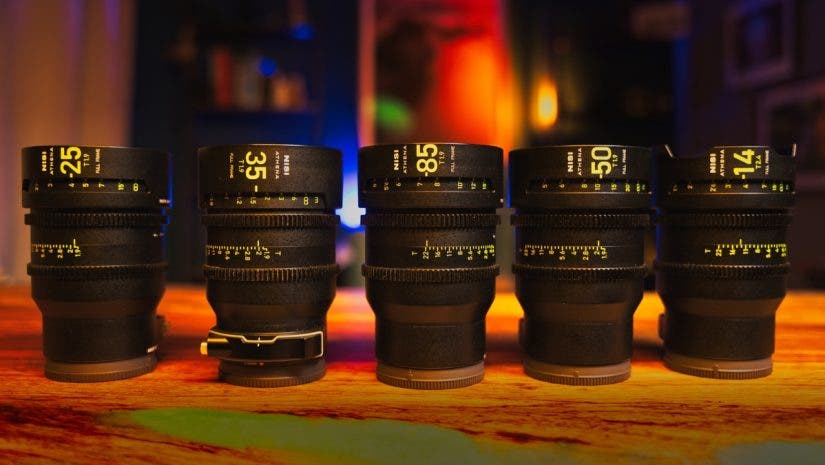
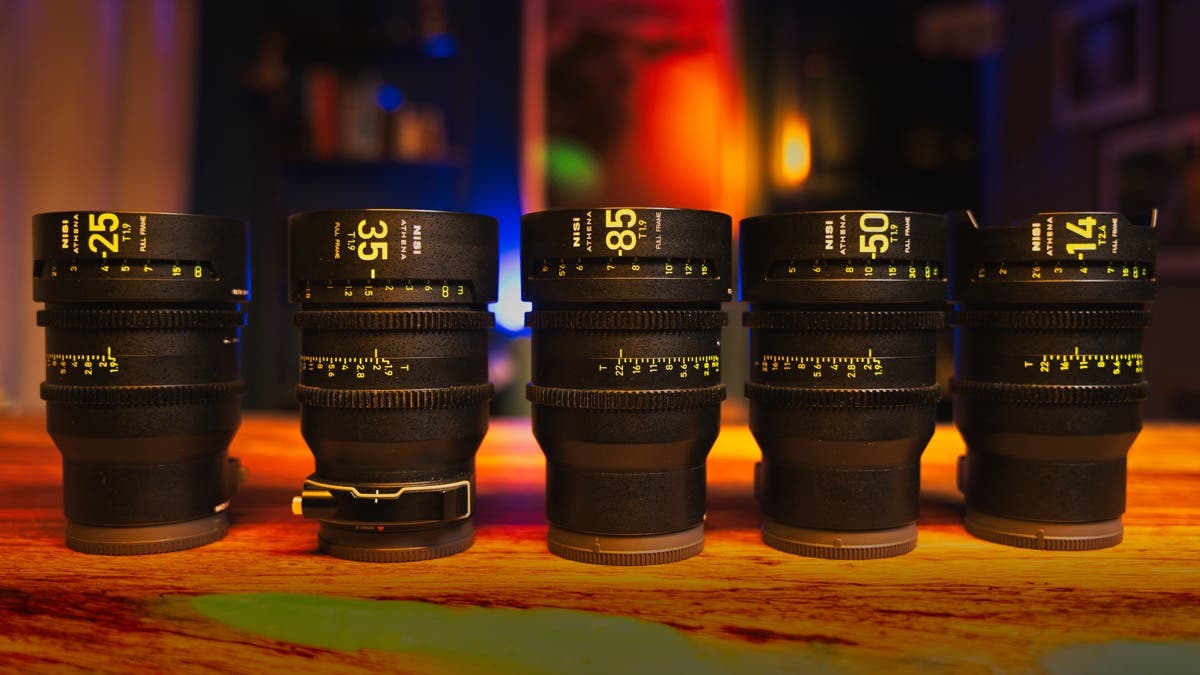
This is part 1 of a 3-part deep dive into the NiSi ATHENA PRIME Lenses. Part two focuses on Cinematic Bokeh, Creative Characteristics & Visual Signature. Part 3 on Compact Cinema and On-Set Efficiency
The NiSi ATHENA PRIME Lens series was first announced in 2023, disrupting the market with its combination of T1.9 speed and compact size. The full range was released in 2024. The lenses remain highly valuable in 2026, primarily due to their optical consistency and mechanical precision, at a fraction of competitors’ prices. Their value lies in the timeless demands of cinematography: image sharpness and consistency across focal lengths, and lens control.
Small and surprisingly affordable, they also claim top-tier optical performance. These lenses demand a technical examination to determine whether they still hold a place on professional film sets in the 2026 market.
This article will dive into the technical specifications to review the optical performance of these lenses, which is crucial for an informed purchase. However, I encourage you to also read my non-technical verdict and personal experience, which I will share at the end.

What Defines a Cinema Lens and When It Is Useful
First, it is vital to understand why a cinema lens or cine lens is distinct from its photographic counterpart and when its use becomes non-negotiable.
Cine lenses enable smooth switching between focal lengths without causing color or exposure shifts; therefore, they are a popular choice for filmmakers who need a professional, controlled, and consistent image. High-quality cine lenses also have similar bokeh and sharpness in the entire lens set. This is crucial for projects like films, commercials, and high-end documentaries that require precise, repeatable focus pulls and uniform appearance across all scenes, even when shot on different days, making it the ideal choice for cinematography, especially for solo filmmakers like me.
For run-and-gun projects like sports events or when time is limited, I use zoom lenses like the 24-70mm with autofocus to keep the gear lightweight without changing lenses.
Cine Lens vs. Photo Lens: The Crucial Differences
Unlike a photographic lens, a cine lens is explicitly built for filmmaking. The main difference is in the focus on mechanical and optical consistency.

Various components of an Athena Prime cine lens
| Feature | Cine Lens Advantage | Why it Matters for Filmmaking |
| Aperture | Marked in T-stops instead of f-stops | T-stops (Transmission Stops) measure the actual light transmitted to the sensor, ensuring consistent exposure when swapping lenses. Aperture is controlled by the De-clicked rings, which allow smooth, seamless exposure changes during a shot. |
| Focus | Long Focus Throw | This refers to the lens’s focusing mechanism, specifically the ring that is rotated to achieve manual focus. On cine lenses, the amount of rotation required to adjust the focus from the minimum distance to infinity is much more precise. They offer a longer rotation range for accuracy, typically 300° to 330°. The focus ring has teeth (gears) that mesh with a follow-focus mechanism, enabling smooth, precise, and remote adjustments. In the world of cinema, there is a specialized role known as a “Focus Puller,” whose responsibility is to keep the subject in focus while the Camera Operator focuses solely on framing the shot. This is typically accomplished using a focusing mechanism attached to the camera rig and lens. As a solo filmmaker, I use a focusing mechanism like the DJI Focus Grip with LiDAR, which allows me to focus while operating the camera. |
| Focus Breathing | Minimized or eliminated | Cine lenses prevent the view from subtly expanding or contracting as focus is adjusted, maintaining a smooth composition. |
| Consistency | Color-matched, similar bokeh, and weight | The results across the lenses are usually uniform in terms of color and bokeh at various T-stops. Their body shape and weight also allow for quick lens changes without adjusting focus motors, changing matte boxes, or rebalancing gimbals. |
The NiSi Athena Prime Technical Deep Dive: Proof on the Pixel
The lenses used for my projects
For my recent film projects shot with the NiSi ATHENA PRIME lenses, I used a lens set designed for the Sony e-Mount system. I filmed with a Sony a7S III and, for testing, used a Sony a7R IV to capture images at various T-stops, allowing me to zoom in and evaluate sharpness.
The lenses that came in the kit were 14mm, 25mm, 35mm, 50mm, and 85mm. Although I initially planned to use the 35mm, 50mm, and 85mm only for this shoot, I also incorporated the 25mm for a few shots after discussing a few ideas with the blacksmith.
Full-Frame and Super 35 Coverage
All ATHENA lenses are designed to cover a Full-Frame image circle (46mm), meaning they easily cover smaller Super 35/APS-C sensors with plenty of room to spare, future-proofing them for evolving sensor sizes.
Optical Engineering: Edge-to-Edge Sharpness
The primary claim of the ATHENA lenses is their sharpness, even wide open at their maximum aperture of T1.9 (T2.4 with 14mm).
Testing at T1.9 (Wide Open): The key test for a professional lens is performance at its widest aperture. Across the five core focal lengths, the Athena lenses exhibit remarkable center sharpness. Crucially, they maintain this detail edge-to-edge on full-frame sensors.
How to test: To accurately test a lens’s sharpness, a focus chart is used. The most precise method is mathematical, rather than relying on the camera’s focus peaking or visual estimation.
- Mount the lens on a tripod and position the camera close enough to the chart to fill the frame.
- Using a measuring tape, measure the distance from the focus chart to the camera’s focal plane, then record it.
- Dial/rotate the lens’s focus throw (or focus ring) to this precise, measured distance, as the focus throw is clearly marked with distance measurements. Ideally, the resulting image should be pin-sharp across the entire image – this is the true test of the lens’s capability.
- Test each lens at various aperture values.
The image below shows the centre of the focus chart and the sharpness of the different lenses at their widest open aperture.
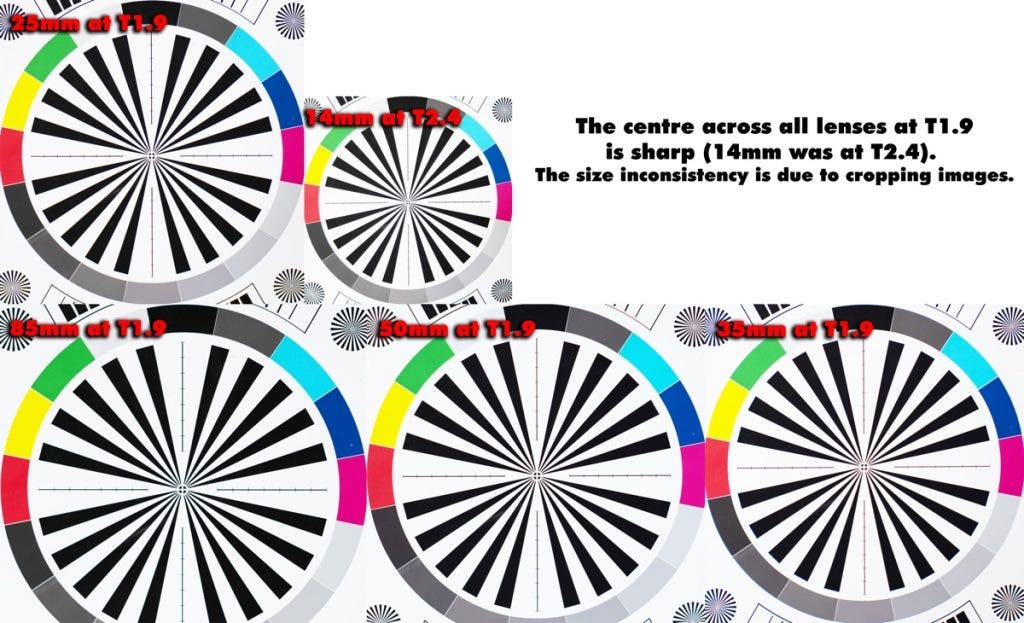
ATHENA PRIME Lenses: Centre Sharpness Across the Focal Lengths at T1.9 (14mm at T2.4)
The Results: The Athena Primes provide consistent corner-to-corner sharpness, clearly placing them in the professional category. With 14mm at T2.4, the widest, and the rest of the lenses at T1.9, from the center to the edge of the frame provided sharp results. This didn’t surprise me because, before testing, I had used these lenses for filming, and many shots with different lenses required focusing on small instruments used by the blacksmiths and ceramicists, who were my models.
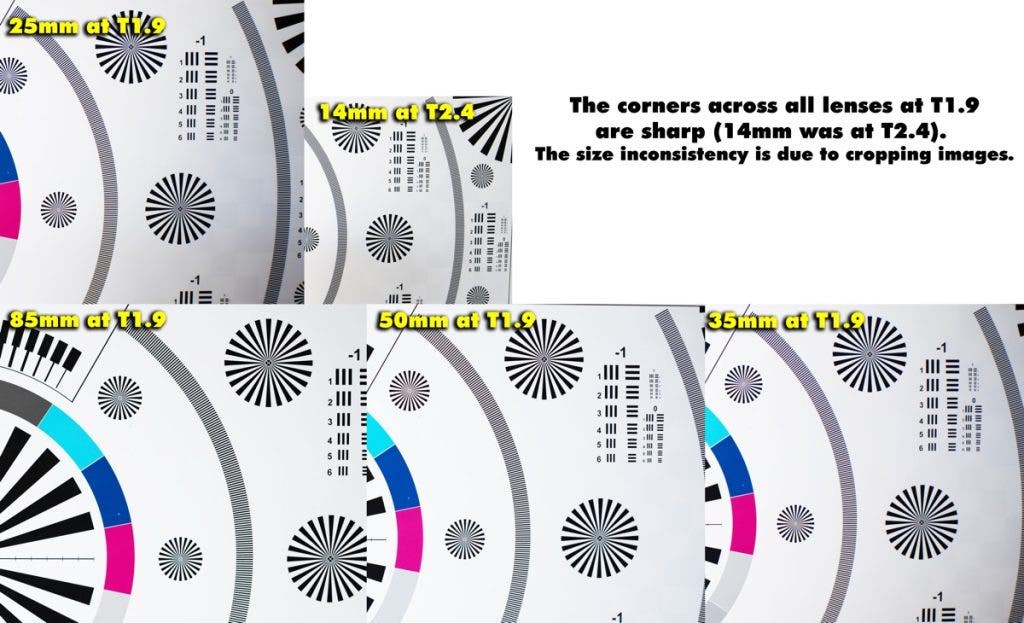
Optical Engineering Excellence: Taming the Light
A cine lens must not only be sharp but also optically clean. NiSi’s incorporation of advanced glass and coatings is where the technical design truly shines.
Chromatic Aberration Control (CA)
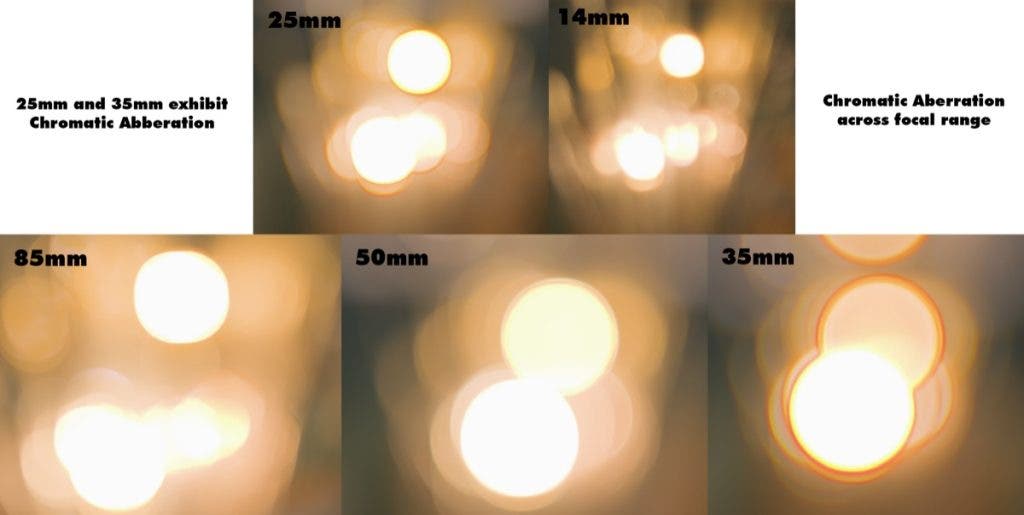
NiSi utilizes Extra-Low Dispersion (ED) and High Refractive (HR) glass elements to combat chromatic aberration, i.e., color fringing and purple halos. In high-contrast testing, shooting bright, reflective objects against a dark background or a harsh backlight, the control of color fringing is outstanding. During the tests, I found that the 35mm and 25mm lenses exhibit chromatic aberration. The cleanliness of the 85mm and 50mm surprised me, as the results showed negligible fringing.
The video below demonstrates chromatic aberration of the ATHENA PRIMEs in action:

ATHENA PRIME Lenses: Chromatic Aberration Across Focal Lengths
Here is a screen grab of the footage that makes the chromatic aberration more obvious.
Color Science and Matching
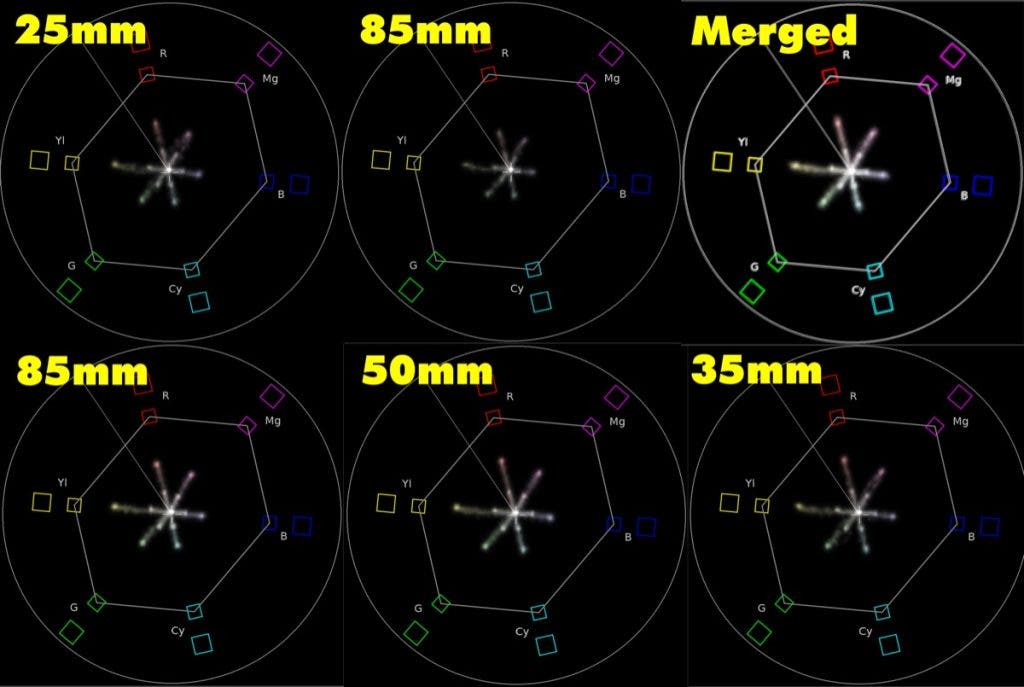
Another essential element of a professional setup is color consistency. The lenses are closely color-matched across all focal lengths, providing a neutral, high-contrast look that requires minimal post-production correction. While shooting the film projects with a Sony a7s III, using S-Log3 across all scenes was a significant advantage; the absence of color differences across various focal lengths enabled easy, consistent color grading in the editing process.
I used a color chart in my studio to test the colors. The vector scope in the editing software shows consistent colors across different focal lengths. When the scope screenshots are overlaid, they align perfectly.
The video below demonstrates the conversion from log footage to Rec.709, and then to final color grading across two scenes shot with different lenses.

Flare and Ghosting Characteristics
Although engineered to reduce unwanted veiling flare and ghosting, the ATHENA PRIMEs exhibit flare when directly exposed to strong light. The video clip below shows a flare test at 14mm in a tight studio space that makes it look a bit harsh. However, when deliberately used in a planned shot, flares and ghosting can create a pleasing cinematic effect, as seen in the footage from the pottery shoot below.

In the scene below, a sudden flare adds interest to a moving scene.

Focus Control and Mechanics
The mechanical operation is exceptionally smooth, thanks to a long, precise 300° focus rotation and industry-standard gears, enabling simple, accurate focus pulls.
This is a significant benefit, especially for shoots involving frequent lens changes. Without this consistency, I would have had to re-mesh the DJI focus motor with each lens change. The consistent placement of both the focus and iris rings across the entire lens set saves considerable time.
For solo filmmakers shooting handheld, I recommend avoiding hand focusing unless absolutely necessary. The focus ring’s extensive 300° rotation, while precise, requires a significant hand turn to shift focus between subjects. This maneuver may result in missed shots or camera shake, especially when trying to manage multiple tasks of composition, camera movement, and focus pulling all at the same time.
To deal with focusing on my own projects, I built a camera rig shown in the video below, which included a mounted DJI Focus Grip. The grip is wired to a focus motor that connects to the lens’s focus ring. This way, you still focus yourself, but utilize the focus motor to overcome the challenges described above. I used this setup for over 90% of my shots.

My Verdict: Is ATHENA the Prime Lens Goddess?
Coming from a background of using photographic lenses from multiple brands for short films and photography, I found that the NiSi ATHENA PRIME series is a significant technical advantage. Here are a few comments worth noting:
- A Complete Set: If you’re used to using photographic zoom lenses, it takes some time to get comfortable needing to switch lenses for different shots on your list. That said, the NiSi set offers a wide range of focal lengths, including 18mm (T2.2) and 135mm, to suit your various needs, making it easier to shoot in line with your creative vision.
- Consistent Results and Editing: The best part of watching the footage on the editing screen was that, at a glance, I couldn’t make out which scene was shot with which lens specifically. The color accuracy, exposure consistency, sharpness, and bokeh at a shallow depth of field made it very easy to color grade and apply LUTs for cinematic effects.
- Handling: Although time-consuming, handling lenses was simple on set, and you get used to it quickly. Their size and weight are similar, so swapping lenses feels smooth in the hand.
- Focusing: If you come from an auto-focus background, the shooting style changes. The process has to slow down and be deliberate. A focusing mechanism for this reason is an invaluable accessory.
These lenses effectively incorporate the main features of premium cinema glass, such as edge-to-edge sharpness, minimal chromatic aberration, negligible focus breathing, and consistent color reproduction, into an affordable, compact system.
In Short
The ATHENA PRIME lenses remain valuable to professional videographers and cinematographers at a good budget. They deliver professional-grade optics, providing a clean, perfectly controlled, and consistent cinematic image. Capable of delivering, ATHENA PRIME lenses offer the technical reliability previously exclusive to much pricier equipment. They are, unequivocally, more than just “good for the price.”