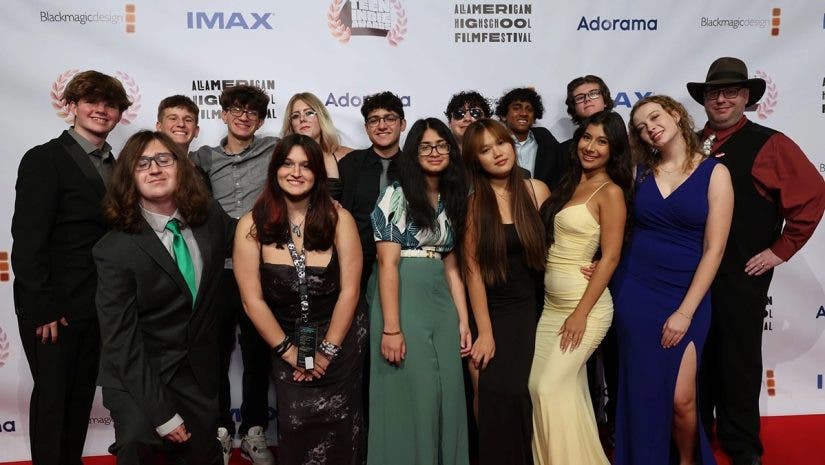
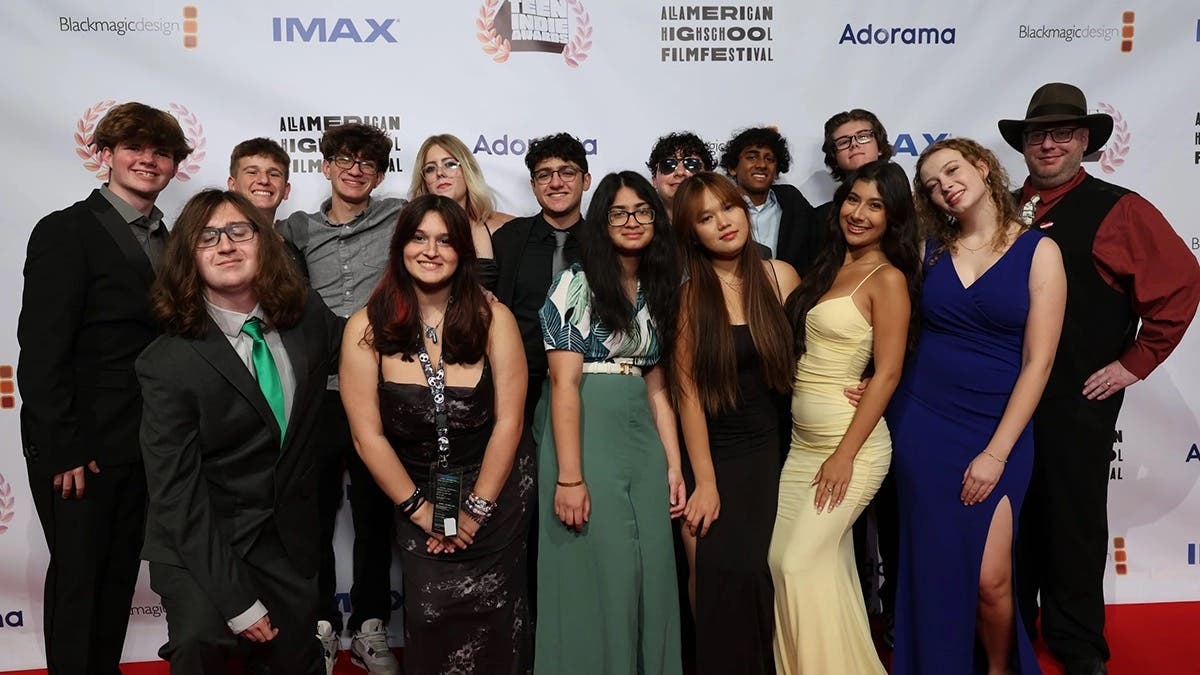
As a lifelong cinephile, there’s nothing quite like that moment when the lights dim. Next thing you know, the images on the screen come to life. In that instant, the world falls away, and I’m taken somewhere else entirely. That same transportive magic pulses through Ways of Remembering. This short film by Hudson Loverro and Maria Cury took home Best Overall Film at this year’s All American High School Film Festival (AAHSFF). It’s a film that feels both intimate and sweeping. The film is a portrait of family, memory, and the ties that pull us through change.

A Bit of History
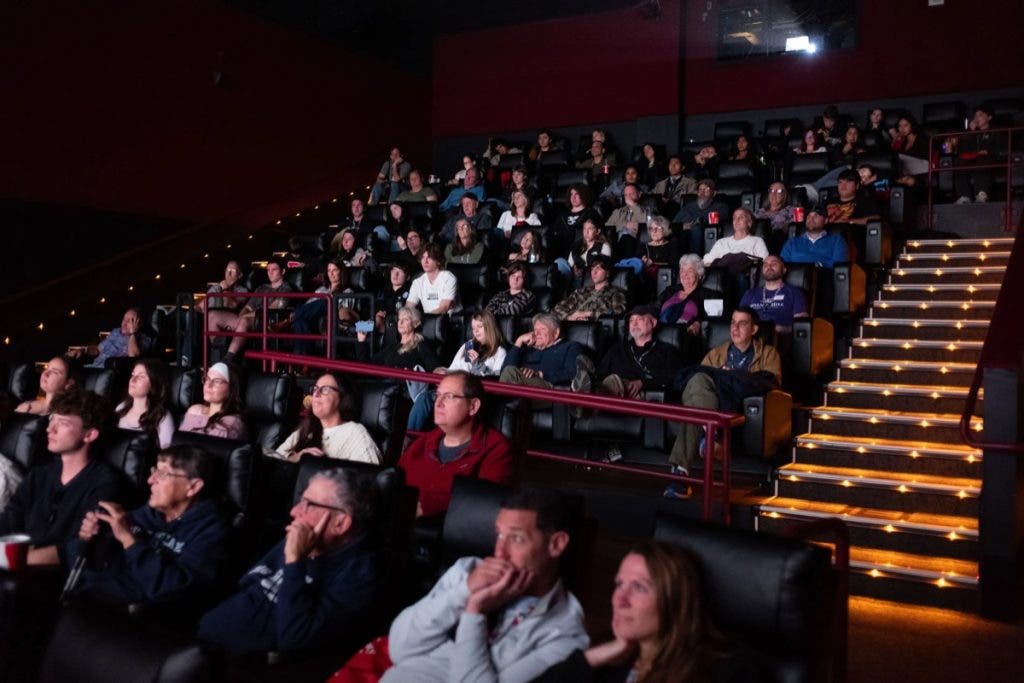
Now in its 13th year, AAHSFF remains a creative launchpad for young storytellers. Particularly, storytellers who are finding their voices. Including Loverro, Cury, and all the other filmmakers who entered the competition this year. Indeed, one of the most exciting highlights is screening the best films in the heart of New York City. These films were shown at AMC Empire 25 in Times Square.
English Teacher Tom Oliva and then high school senior Andrew Jenks Co-founded AAHSF in 2013. This festival is based on a simple premise: to give young filmmakers more than applause—to provide them with a real shot. Today, it’s the world’s largest showcase of student talent. In this community, aspiring directors, writers, and dreamers find mentorship, inspiration, and the spark to keep creating long after the credits roll.
AAHSFF 2025
This year’s festival, held October 17–19 in New York City, was aimed at high school students ages 14-18 and drew over 2,600 submissions—its most competitive yet. “Out of those, we had about 250 category nominees and just 35 winners,” says Oliva. “To rise to the top, a film has to offer a compelling narrative, emotional engagement, and attention to high-quality production and cinematic technique.”
That’s precisely what sets Ways of Remembering apart. The film, which centers on a lively Brazilian family, “offered a story propelled by a universal theme of tradition versus change,” says festival co-founder Oliva. “It’s filled with dynamic characters, a heartwarming yet complex script, and inventive filmmaking that carries the audience through every emotional beat. Hudson, Maria, and their team combined all of that into a full-circle story arc that won our judges over.”
Cury points out that while this win means so much to her professionally, it’s also important to her on a deeply personal level. “This film is a reflection of my family and my home country, Brazil,” she explains. “Being able to represent my heritage in a time when most mainstream films are American is incredibly meaningful to me. I believe it’s important for immigrants to have platforms where they can create art they’re proud of and be recognized for; it’s very important to me.”
“We Let the Film’s Emotion Dictate Everything”
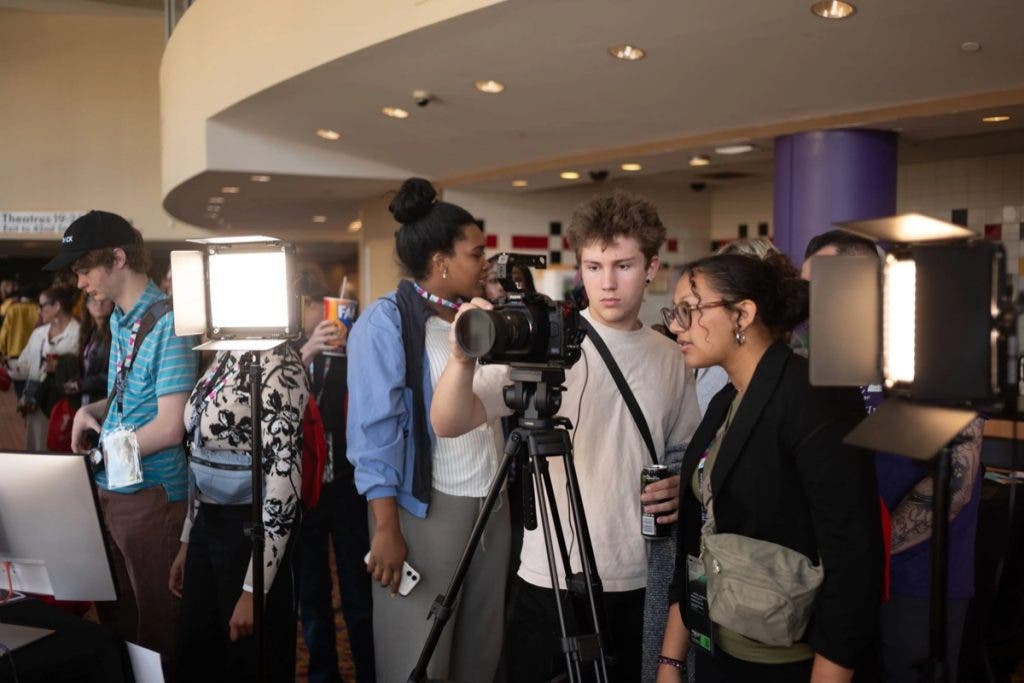
Shot on a Blackmagic 6K Pyxis camera with Rokinon DS Prime lenses, the film started with a shot list, but Loverro and Cury scrapped it 30 minutes in. “It all felt too contrived,” says Loverro. “From that moment, we let the film’s emotion dictate everything—the camera, the blocking, the tone. The trust we have as collaborators is what makes our work what it is, and the whole cast and crew fed off that energy.”
The creative duo’s back story is as compelling as their winning film. “Maria and I met at the Professional Performing Arts High School in New York City,” says Loverro. “In our Junior Year, she was recommended to me by our teacher to be the Cinematographer for a film I was making, and we have worked together on every single project we’ve been a part of since. In the spring, we’ll both be based in the SoCal area (with me at USC and Maria at Chapman). We recently started a production company together, Overtime Productions, and are currently raising money to make our first completely independent film, Just Kids.
Adorama and the AAHSFF
Adorama, a Preferred Partner and Sponsor of AAHSFF, is a dedicated champion of young filmmakers like Lovarro and Cury, and is proud to support the next generation of filmmakers, as well as providing gear, prizes, and educational opportunities.
This year, Adorama Business Solutions presented the Teacher of the Year Award, which came with a $1,000 credit for a future project with Adorama Business Solutions. Adorama contributed prizes across a couple of competition categories—including a lighting kit for Best Comedy and Best Documentary winners. As an official festival partner, Adorama helps make it possible for AAHSFF to provide meaningful rewards and professional-grade tools that empower young storytellers and educators alike.
Another 2025 AAHSFF winner is Why Can’t We Just Be Ghosts by Patrick Jang, whose film took Best Comedy. The almost nine-minute short is about “a depressed ghost who rants about his terrible life to his best friend as they both learn what it means to feel okay,” explains Jang. “The idea of the film came from my own experience with trying to navigate through my emotions and learning that sometimes it’s okay to feel things the way they are instead of thinking too much about them.”

A Passion That Started Young
Jang, who has entered AAHSFF for the past three years, says his love for filmmaking prompted him to start a YouTube channel in about the fourth or fifth grade, and he began developing scripts, ideas, and skits. “I was editing by myself, shooting by myself using my dad’s old camera on a music stand and saving up money for a green screen.”
He adds that as he became more exposed to mental health struggles in his teenage years, he decided to focus more on that in his films. He says he finds his win in the comedy category amusing because, “I see the film as more of a drama or dramedy than just a comedy (my goal was to generate equal amounts of tears as much as laughter by the end of the film), but there certainly are comedic elements that audiences at AAHSFF appreciated. It means a great deal to have my work recognized at this level, but what means more is realizing the amount of support and love I have for my work that I felt at the festival, being surrounded by inspirational artists who have shared that they connected to my work on a personal level.”
Continued Exploration
Jang adds that while he doesn’t know what his next film will be, he thinks he will continue exploring the dramedy genre, perhaps with a romantic element to it. “I’ve also wanted to do horror, so maybe that is something that could be in my toolbox in the future.”
Connor Strange, a high-school graduate and filmmaker with the Youth Documentary Academy when he made the film, took top honors in the Best Documentary category for Not All Heroes. “It’s a personal film about absent fathers,” says Strange. “I was inspired by Skinned Knees by Olive Van Eimeren, which I saw at my high school. I honestly didn’t expect to win, but what I learned through this process is that film—and the ability to create art—is what I want to do. And now I know I can do it.”
What I like about Strange’s film is that it has a home video aesthetic, complete with Strange himself as the narrator. He tells his story and experiences in a personal, direct-to-camera style, and his win is great validation for creatives who can tell their story not with lots of bells and whistles but with raw authenticity and candor.

AAHSFF and The Sheer Passion of Young Filmmakers
What’s truly remarkable about all the AAHSFF entries is the sheer passion these young filmmakers bring to their craft. The gear prizes are exciting, of course, but what stood out in every conversation I had was how deeply each filmmaker cares about the ideas and messages that come across in their films. Each entry, says Oliva, was screened and judged by the festival team, industry professionals, and alumni, as well as a panel of celebrity judges. (For the complete list of nominees and winners, click here.)
In the end, Oliva reminds us that the AAHSFF story doesn’t end when the festival lights fade at the end of each October. “We run a year-round lineup of programs, from summer film camps and remote competitions to webinars, brand partnerships, and the Future of Film podcast,” he says. “Our goal has always been to showcase the future of film on a grand stage. As our community grows, we evolve with it—curating new opportunities and developing resources that keep students learning, inspired, and connected.”
Eligibility and How You can Submit in 2026
AAHSFF eligibility extends to students currently in high school or who graduated the year prior, and teams must have an adult team leader or mentor. For the list of prizes and awards, click here. Check out submission rules and guidelines here.
Submissions for 2026 opened on November 1, 2025. For the full list of submission deadlines and entry fees, click here.
Student filmmakers gearing up for their next project can take advantage of Adorama’s Classroom Connect EDU discount program. This free initiative is designed to support emerging talent like Hudson and Maria by providing substantial year-round savings on essential gear, including cameras, lenses, and production equipment. Educators and students can register to unlock exclusive discounts, member-only deals, and other resources to help equip the next generation of storytellers.