This item is no longer available.
The Arista.EDU Ultra FB VC offers adjustable contrast control from grade 0 through grade 5, using standard Ilford Multigrade or Kodak Polymax/Polycontrast filters. An enlarger color head can also be used by adjusting the amount of magenta or yellow filters.
The Arista.EDU Ultra FB VC is specifically designed for use with tungsten or tungsten quartz halogen light sources. However, other light sources can be used but may yield different contrast values.
The paper should only be opened in a photographic darkroom illuminated by standard OC, red, or sodium vapor safelights. For storage, it's recommended to store the paper in a cool, dry place or a freezer for prolonged storage. Unused paper should be returned to its original packaging.
The Arista.EDU Ultra VC FB can be developed in any standard black and white photographic paper developer, typically requiring 90 - 120 seconds at 68 Degree F/20 Degree C. To stop development and extend fixer life, a standard stop bath for a minimum of 20-30 seconds at a temperature between 65 Degree -75 Degree F is recommended.
Review Summary
2021-03-19T08:12:51
It is a good paper, and does work well with split grade exposures very well, however the light cream color base tends to give a greyish cast to intermediate highlights.
John M.
2020-12-27T12:54:31
Lovely, lovely paper, although I will note that sometimes exposure changes with a new box. That being said, the texture is that of a semi-gloss inkjet paper with a subtle, horizontal ripple across the surface giving it a very nice and understated look with a mild, diffuse gloss. If dried against a ferrotyping surface it does indeed produce a mirror-like gloss surface, although in practice this is almost impossible to achieve reliably these days without access to the now-historic chemistry needed to use old ferrotyping plates. Great detail in shadows and nice highlights. Response to Ilford contrast filters are as expected. It takes a very mild purple tint with very deep blacks in 1:3 selenium and barely any shift in 1:20 selenium. Without any toning it has a charcoal color with maybe a very slight dark greenish/yellowish tint, but it's subtle. I feel lucky to have access to such an affordable yet high quality darkroom paper.
Julius S.
2020-12-27T12:46:00
The 11x14 FB VC Glossy seems to be dramatically different than the Arista EDU FB VC Glossy in 5x7 and 8x10, both of which have a slightly textured, almost ripply surface which i'd describe as semi-gloss compared to an inkjet glossy paper, however when dried on a ferrotyping surface it does indeed become mirror-smooth. It also has no reflectivity difference between shadows and highlights. The 11x14, however, is far more matte than the smaller sizes, lacking in the rippled, art-paper texture that I love in the 8x10. The 11x14 also has a very major and very noticeable reflectivity difference between the shadows and highlights, with the shadows being much less reflective - it looks like a cheap inkjet without a chroma optimizer. The tonality and exposure times appear, however to be exactly the same as the 8x10 and 5x7 papers, which is great for testing prior to exposing an entire sheet at 11x14. Honestly I would rather spend the extra money and get a different brand than buy another pack of this, as it does not match the look and feel of their smaller sizes of what is supposed to be the same paper. Highly recommend FB VC Glossy in smaller sizes though!!
Julius S.
2020-06-15T18:01:33
I find this fiber base paper to be a very good product for making traditional photographs. So far, the only developer I've used with this paper is Ilford Multigrade, which is an excellent all-around print developer (different developers will produce different results.) The results were prints with excellent details in both highlights and shadow areas; blacks are velvety. Some of the prints were later toned with a Fomatone Sepia kit. I gave each print a light bleach bath followed (after a water wash) with a standard toning bath. After washing the prints, again, they would receive and selenium toning bath in order to further deepen the blacks (1:20 dilution.) All being said, the quality of the photos one gets from this Arista EDU Ultra VC FB or any other paper is determined, ultimately, by the skills of the printer. This paper can respond well with minimum fuss, but, with ambitions on the part of the printer, it can follow those ambitions. I suppose I could have given it five stars, but, when I remember the legendary papers that are no longer made, like Ilford Gallerie and Kodak's Elite and Ektalure, then I get so sad from their absence from the scene. I will be reordering Arista EDU when I need it.
JOHN K.
2019-02-26T10:18:21
Wasn't what I expected. First sheet of paper when to waste because I couldn't tell the difference between the front or back. The quality of paper is good but I do not like the matte finish. I just ordered a pack of 25 of the glossy fiber paper. The photos also came back darker, I wasn't impressed.
Audris V.
Negative
Fiber Base / Double Weight
Semi-Matte
Multigrade
Neutral
100 Sheets
8 x 10" (20.3 x 25.4cm)
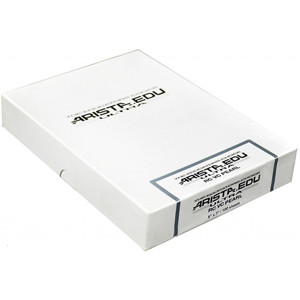
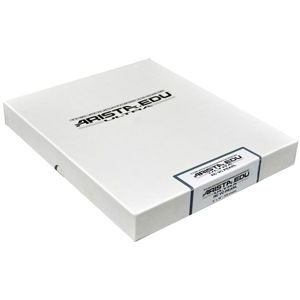
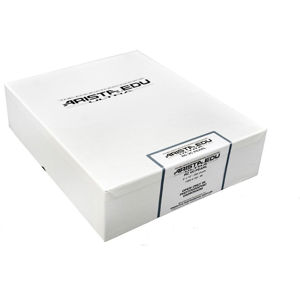
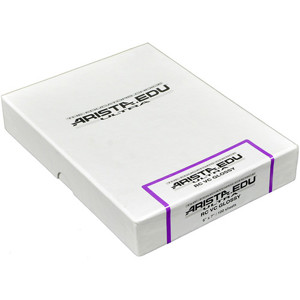
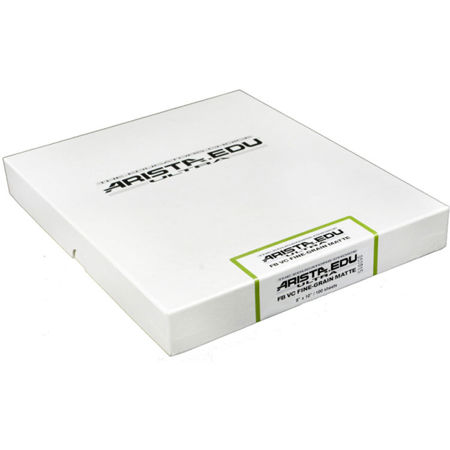
While the Arista.EDU Ultra FB VC is a versatile black and white enlarging paper, it offers more than just a double weight, fiber base. This variable contrast paper is designed to provide a range of contrast grades, similar to those of graded papers, through the use of yellow and magenta colored filters. Available in both Glossy and Semi-Matte surfaces, this fine grain paper is adaptable to your photographic needs.
Contrast control is a key feature of the Arista.EDU Ultra FB VC. Adjustments can be made from grade 0 through grade 5 using standard Ilford Multigrade or Kodak Polymax/Polycontrast filters. Alternatively, an enlarger color head can be used by tweaking the amount of magenta or yellow filters.
This fine grain paper is specifically designed for use with tungsten or tungsten quartz halogen light sources, although other light sources may yield different contrast values. The exposure of the paper is straightforward, depending on the filter system in use. For Ilford Multigrade filters, grades 00 - 3.5 share the same speed rating (ISO P200), while grades 4 through 5 require approximately double the exposure.
When it comes to handling and safelights, the Arista.EDU Ultra FB VC should only be opened in a photographic darkroom illuminated by standard OC, red, or sodium vapor safelights, such as Thomas brand safelights. It's recommended to keep safelights at least 3 feet from the paper at all times and minimize exposure to safelights.
The Arista.EDU Ultra VC FB can be processed in either trays or processing machines approved for photographic papers on a baryta base. Despite the paper containing a developing agent, activation/stabilization processing is not recommended. The paper can be developed in any standard black and white photographic paper developer, typically requiring 90 - 120 seconds at 68 Degree F/20 Degree C.
To stop development immediately and extend fixer life, a standard stop bath for a minimum of 20-30 seconds at a temperature between 65 Degree -75 Degree F (18 Degree -24 Degree C) is recommended. Fixed prints should be washed in running water for 35-45 minutes, and a standard hypo clearing agent or hypo eliminator can be used to shorten wash time and conserve water.
For optimal preservation, store the Arista.EDU Ultra VC FB in a cool, dry place. For prolonged storage, a freezer can be used, but allow sufficient time for warming up and avoid condensation on the paper. Unused paper should be returned to its original packaging for storage, and kept out of reach of harmful vapors and gases.