

Need help? Ask our experts.
The main purpose of this filter is to enhance the natural purity of colors in your photos, boost saturation and contrast, and reduce reflections and glare for improved image quality.
The filter is compatible with nearly all modern cameras, especially those using beam splitters in the light path for TTL exposure metering or autofocus.
The rotating mount allows photographers to visibly control the polarization effect directly in the viewfinder or on the monitor display.
The circular design helps to reduce vignetting and provides a more evenly lit image, which is especially beneficial when shooting with wide-angle lenses.
Yes, in ideal lighting and shooting angles, this filter can completely suppress reflections, enhancing the overall quality of the image.
Review Summary
2026-07-07T09:07:42
This is actually the first circular polarizer I have ever owned. I used to use polarizers a lot when I was shooting film, with old manual focus lenses. I was never ready to drop the $$$ on a circular polarizer for my autofocus lenses until now. I gotta say, it's pretty cool to have. I have been a B+W buyer for years, mostly their MRC 007 protective filters. It seems crazy to drop $$$ on good glass, and then throw a cheap piece of glass at the end to protect it. That said, it also seems crazy to leave it unprotected, so B+W has always been my compromise. Never had a reason to complain, still don't.
Scott H.
2024-11-07T12:16:14
Sometimes I forget just how much better B+W filters are than others. I again tried a more budget-oriented brand and finally had to replace it. These polarizers are just so good - very pronounced effect, smooth turning, no perceptible color cast, and I have never, not once had a B+W filter get stuck on a lens. I have used the top -of-the-line polarizers from B+W, but honestly this entry-level model is all I need for my professional work.
Julius S.
2023-05-22T15:35:26
Circular polarizing filter is a must for landscape photography. The B+W was a great choice. It fits snuggly on the lens but is easy to take off when not needed. Allows plenty of light onto the sensor while blocking reflections from water or chrome. Gives nice rendering of colors without being overly saturated.
MARK C.
2022-08-03T08:44:52
Excellent quality. I highly recommend this brand.
SEBASTIEN M.
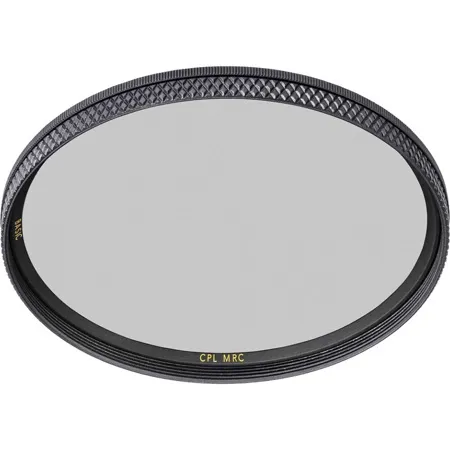
For photographers seeking to capture the vibrant hues of a deep blue sky or the rich colors of autumn foliage, the 95mm Basic Circular Polarizer MRC Filter is an essential tool. This high-quality, durable filter enhances the natural purity of colors, significantly boosting saturation and contrast in both analog and digital photography.
The multi-coated coating on this versatile filter effectively reduces reflections, glare, and lens flare, resulting in improved image quality. It also minimizes reflections from non-metallic surfaces like water, glass, and glossy paint, making objects and people behind these surfaces visible again. This fascinating image enhancement is achieved without any need for post-processing.
The 95mm Basic Circular Polarizer MRC Filter features a rotating mount, allowing photographers to visibly control the polarization effect in the viewfinder or on the monitor display. This easy-to-use filter is compatible with nearly all modern cameras, ensuring no exposure errors when beam splitters are used in the light path for TTL exposure metering or autofocus.
With a multiplying factor of 2 to 3, equivalent to 1 to 1.5 f-stops, this filter outperforms other polarizers that reach up to approximately 3 stops. The maximum polarization effect is achieved in landscape photography when shooting at a 90-degree angle to the sun.
The circular design of the filter reduces vignetting and provides a more evenly lit image, especially beneficial when shooting with wide-angle lenses. In an ideal situation, with the right lighting and shooting angles, reflections can be completely suppressed using this polarizer.
In summary, the 95mm Basic Circular Polarizer MRC Filter is a vital accessory for photographers aiming to enhance their images' contrast, saturation, and overall quality.