+2
more
more
See Options
Need help? Ask our experts.
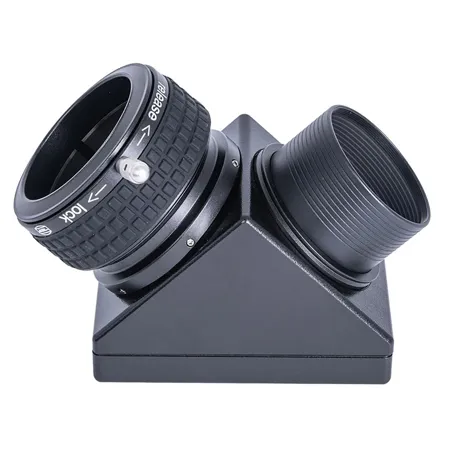
Baader Planetarium's star diagonals not only offer the highest mechanical and optical quality, but also have the additional advantage of being part of a large, modular system. Of course, also the BBHS-mirrors make very short adaptations possible and provide threads for direct connections to a telescope or a Baader focuser, as well as adaptation to a wide range of threads for torsion-free use with heavy or long accessories, such as bino viewers. Even a 2" filter can be inserted permanently into the eyepiece-side of the 2" nose-piece, e.g. as dust protection, so that you can still use the 2" filter thread on the telescope side as usual.
Silver is the first choice for mirror materials, but it must be protected against corrosion - otherwise simple silver mirrors will tarnish over the years. Popular dielectric mirrors are more robust, but usually reflect only visible light between about 400 and 700 nm.
For a viewing experience comparable to looking through the telescope without a mirror, Baader's BBHS mirrors use an additional BBHS First Surface Silver layer, elaborately sealed against corrosion. This is responsible for the outstanding brilliance and richer colors compared to simpler prisms. BBHS is an abbreviation for Broad Band Hard Silver; the silver layer is stabilized long-term by a hard protective coating. Its weather resistance is comparable to an AlSiO2 coating on a Newtonian telescope mirror.
Compared to purely dielectric coatings, BBHS provides a much broader spectral range with 98-99% reflection from just above 390 nm to 2000 nm, and it maintains high reflectivity even with varying viewing angles - the silver layer produces no stray light whatsoever. A trained eye will especially see a greater color range when using short focal length APO refractors.
Particularly in planetary observation at the highest magnifications, a noticeable increase in color intensity can be easily observed compared to all previous coatings. Additionally, a clear increase in contrast is noticeable due to the absence of any stray light. Only glass-ceramic is used as the substrate for the BBHS coating, ensuring extremely fast temperature adaptation and image stability in combination with the CNC-milled aluminum housings.
It has been proven that silver, in combination with temperature-resistant glass-ceramic, offers the absolute best viewing experience with a complete absence of stray light. Try it - the difference is impressive. Afterwards, you will want to observe planets only straight-through or with these hard-silver-coated Sitall mirrors. As a guideline, prisms are recommended for telescopes with a focal ratio of about f/6 to f/7 or slower, and for faster optics, the BBHS mirrors are preferable.
In addition to the sealed BBHS rear-surface coating, the prisms feature the proven Phantom Coating Group anti-reflection treatment.
The precisely fitting 2" ClickLock eyepiece clamp securely holds even heavy accessories with a simple 20 Degree twist. By cleverly using leverage, the clamping force is multiplied many times. The inserted accessory is held on three sides, similar to a quick-release chuck, preventing any tilting movement. Every eyepiece or measuring device is automatically aligned parallel to the optical axis - even in the case of diameter tolerances.
The BBHS mirror is mounted in a CNC-machined aluminum housing and rests stress-free on an adjustable cradle. Just like a high-quality refractor objective, the mirror can also be collimated. This allows the realization of fully adjustable systems, for example for the construction of binocular telescopes. As with a premium refractor, you will not need to change the collimation during normal use: the 3-point alignment is set at our factory so that the image shows no noticeable rotation around its center when the star diagonal is rotated by 180 Degree in a correctly aligned eyepiece clamp. Optical and mechanical axes are perfectly matched on our optical test benches. Therefore, make sure to rule out all other potential sources of error - such as a tilted focuser - before adjusting the collimation.