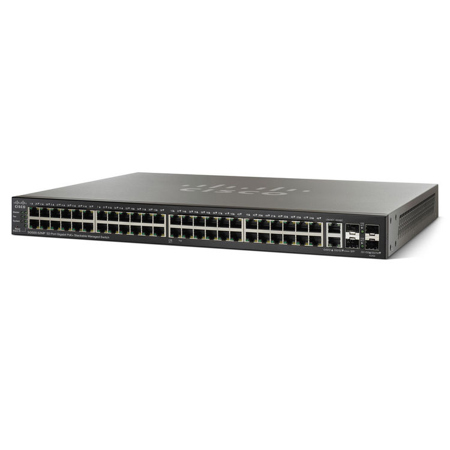
Overview
Compare
Specs
Protection

Reviews about this item

Review Summary

Cisco SG500-52MP-K9 Specifications

  • Performance

    Capacity in mpps (64-byte packets): 77.38mpps
    Switching Capacity: 120Gbps

  • Spanning Tree Protocol

    Standard 802.1d Spanning Tree Support
    Fast convergence using 802.1w (Rapid Spanning Tree [RSTP]), enabled by default
    Multiple spanning tree instances using 802.1s (MSTP). 16 instances are supported

  • Port grouping/link aggregation

    Support for IEEE 802.3ad Link Aggregation Control Protocol (LACP)
    Up to 32 groups
    Up to 8 ports per group with 16 candidate ports for each (dynamic) 802.3ad LAG

  • VLAN

    Support for up to 4096 VLANs simultaneously Port-based and 802.1Q tag-based VLANs MAC-based VLAN
    Management VLAN
    PVE (Private VLAN Edge), also known as Protected Port, with multiple uplinks
    Guest VLAN Unauthenticated VLAN Protocol-based VLAN CPE VLAN
    Dynamic VLAN assignment via Radius server along with 802.1x client authentication

  • Voice VLAN

    Voice traffic is automatically assigned to a voice-specific VLAN and treated with appropriate levels of QoS. Auto voice capabilities deliver network-wide zero touch deployment of voice endpoints and call control devices.

  • Multicast TV VLAN

    Multicast TV VLAN allows the single multicast VLAN to be shared in the network while subscribers remain in separate VLANs. This feature is also known as Multicast VLAN Registration (MVR).

  • Q-in-Q

    VLANs transparently cross over a service provider network while isolating traffic among customers.

  • GVRP/GARP

    Generic VLAN Registration Protocol (GVRP) and Generic Attribute Registration Protocol (GARP) enable automatic propagation and configuration of VLANs in a bridged domain.

  • Unidirectional Link Detection (UDLD)

    UDLD monitors physical connection to detect unidirectional links caused by incorrect wiring or port faults to prevent forwarding loops and blackholing of traffic in switched networks

  • DHCP Relay at Layer 2

    Relay of DHCP traffic to DHCP server in a different VLAN. Works with DHCP Option 82.

  • IGMP (versions 1, 2, and 3) snooping

    Internet Group Management Protocol (IGMP) limits bandwidth-intensive multicast traffic to only the requesters; supports 1K (1024) and 4K (for SG500X in native mode) multicast groups (source-specific multicasting is also supported).

  • IGMP querier

    IGMP querier is used to support a Layer 2 multicast domain of snooping switches in the absence of a multicast router.

  • HOL blocking

    Head-of-line (HOL) blocking.

  • IPv4 routing

    Wirespeed routing of IPv4 packets
    Up to 2K (2048) static routes and up to 256 IP interfaces

  • Wirespeed IPv6 Static Routing

    Up to 2K (2048) static routes and up to 128 IPv6 interfaces

  • Layer 3 Interface

    Configuration of layer 3 interface on physical port, LAG, VLAN interface or Loopback interface

  • CIDR

    Support for Classless Inter-Domain Routing

  • RIP v2 (on 500X)

    Support for Routing Information Protocol version 2, for dynamic routing

  • VRRP (on 500X)

    Virtual Router Redundancy Protocol (VRRP) delivers improved availability in a Layer 3 network by providing redundancy of the default gateway servicing hosts on the network. VRRP versions 2 and 3 are supported. Up to 255 virtual routers are supported.

  • DHCP Server

    Switch functions as an IPv4 DHCP Server serving IP addresses for multiple DHCP pools/scopes
    Support for DHCP options

  • DHCP Relay at Layer 3

    Relay of DHCP traffic across IP domains.

  • User Datagram Protocol (UDP) Relay

    Relay of broadcast information across Layer 3 domains for application discovery or relaying of BOOTP/DHCP packets.

  • Hardware stack

    Up to 8 units in a stack. Up to 416 ports managed as a single system with hardware failover.

  • High availability

    Fast stack failover delivers minimal traffic loss.

  • Plug-&-play stacking config./management

    Master/backup for resilient stack control
    Auto-numbering
    Hot swap of units in stack
    Ring and chain stacking options Auto stacking port speed Flexible stacking port options

  • High-speed stack interconnects

    Cost-effective 5G copper and high-speed 10G Fiber and Copper interfaces.

  • Hybrid stack

    A mix of SF500, SG500, and SG500X in the same stack (10/100, Gigabit, and 10 Gigabit).

  • SSH

    SSH is a secure replacement for Telnet traffic. SCP also uses SSH. SSH versions 1 and 2 are supported.

  • SSL

    Secure Sockets Layer (SSL) encrypts all HTTPS traffic, allowing secure access to the browser-based management GUI in the switch

  • IEEE 802.1X (Authenticator role)

    RADIUS authentication and accounting, MD5 hash, guest VLAN, unauthenticated VLAN, single/multiple host mode and single/multiple sessions
    Supports time-based 802.1X Dynamic VLAN assignment

  • Web Based Authentication

    Web based authentication provides network admission control through web browser to any host devices and operating systems.

  • STP BPDU Guard

    A security mechanism to protect the networks from invalid configurations. A port enabled for Bridge Protocol Data Unit (BPDU) Guard is shut down if a BPDU message is received on that port. This avoids accidental topology loops.

  • STP Root Guard

    This prevents edge devices not in the network administrator's control from becoming Spanning Tree Protocol root nodes.

  • DHCP snooping

    Filters out DHCP messages with unregistered IP addresses and/or from unexpected or untrusted interfaces. This prevents rogue devices from behaving as a DHCP Server.

  • IP Source Guard (IPSG)

    When IP Source Guard is enabled at a port, the switch filters out IP packets received from the port if the source IP addresses of the packets have not been statically configured or dynamically learned from DHCP snooping. This prevents IP Address Spoofing.

  • Dynamic ARP Inspection (DAI)

    The switch discards ARP packets from a port if there are no static or dynamic IP/MAC bindings or if there is a discrepancy between the source or destination address in the ARP packet. This prevents man-in-the-middle attacks.

  • IP/Mac/Port Binding (IPMB)

    The features (DHCP Snooping, IP Source Guard, and Dynamic ARP Inspection) above work together to prevent DoS attacks in the network, thereby increasing network availability

  • Secure Core Technology (SCT)

    Ensures that the switch will receive and process management and protocol traffic no matter how much traffic is received.

  • Secure Sensitive Data (SSD)

    A mechanism to manage sensitive data (such as passwords, keys, etc.) securely on the switch, populating this data to other devices, and secure autoconfig. Access to view the sensitive data as plaintext or encrypted is provided according to the user configured access level and the access method of the user.

  • Layer 2 isolation(PVE) w/ community VLAN

    Private VLAN Edge provides security and isolation between switch ports, which helps ensure that users cannot snoop on other users' traffic; supports multiple uplinks.

  • Port security

    Ability to lock Source MAC addresses to ports, and limit the number of learned MAC addresses.

  • RADIUS/TACACS+

    Supports RADIUS and TACACS authentication. Switch functions as a client.

  • RADIUS accounting

    The RADIUS accounting functions allow data to be sent at the start and end of services, indicating the amount of resources (such as time, packets, bytes, and so on) used during the session.

  • Storm control

    Broadcast, multicast, and unknown unicast.

  • DoS prevention

    Denial-of-Service (DoS) attack prevention.

  • Multiple user privilege levels in CLI

    Levels 1, 7, and 15 privilege levels.

  • ACLs

    Support for up to 2K (2048) rules on 500 Series and 3K (3072) on 500X series.
    Drop or rate limit based on source and destination MAC, VLAN ID or IP address, protocol, port, DSCP/IP precedence, TCP/User Datagram Protocol (UDP) source and destination ports, 802.1p priority, Ethernet type, Internet Control Message Protocol (ICMP) packets, Internet Group Management Protocol (IGMP) packets, TCP flag.
    Time-based ACLs supported.

  • Priority levels

    8 hardware queues

  • Scheduling

    Strict Priority and weighted round-robin (WRR)

  • Class of service

    Port based; 802.1p VLAN priority based; IPv4/v6 IP precedence/ToS/DSCP based; DiffServ; classification and re-marking ACLs, Trusted QoS
    Queue assignment based on differentiated services code point (DSCP) and class of service (802.1p/CoS)

  • Rate limiting

    Ingress policer; egress shaping and ingress rate control; per VLAN, per port, and flow based

  • Congestion avoidance

    A TCP congestion avoidance algorithm is required to minimize and prevent global TCP loss synchronization.

  • Standards

    IEEE 802.3 10BASE-T Ethernet, IEEE 802.3u 100BASE-TX Fast Ethernet, IEEE 802.3ab 1000BASE- T Gigabit Ethernet, IEEE 802.3ad Link Aggregation Control Protocol, IEEE 802.3z Gigabit Ethernet, IEEE 802.3x Flow Control, IEEE 802.3 ad LACP, IEEE 802.1D (STP, GARP and GVRP), IEEE 802.1Q/p VLAN, IEEE 802.1w Rapid STP, IEEE 802.1s Multiple STP, IEEE 802.1X Port Access Authentication, IEEE 802.3af, IEEE 802.3at

  • Standards (cont.)

    RFC 768, RFC 783, RFC 791, RFC 792, RFC 793, RFC 813, RFC 879, RFC 896, RFC 826, RFC 854, RFC 855, RFC 856, RFC 858, RFC 894, RFC 919, RFC 922, RFC 920, RFC 950, RFC 951, RFC 1042, RFC 1071, RFC 1123, RFC 1141, RFC 1155, RFC 1157, RFC 1350, RFC 1533, RFC 1541, RFC 1542, RFC 1624, RFC 1700, RFC 1867, RFC 2030, RFC 2616, RFC 2131, RFC 2132

  • Standards (cont.)

    RFC 768, RFC 783, RFC 791, RFC 792, RFC 793, RFC 813, RFC 879, RFC 896, RFC 826, RFC 854, RFC 855, RFC 856, RFC 858, RFC 894, RFC 919, RFC 922, RFC 920, RFC 950, RFC 951, RFC 1042, RFC 1071, RFC 1123, RFC 1141, RFC 1155, RFC 1157, RFC 1350, RFC 1533, RFC 1541, RFC 1542, RFC 1624, RFC 1700, RFC 1867, RFC 2030, RFC 2616, RFC 2131, RFC 2132

  • IPv6

    IPv6 Host Mode IPv6 over Ethernet Dual IPv6/IPv4 stack
    IPv6 Neighbor and Router Discovery (ND) IPv6 Stateless Address Autoconfiguration Path MTU Discovery
    Duplicate Address Detection (DAD) ICMPv6
    IPv6 over IPv4 network with ISATAP tunnel support
    USGv6 and IPv6 Gold Logo certified

  • IPv6 QoS

    Prioritize IPv6 packets in hardware

  • IPv6 ACL

    Drop or Rate Limit IPv6 packets in hardware

  • IPv6 First Hop Security

    RA guard
    ND inspection
    DHCPv6 guard
    Neighbor binding table (Snooping and static entries)
    Neighbor binding integrity check

  • Multicast Listener Discovery snooping

    Deliver IPv6 multicast packets only to the required receivers (MLD v1/2)

  • IPv6 applications

    Web/SSL, Telnet Server/SSH, Ping, Traceroute, SNTP, TFTP, SNMP, RADIUS, Syslog, DNS client, DHCP Client, DHCP Autoconfig, IPv6 DHCP Relay, TACACS

  • IPv6 RFC supported

    RFC 4443 (which obsoletes RFC 2463) - ICMPv6
    RFC 4291 (which obsoletes RFC 3513) - IPv6 Address Architecture
    RFC 4291 - IP Version 6 Addressing Architecture
    RFC 2460 - IPv6 Specification
    RFC 4861 (which obsoletes RFC 2461) - Neighbor Discovery for IPv6

  • IPv6 RFC supported (cont.)

    RFC 4862 (which obsoletes RFC 2462) - IPv6 Stateless Address Auto-configuration
    RFC 1981 - Path MTU Discovery
    RFC 4007 - IPv6 Scoped Address Architecture
    RFC 3484 - Default address selection mechanism
    RFC 5214 (which obsoletes RFC 4214) - ISATAP tunneling RFC 4293 - MIB IPv6: Textual Conventions and General Group RFC 3595 - Textual Conventions for IPv6 Flow Label

  • Web user interface

    Built-in switch configuration utility for easy browser-based device configuration (HTTP/HTTPS). Supports configuration, system dashboard, system maintenance and monitoring

  • SNMP

    SNMP versions 1, 2c, and 3 with support for traps, and SNMP v3 User-based Security Model (USM)

  • RMON

    Embedded RMON software agent supports 4 RMON groups (history, statistics, alarms, and events) for enhanced traffic management, monitoring, and analysis

  • IPv4 and IPv6 Dual Stack

    Coexistence of both protocol stacks to ease migration

  • Firmware upgrade

    Web browser upgrade (HTTP/HTTPS) and TFTP and SCP
    Upgrade can be initiated through console port as well
    Dual images for resilient firmware upgrades

  • Port mirroring

    Traffic on a port can be mirrored to another port for analysis with a network analyzer or RMON probe. Up to 8 source ports can be mirrored to one destination port.

  • VLAN mirroring

    Traffic from a VLAN can be mirrored to a port for analysis with a network analyzer or RMON probe. Up to 8 source VLANs can be mirrored to one destination port.

  • DHCP (Options 12, 66, 67, 82, 129 & 150)

    DHCP options facilitate tighter control from a central point (DHCP Server), to obtain IP address, auto configuration (with configuration file download), DHCP Relay, and host name.

  • Auto configuration w/ SCP file download

    Enables secure mass deployment with protection of sensitive data.

  • Text-editable configs

    Config files can be edited with a text editor and downloaded to another switch, facilitating easier mass deployment.

  • Smartports

    Simplified configuration of QoS and security capabilities.

  • Auto Smartports

    Automatically applies the intelligence delivered through the Smartports roles to the port based on the devices discovered over Cisco Discovery Protocol or LLDP-MED. This facilitates zero touch deployments.

  • Secure Copy (SCP)

    Securely transfer files to and from the switch.

  • Textview CLI

    Scriptable CLI. A full CLI as well as a menu CLI is supported.

  • Cloud Services

    Support for Cisco Small Business and Cisco OnPlus.

  • Localization

    Localization of GUI and documentation into multiple languages.

  • Login banner

    Configurable multiple banners for web as well as CLI.

  • Time-based port operation

    Link up or down based on user-defined schedule (when the port is administratively up).

  • Other management

    Traceroute; single IP management; HTTP/HTTPS; SSH; RADIUS; port mirroring; TFTP upgrade; DHCP client; BOOTP; Simple Network Time Protocol (SNTP); Xmodem upgrade; cable diagnostics; Ping; syslog; Telnet client (SSH secure support); Automatic time settings from Management Station

  • Energy Detect

    Automatically turns power off on Gigabit Ethernet RJ-45 port when detecting link down. Active mode is resumed without loss of any packets when the switch detects the link is up.

  • Cable length detection

    Adjusts the signal strength based on the cable length. Reduces the power consumption for cable shorter than 10m. Supported on Gigabit Ethernet models.

  • EEE compliant (802.3az)

    Supports IEEE 802.3az on all Gigabit copper ports.

  • Disable port LEDs

    LEDs can be manually turned off to save on energy

  • Jumbo frames

    Frame sizes up to 9K (9216) bytes. Supported on 10/100 and Gigabit Ethernet interfaces. The default MTU is 2K.

  • MAC table

    16K (16384) MAC addresses.

  • Bonjour

    The switch advertises itself using the Bonjour protocol.

  • LLDP (802.1ab) with LLDP- MED extensions

    Link Layer Discovery Protocol (LLDP) allows the switch to advertise its identification, configuration, and capabilities to neighboring devices that store the data in a MIB. LLDP-MED is an enhancement to LLDP that adds the extensions needed for IP phones.

  • Cisco Discovery Protocol (CDP)

    The switch advertises itself using the Cisco Discovery Protocol (CDP). It also learns the connected device and its characteristics via CDP.

  • Power over Ethernet (PoE)

    Power Dedicated to PoE: 740W
    Number of Ports That Support PoE: 48

  • Power consumption (worst case)

    Green Power (mode): EEE + Short Reach + Energy Detect
    System Power Consumption: 110V=70.3W, 220V=70.5W
    Power Consumption (with PoE): 110V=873.5W, 220V=857.3W
    Heat Dissipation: 2807.51BTU/hr

  • Ports

    Total System Ports: 48GE + 4 GE (5G Stacking)
    RJ-45 Ports: 48 GE
    Combo Ports (RJ-45 + SFP): 2 combo GE + 2 1G/5G SFP

  • Gigabit Ethernet Ports

    48x 10/100/1000 PoE+ ports with 740W power budget
    4x Gigabit Ethernet (2 combo x Gigabit Ethernet+ 2 1GE/5GE SFP)

  • Buttons

    Reset button

  • Cabling type

    Unshielded twisted pair (UTP) Category 5 or better; Fiber options (SMF and MMF); Coaxial SFP+ for stacking purposes

  • LEDs

    LED power savings, System, Link/Act, PoE, Speed

  • Flash

    32MB

  • 800 MHz ARM CPU memory

    256MB

  • Packet buffer

    2x 8MB

  • Fan (Number)

    4 pcs/9500rpm and fan speed control

  • Acoustic Noise

    30 deg. C=41.1dB
    40 deg. C=54.8dB

  • MTBF

    186,968hr at 50 deg. C

  • Minimum Requirements

    Web browser: Mozilla Firefox version 8 or later; Microsoft Internet Explorer version 7 or later, Safari, Chrome
    Category 5 Ethernet network cable
    TCP/IP, network adapter, and network operating system (such as Microsoft Windows, Linux, or Mac OS X) installed

  • Power

    100-240V 47-63 Hz, internal, universal

  • Certification

    UL (UL 60950), CSA (CSA 22.2), CE mark, FCC Part 15 (CFR 47) Class A

  • Operating temperature

    32 to 122deg. F (0 to 50deg. C)

  • Storage temperature

    -4 to 158deg. F (-20 to 70deg. C)

  • Operating humidity

    10% to 90%, relative, noncondensing

  • Storage humidity

    10% to 90%, relative, noncondensing

  • Dimensions (WxHxD)

    440 x 44 x 350mm (17.32 x 1.73 x 13.78")

  • Weight

    5.6kg (12.35 lbs)

  • UPC Code

    882658595059

About Cisco SG500-52MP-K9

Advanced Features for Demanding Environments, at an Affordable Price
Your business is growing and that means more customers, more opportunities and more attention on your company. The only problem: Your network was built for a smaller operation. As you add more devices, applications and users, your IT environment will become increasingly difficult and expensive to manage. Even worse, as the network becomes more complex and overloaded, your users are likely to see sluggish performance and even outages.

With more customers and employees depending on your business than ever before, a slow or unreliable network is simply not an option. You need an IT backbone that provides excellent performance, nonstop availability and advanced security. The ideal network will be easy to manage, even as it supports more advanced features and will be designed to grow with your company. And it is available at a price you can afford.

Cisco 500 Series Stackable Managed Switches
The Cisco 500 Series Stackable Managed Switches are a new line of stackable managed Ethernet switches that provide the advanced capabilities you need to support a more demanding network environment, at an affordable price. These switches provide 24 or 48 ports of Fast Ethernet and 24 to 52 ports of Gigabit Ethernet connectivity with optional 10 Gigabit uplinks, providing a solid foundation for your current business applications, as well as those you are planning for the future. At the same time, these switches are easy to deploy and manage, without a large IT staff.

Cisco 500 Series switches are designed to protect your technology investment as your business grows. Unlike switches that claim to be stackable but have elements which are administered and troubleshot separately, the Cisco 500 Series provides true stacking capability, allowing you to configure, manage and troubleshoot multiple physical switches as a single device and more easily expand your network. The Cisco 500 Series switch offer models which are fanless making it one of the industry's first in stackable switches, thereby delivering increased reliability, power efficiency and minimizing noise.

A true stack delivers a unified data and control plane, in addition to management plane, providing flexibility, scalability and ease of use since the stack of units operate as a single entity constituting all the ports of the stack members. The switches also protect your technology investment with an enhanced warranty, dedicated technical support and the ability to upgrade equipment in the future and receive credit for your Cisco 500 Series switch. Overall, the Cisco 500 Series provides the ideal technology foundation for a growing business.

What's in the box:

  • Cisco SG500-52MP 52 Port Gigabit Maximum PoE+ Stackable Managed Switch
  • Power Cord
  • Mounting Kit
  • Serial Cable
  • CD-ROM with User Documentation
  • Quick Start Guide
  • Cisco Lifetime Limited Warranty