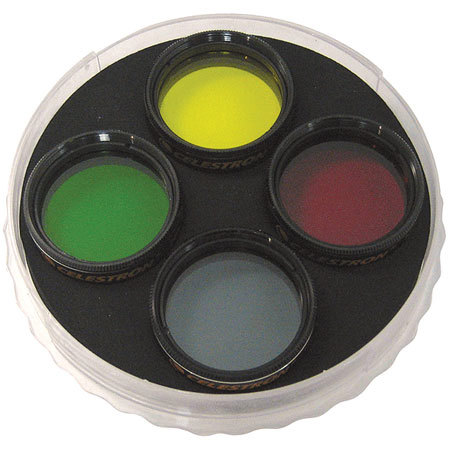
Celestron Filter Set #2 (1.25"), Deep Yellow #12, Red #25, Light Green #56, ND-25% T., 0.6 Density #96.
SKU: CNFS2
This item is no longer available.
Share:
Overview
Compare
Learn
Specs
Protection
About Celestron Filtr Set#2 (1.25), DYlw #12, Rd#25, LtGn#56
Celestron's filters are made of high quality, solid plane parallel glass with excellent homogeneity. They're anti-reflection coated to prevent glaring and ghosting. All eyepiece filters are threaded to fit Celestron's, and most other manufacturer's, 1¼" eyepieces, and offer a full 26mm clear aperture.
#12 Deep Yellow 74% T [Series 2] Moon - Enhance lunar features. Jupiter - Penetrate and darken atmospheric currents containing low-hue blue tones. Enhance orange and red features of the belts and zones. Useful for studies of the polar regions. Mars - Reduce light from the blue and green areas which darken the maria, oases and canal markings, while lightening the orange-hued desert regions. Also sharpen the boundaries of yellow dust clouds. Neptune - Improve detail in larger telescopes (11" and larger apertures). Saturn - Penetrate and darken atmospheric currents containing low-hue blue tones. Enhance orange and red features of the belts and zones. Uranus - Improve detail in larger telescopes (11" and larger apertures). Venus - Reveal low-contrast surface features. Comets - Enhance definition in comet tails.
#25 Red 14% T [#94118-07 & Series 2] Moon - Improves lunar features. Jupiter - Useful for studying bluer clouds. Mars - Ideal for observation of the polar ice caps and features on the Martian surface. Sharpens the boundaries of yellow dust clouds. Mercury - Improves observation at twilight, when the planet is near the horizon. During daylight, it reduces the brightness of the blue sky to enhance surface features. Saturn - Useful for studying bluer clouds. Venus - Use during daylight observing to reduce brightness of blue sky. Occasionally deformations of the terminator are visible.
#56 Light Green 53% T [Series 2] Moon- Enhances lunar features. Jupiter - Increases visibility of the Great Red Spot. Useful for observing the low-contrast hues of blue and red that exist in the Jovian atmosphere. Mars - Excellent for increased contrast of Martian polar caps, low clouds and yellowish dust storms. Venus - Useful for Venusian cloud pattern studies. Reduces brightness of blue sky during daylight observing.
#96ND 25% T - Density 0.6 [#94118-15 & Series 2] Moon - Excellent for reducing irradiation, glare and subject brightness. Colors are unaltered, as light is transmitted uniformly over the entire spectrum. Each model performs somewhat differently, depending on the brightness of the moon. Planets - Stacking in combination with color filters lowers transmission, but retains true color balance for specific applications. Reduces glare on brighter planets and minimizes irradiation. Binary Stars - Helpful in splitting binary stars, because it reduces glare and diffraction effects around the brighter star of the binary pair.