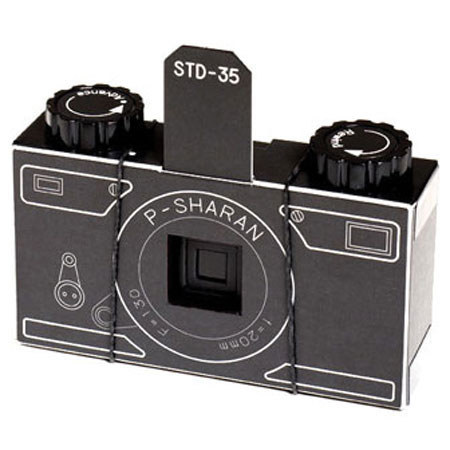
Lomography Sharan Paper Pinhole Camera
SKU: CZLPHS
This item is no longer available.
Share:
Overview
Compare
Learn
Specs
Protection
About Lomography Sharan DIY Paper Pinhole
Crafted in Japan, this is a do-it-yourself pinhole camera in a league of its own. First off, it uses the easy 35mm film & normal development that we all know and love. As with all things pinhole, you'll get dreamy soft focus images with straight wide-angle lines and endless depth of field. Its 20mm angle of view captures a fat & wide chunk of everything in front of the camera.
It's constructed of sturdy 1mm paper card, secured with rubber bands, and includes all the tape and fixins that you need. We clocked about 1 hour from unpacking to complete assembly. Not to mention, this little guy is cute as a button and unbelievably functional once it's all put together.
The science behind the magic
As you know, a pinhole camera has no lens. In its place is an extremely small aperture through which exterior light is projected onto sensitive film or paper. A lens functions by collecting the light rays outside, inverting them, and focusing them into a smaller image. A pinhole does not focus at all. It merely acts as a "center of projection" inverting the light rays without re-organizing them.
The size of the inverted image depends on the distance of the pinhole to the projection surface - a closer distance yields a smaller image and vice-versa. As the hole is not truly a point, it allows more than only one ray from the subject to register on the film. This imparts a characteristic "soft focus" effect.
Moreover, as the light is not altered, the pinhole has nearly unlimited depth of field, with reasonably close objects registering at the same sharpness as faraway objects. As the pinhole is so tiny, it yields a wide-angle focal view and reproduces true geometrical lines, unlike the usual curved effect of a wide-angle lens.
Using larger format film (ex. 120 vs. 35mm) will result in a wider field of vision. The field also widens as the distance of the film from the pinhole grows although the image will become less sharp as well.