
See Options
Need help? Ask our experts.
- RS 4 Pro Gimbal Stabilizer -
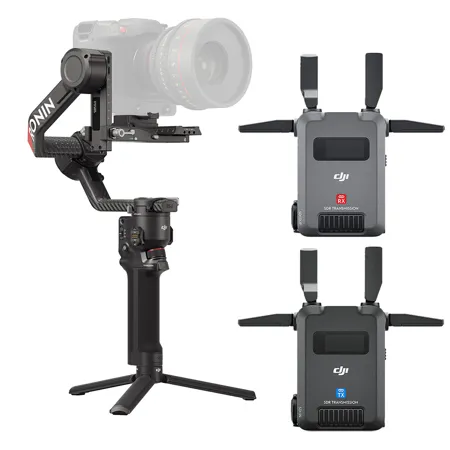
The DJI RS 4 Pro expansive flagship stabilizer integrates seamlessly with the DJI Focus Pro lens control system, DJI Transmission, and an extensive control ecosystem. This synergy empowers the film and television industry with a full-scale production solution that unites stabilization, transmission, monitoring, focusing, and control. It broadens the horizons of creative possibilities, enabling cinematographers to harness their full potential and showcase their skills.
PRO Design: Packed With Capabilities
Powerful Payload
Equipped with carbon fiber axis arms, DJI RS 4 Pro boasts a 4.5kg (10lbs) payload capacity as well as robust power and torque, easily accommodating mainstream mirrorless/cinema camera and lens setups.
2nd-Gen Native Vertical Shooting
Designed with an all-new horizontal plate, RS 4 Pro enables the second generation of native vertical shooting for further elevated efficiency. Without the need for additional accessories, cinematographers can simply release the horizontal plate and secure it into the vertical position for an effortless switch to vertical shooting.
Smooth Balancing
The roll axis now has dual rolling bearings, facilitating easier adjustments. All three axes feature a Teflon coating with a low friction coefficient, ensuring smooth balancing even when mounting heavy cameras. When switching cameras or lenses, a fine-tuning knob on the tilt axis allows you to move the camera forward or backward, achieving precise, millimeter-level balancing. The upper quick-release plate has added an adjustable placement guide to prevent the camera from loosening or shifting.
Automatic Screen Lock
The OLED touchscreen incorporates a new auto-lock feature, preventing accidental touches during shooting. When the screen is locked, it can still display the current gimbal and joystick modes at a low brightness, reducing power consumption.
2nd-Gen Automated Axis Locks
With next-generation automated axis locks, DJI RS 4 Pro can quickly start working or enter sleep mode, significantly enhancing shooting, transition, and storage efficiency. In addition, the axis locks have been upgraded to achieve smaller gaps, further reducing gimbal shakes when locked.
PRO Stabilization: Excellent Stability, Exceptional Standards
DJI RS 4 Pro features a 20% increase in motor torque across three axes, offering greater power redundancy once balanced. This ensures that the gimbal remains responsive and accurate in its tracking movements, even with heavy cameras or multiple accessories. Additionally, it provides sufficient power to support gimbal stabilization in various shooting scenarios.
Car Mount Mode
The new Car Mount mode optimizes the gimbal stabilization algorithm based on vehicle vibrations and wind resistance data, enabling steady capture even in shaky conditions.
4th-Gen RS Stabilization Algorithm
The next-generation RS stabilization algorithm has been comprehensively optimized for different usage scenarios. It strikes a superior balance between stabilization strength and the tactile feel of camera movement, delivering excellent performance and an enhanced user experience. Additionally, RS 4 Pro provides significantly enhanced stability in vertical shooting, easily mastering dynamic shots like running or low-angle perspectives.
PRO Shooting: Master of Versatility
LiDAR Intelligent Focusing for Confident Shooting
DJI Focus Pro LiDAR
When paired with the all-new Focus Pro LiDAR and Focus Pro Motor, RS 4 Pro allows solo cinematographers to experience more accurate, distant, and intelligent LiDAR autofocus, gaining precise control over cinematic expression in dynamic shooting scenarios.
76,800 Ranging Points
A leap of 77%, sharpening human subject edge detection while effectively reducing focus hunting.
20m Max Focus Distance
The human-subject focus distance is approximately three times that of the previous generation, effortlessly handling long-distance focusing with telephoto lenses.
70 Degree FOV
Beneficial for edge compositions and close-up shots, providing a larger framing space.
30 Hz LiDAR Refresh Rate
Focus on moving subjects with confidence with faster subject information collection and the enhanced speed of the Focus Pro Motor.
Next-Gen ActiveTrack Pro
Leveraging the all-new Focus Pro LiDAR and AI algorithms, the next-gen ActiveTrack Pro enables RS 4 Pro's three-axis gimbal to steadfastly track your subject. Even if the subject is briefly obscured, it can quickly relocate and retain focus. ActiveTrack Pro also exhibits excellent recognition and tracking performance in scenarios involving multiple subjects or when the subject is at a distance.
Dual Focus & Zoom Motors for Elevated Performance
DJI Focus Pro Motor
Improved motor performance offers even more precise control for increasingly versatile cinematic language.
• 30% Increase in Motor Speed: More responsive focus, zoom, and aperture controls
• 15mm Universal Rod: More mainstream and versatile
• 10 ms Lowest Latency: Rapid response for seamless operation
High-Efficiency Lens Control
DJI RS 4 Pro introduces a new joystick mode switch that allows for the control of either the gimbal movement or the lens zoom via the joystick. In zoom control mode, cinematographers can perform Power Zoom for PZ lenses, Clear Image Zoom, and external focus motor zoom. When paired with two Focus Pro Motors, RS 4 Pro allows cinematographers to adjust the lens zoom via the joystick and precisely control the focus via the dial, facilitating smooth and effortless lens control.
Remote Control System for Professional Collaboration
DJI Focus Pro Hand Unit
DJI Focus Pro ushers in innovative LiDAR autofocus technology and introduces a high-precision magnetic-damping manual control unit: Focus Pro Hand Unit.
FIZ Control Channels
Supports FIZ control, mastering the power of focus, iris, and zoom with ease.
160m Communication Distance
Supports vehicle shoots and long-distance one-takes.
A-B Points Electronic Marking
Provides spring-back tactile feedback for endpoints, facilitating more accurate focusing on a fixed path or two subjects in static positions.
- SDR Transmission Combo -
SDR Transmission Strong and Stable
Built around Software-Defined Radio technology, DJI SDR Transmission utilizes both SDR and Wi-Fi video transmission modes. SDR technology takes video transmission performance to a whole new level, offering enhanced stability, interference resistance, and penetration capabilities. For instances that require temporary monitoring, DJI SDR Transmission also accommodates Wi-Fi transmission to provide teams with increased flexibility.
Kilometer-Level Transmission, Robust Penetration
DJI SDR Transmission can reach up to 3 km/10,000 ft, accommodating wide-area, dynamic filming scenarios. Coupled with superior penetration capabilities, it meets on-site live feed monitoring demands in various complex scenarios.
20Mbps High Bitrate, 1080p FHD Image Quality
DJI SDR Transmission supports 1080p/60fps live feeds, with a high bitrate of up to 20 Mbps, ensuring smooth monitoring and collaboration.
Seamless Auto Frequency Hopping
DJI SDR Transmission supports seamless auto frequency hopping across 2.4 GHz, 5.8 GHz, and DFS frequency bands. In case of interference, it can automatically switch to the optimal channel, effortlessly tackling complex environmental challenges.
Unlimited Number of Receivers
In Broadcast mode, each transmitter can connect to an unlimited number of receivers, providing a high-quality monitoring experience for multiple collaborators and meeting the independent monitoring needs of various professional roles.
35 ms Low-Latency Transmission
The minimal latency of just 35 ms ensures smooth monitoring and efficient collaboration.
Metadata Transmission
DJI SDR Transmission supports metadata transmission from mainstream cinema cameras like ARRI and RED via SDI. This provides directors, cinematographers, and DIT teams with quick access to detailed shooting information in real time.
Voice Call
DJI SDR Transmission enables one-on-one real-time communication between the receiver and transmitter, allowing for seamless conversations between the cinematographer and the director or client at any time.
Agile and Innovative Monitoring
Compact, Lightweight, Portable
With a lightweight design and foldable antennas for easy storage, a single transmitter or receiver weighs approximately 145 g. This not only ensures portability but also supports various mounting methods, satisfying a wide range of on-scene demands.
Innovative USB-C Port, Diverse Monitoring Methods
DJI SDR Transmission supports multiple monitoring methods and can output three SDR signals and two Wi-Fi signals simultaneously. The receiver can output to monitors via SDI/HDMI. Additionally, the transmitter allows for direct connection to smartphones or tablets over Wi-Fi, offering a cost-effective, dual-channel monitoring experience without the need for a receiver.
On top of this, DJI SDR Transmission also introduces a USB-C output monitoring method that combines stability with convenience. Users can use a USB-C cable to connect the receiver to a smartphone or tablet for smooth and stable monitoring.
Join VIP PRO
Earn 2X Points + Exclusive Perks!
Request a Callback
Chat one-on-one with an expert
Sell or Trade your Gear
Get started in 3 easy steps