Share:
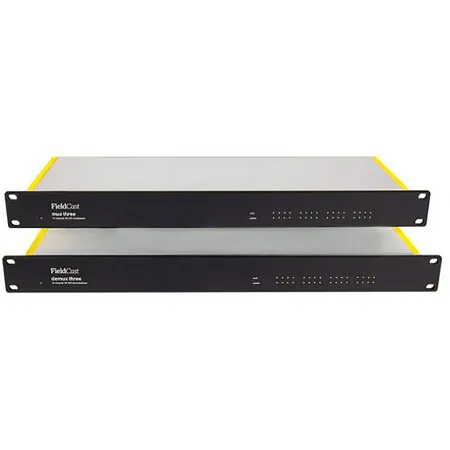
FieldCast Mux Demux Three Plus 3G 16-Channel SDI and Ethernet over Fiber
SKU: FCCO132 MFR: CO132
Earn VIP Reward PointsKey Features
- Seamlessly integrate 16 SDI inputs and Ethernet over a single fiber, simplifying your video workflow.
- Experience superior video quality with support for up to 3G SDI, ensuring crystal-clear visuals for your audience.
- Enjoy flexible input/output options with 16 SDI inputs, each featuring loopthrough, and dual SDI outputs per channel.
- Achieve reliable, long-distance signal transmission up to 40km, perfect for extensive production setups.
- Streamline your setup with robust multiplexing technology, consolidating multiple signals onto one fiber optic cable.
- Benefit from a user-friendly 1RU design, making this video switcher easy to incorporate into any rack.
Temporarily On Backorder?Expected Availability: 09/2026
Free Shipping
See Options
1
Add to ListGet Sale Alert

Add Adorama Protect:
Available to U.S. customers only.
Need help? Ask our experts.
Overview
Compare
Specs
Protection







About FieldCast Mux/Demux Three Plus 3G
Mux Three Plus 3G and its twin brother Demux Three Plus 3G, as a pair, allow you to transport sixteen independent channels of 3G SDI video plus full duplex 1 Gb Ethernet over just one fiber optic channel.
Is your infrastructure such that you only have access to one single mode (simplex) fiber optic connection? Mux Three Plus and Demux Three Plus can help you to get this all done, plain and simple. Or else, do you want to roll out a minimum number of cables in live event environments? Just use Mux Three and Demux Three, multiplex up to sixteen channels of video plus Ethernet, and get all data from A to B using only one strand of fiber!
No hidden processing involved! All 3G video signals preserve full data integrity! What goes in comes out, unchanged. And the Ethernet connection simply behaves like a Cat5 cable connecting your hubs!
Transport over long distance
The mux/demux pair can transport video over distances of up to 40 km/24 mi for 3G SDI. The mux is typically placed at the camera side, and the demux at the control room side.
16 independent video channels with loop-through and dual output
The set supports 16 independent SDI video channels. The SDI inputs have a reclocked loop-through. The SDI outputs are dual. Hence, monitoring on both sides (input and output) is possible. The SDI input is typically connected to the camera's SDI output. The SDI output is generally connected to the SDI input of a monitor or switcher.
16 independent bidirectional Ethernet channels
Both the Mux and Demux units contain one full-duplex 1Gb Ethernet port. The 1Gb Ethernet port is typically used to transport camera control data between the camera and the camera controller or switcher. Connect the cameras' Ethernet ports to a hub, then connect the hub to the Mux's Ethernet port. On the other side, connect the Demux's Ethernet port to the camera controller/switcher's Ethernet port, or connect to a hub if more data controller devices are needed, for instance, a camera controller and a laptop.
Transport over one fiber optic core
All information for up to 16 SDI video channels and their corresponding control data, back and forth, runs over a single fiber optic core. This means a simplex fiber-optic cable is sufficient to bridge the distance between mux and demux, saving on fiber-optic cable costs. Alternatively, if you have a fiber optic cable with 2 cores, you have 1 core (or channel) left for other fiber optic transport. You might, for example, use the free fiber optic core to connect to a second, similar Mux/Demux pair to add redundancy to your setup.
No compression
There is no signal processing involved, so there is no compression; full data integrity is guaranteed.
Unidirectional video by default
The standard model is unidirectional, meaning that 16 SDI signals go from mux to demux; it's denoted as 16i/o, where 'i' stands for input and 'o' stands for output.
Bidirectional video on request
Upon request, the direction of the SDI signals can be changed to bidirectional. Customization is done at the factory level and built as requested. Custom bidirectional models can be configured in any way, for instance, 8 channels mux to demux and 8 channels demux to mux (8i/8o), or 14 channels mux to demux and 2 channels demux to mux (14i/2o, which is technically the same as 2i/14o).Logically, all possible custom solutions for a 16-channel multiplexer set can be configured as follows: 1i/15o, 2i/14o, 3i/13o, 4i/12o, 5i/11o, 6i/10o, 7i/9o, 8i/8o. The next logical successor, 9i/7o, is the same as 7i/9o and was already listed before.
LC fiber by default
By default, the mux/demux set is supplied with an LC single mode fiber optic port. On request, other fiber ports, such as SC or ST connectors, can be built in.
FieldCast Mux/Demux Three Plus 3G Features
- Transport over long distance up to 40 km/24 mi for 3G SDI
- 16 independent video channels with loop-through and dual output
- 16 independent bidirectional Ethernet channels
- Transport over one fiber optic core up to 16 SDI video channels
- No signal processing involved, so there is no compression
- Unidirectional video by default
- Bidirectional video on request
- LC fiber by default