


See Options
Need help? Ask our experts.
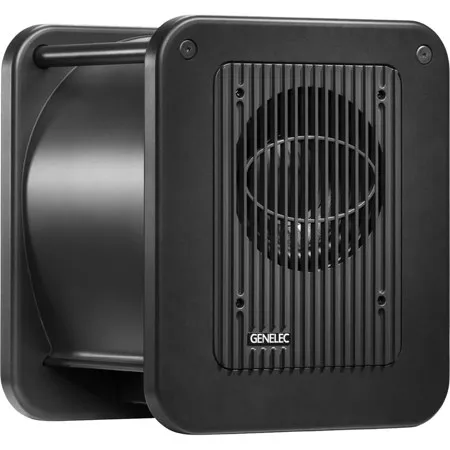
For powerful, intelligent low frequency performance in a compact package, the 7350A Smart Active subwoofer simply can't be beaten.
Clean and precise
Designed to complement our 8320A and 8330A smart monitors, the 7350A delivers clean, precise bass reproduction that provides low frequency extension and increases the headroom of your entire monitoring system through flexible bass management. This results in well-articulated LF performance with very low distortion, while your main monitors are free to concentrate their energy on the rest of the frequency spectrum.
Perfect integration
The 7350A also works closely with our GLM software, via which it can be configured for stereo or multichannel formats. Once configured, GLM will then analyze your room acoustics and intelligently adjust frequency, level and crossover phase - so monitors and subwoofer integrate perfectly. This process produces a totally optimized listening experience, delivering mixes that translate beautifully.
Active Crossovers
Active crossover operating at low signal levels
Audio electronic crossovers allow the audio signal to be split into separate frequency bands that are separately routed to individual power amplifiers, which are then connected to specific transducers optimized for a particular frequency band. Active crossovers come in both digital and analogue varieties. Genelec digital active crossovers include additional signal processing, such as driver protection, delay, and equalization.
Genelec analogue active crossover filters contain electronic components that are operated at low signal levels suitable for power amplifier inputs. This is in contrast to passive crossovers that operate at the high signal levels of the power amplifier's outputs, having to handle high currents and, in some cases, high voltages. In a typical two-way system the active crossover needs two power amplifiers - one for the woofer and one for the tweeter.
The active crossover design offers multiple benefits:
• The frequency response becomes independent of any dynamic changes in the driver's electrical characteristics or the drive level
• There is increased flexibility and precision for adjusting and fine-tuning each output frequency response for the specific drivers used
• Each driver has its own signal processing and power amplifier. This isolates each driver from the drive signals handled by the other drivers, reducing inter-modulation distortion and overdriving problems
• The ability to compensate for sensitivity variations between drivers
• The possibility to compensate for frequency and phase response anomalies associated with a driver's characteristics within the intended pass-band
• The flat frequency response of a high-quality active loudspeaker is a result of the combined effect of the crossover filter response, power amplifier responses and driver responses in a loudspeaker enclosure
Using the active approach enables frequency response adjustments and optimization of the full loudspeaker system, placed in various room environments, without expensive external equalizers. The end result is a simpler, more reliable, efficient, consistent and precise active loudspeaker system.
Bass Management System
Bass Management System handles multichannel low frequency content
The principle of bass management is that the bass content of the main channels and the Low Frequency Effect (LFE) channel are directed and reproduced only by loudspeakers capable of handling them, whether they are main system loudspeakers or one or more subwoofer.
In stereo reproduction, signals from 20 Hz to 20 kHz need to be replayed. Large multi-way monitoring systems will reproduce such a wide bandwidth evenly. With multichannel audio, professional and consumer audio systems must also be able to reproduce audio between 20 Hz and 20 kHz for each channel. To achieve this, main monitors, subwoofers and crossover electronics should work together.
A Bass Management system uses either analogue electronic circuitry or software based filtering which will filter low frequency information from the main channels and route that information to one, or more, subwoofer feed. The dedicated LFE channel can also be monitored via that subwoofer and added to the low frequencies of the other main channels. Therefore, the Bass Management's basic and main goal is to ensure that the entire audio bandwidth of all channels can be accurately monitored.
The benefits of the Bass Management System:
• The subwoofer extends the system frequency response down the lower limit of the audible range
• Monitor can produce a higher maximum sound level when not reproducing low frequencies
• Optimized low frequency reproduction by selecting adequate subwoofer location; monitors can also be placed more freely
• Subwoofer's output are aligned in level and phase with monitors allowing flat and accurate reproduction down to 19 Hz and across the crossover point
• LFE channel output level (0 or +10 dB re. main channels) can be selected for accurate reproduction depending on the source type
• The ability to bypass the subwoofer allows to evaluate the audible impact of the subwoofer
Intelligent Signal Sensing (ISS) Technology
Intelligent Signal Sensing (ISS) for power consumption reduction in stand-by mode
Introduced early 2013, Genelec's Intelligent Signal-Sensing technology has been developed to meet with both European Union ErP Directives and Genelec's own ambitious sustainability standards. The Intelligent Signal Sensing, ISS circuitry tracks the signal input of the loudspeaker and detects if it is in use. If the ISS circuit does not find any audio on the input for a period of time, it sets the loudspeaker to a low-power sleep state and the loudspeaker will consume less than 0.5 watts. When an input signal is detected, the loudspeaker immediately turns itself on.
Additionally an 'ISS Disable' switch is located on each product's back plate next to the other room response controls. First, when the mains power switch of the loudspeaker is set to 'ON', the ISS auto-start function (low-power sleep state on/off) of the loudspeaker is active. If this function is not desired, the ISS function can be disabled by setting the 'ISS Disable' switch on the back panel to 'ON' position. In this mode, the monitor is only powered on and off using the mains power switch. Note that the mains power switch will always turn the monitor off completely.
Laminar Spiral Enclosure (LSE) Technology
Highly efficient Laminar Spiral Enclosure (LSE) provides accurate low frequency reproduction
The demands placed on subwoofers over the last years have increased substantially to the point where traditional design concepts are no longer valid. For Genelec, in order to achieve the absolute best performance possible, bold initiatives must be taken. Drawing on years of acoustic research and knowledge, Genelec's engineering group accepted the challenges placed upon them in the beginning of the 21st Century. The totally unique, curvilinear shape of the LSE Series Active Subwoofer enclosure is the revolutionary patented result of their efforts.
All of the Genelec LSE series subwoofers feature this innovative Laminar Spiral Enclosure (LSE) bass reflex cabinet. It provides excellent laminar flow characteristics with minimal turbulence noise and enables an optimal packing of a very long reflex tube into a small space. The learnings from the LSE Technology are also utilized in the reflex port design of our aluminum enclosure products.
The spiral-shaped design yields an extremely rigid enclosure exterior while also forming the subwoofer's integral port. The fact that one is part of the other means that air flow in and out of the enclosure's interior through the port is totally unrestricted. This results in an extraordinarily accurate and responsive low-frequency system with measured second and third harmonic distortion levels typically better than 30 dB below the fundamental.
When combined with Genelec stereo and multichannel bass management active electronics, the LSE Series Subwoofers provide a low-frequency listening experience like no other. The result is a product range with impeccable technical performance: The Genelec LSE subwoofer range is unique, complete, functional, different from any other products on the market, and consistent.
Optimized Amplifiers
Audio electronic crossovers allow to split the audio signal into separate frequency bands that can be separately routed to individual power amplifiers, which are then connected to specific transducers optimized for a particular frequency band.
In a typical 2-way loudspeaker system, the active crossover needs two power amplifiers - one for the woofer and one for the tweeter. The power amplifiers are connected directly to the drivers of an active loudspeaker, resulting in the power amplifier's load becoming much simpler and well known. Each driver-specific power amplifier has only a limited frequency range to amplify (the power amplifier is placed after the active crossover) and this adds to the ease of design.
The active design principle offers multiple benefits:
• The power amplifiers are directly connected to the speaker drivers, maximizing the control exerted by the power amplifier's damping on the driver's voice coil, reducing the consequences of dynamic changes in the driver electrical characteristics.
