


See Options
Need help? Ask our experts.
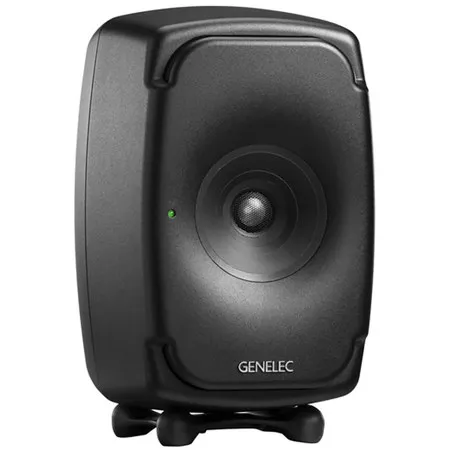
Incredible three-way point source monitor with the footprint of a compact two-way. When space and precision is of the essence, nothing even comes close.
Work faster, for longer
For applications calling for extraordinary imaging, extended frequency response, short to medium listening distance or long, fatigue-free working hours, The Ones are in an elite league of their own. They promote faster and more consistent decision making, and they also extend listening time, because unnatural imaging - a main contributor to listener fatigue - is minimized.
Mixes that translate
The smallest in The Ones series, the 8331A is perfect for small rooms or ultra-nearfield applications, and offers an outstanding solution where none existed before. And in conjunction with our GLM calibration software, the 8331A will compensate for detrimental room acoustics and distance delay, regardless of whether you work in mono, stereo or immersive formats. So now you can deliver mixes that translate beautifully - every time.
Smart Active Monitoring (SAM) and GLM calibration technology
Networked Smart Active Monitor (SAM) Systems feature automatic calibration to the environment
Now, more than ever, audio productions are engineered in tighter, more confined working environments. This increases acoustic problems and lowers the reliability of monitoring. At the same time, an audio engineer's need to trust a reliable and precise monitoring system that reproduces sound neutrally and without distortion has not changed.
Built upon the solid electro-acoustic foundations of our 1200, 8000 and 7000 Series products, Genelec SAM Systems are today's most advanced and flexible monitoring solutions. They are an indispensable tool for audio professionals, as they automatically adapt to the acoustic environment and correct for level, delay and room anomalies. SAM Systems are controlled using Genelec's proprietary Loudspeaker Manager (GLM) network and software, enabling you to build a highly flexible and reliable monitoring system.
GLM is a highly intuitive and powerful monitor control networking system that manages connectivity to all SAM studio monitors and subwoofers on the network. GLM software features adjustment of level, distance delay and flexible room response compensation equalization with our state-of-the-art, highly robust Auto Cal 2 algorithm automated calibration system. All parameters and settings are stored in system setup files or saved in each individual monitor or subwoofer, if the GLM network needs to be disconnected.
Also, all acoustical features of SAM Systems can be optimized and tailored for different working styles or client demands. Additionally, even if the monitors or the production projects move between rooms, you can expect SAM technology to provide the highest consistency in monitoring, providing neutral soundstage imaging with low distortion - in each environment. Genelec SAM Systems offer a comprehensive, solution-oriented, intelligently networked product range supporting analogue and digital signals in virtually any working environment.
Minimum Diffraction Coaxial (MDC) Driver Technology
Minimum Diffraction Coaxial (MDC) Driver Technology reproduces outstanding sound image
Typical coaxial designs suffer from a somewhat ragged frequency response due to diffraction problems inherent in their unrefined design. However, crossover issues due to the non-coincident location of sources are solved with a coaxial configuration, so a coaxial solution without diffraction problems is the ideal. Genelec's Minimum Diffraction Coaxial (MDC) Driver Technology provides all the benefits of coaxial design while overcoming the typical shortages - solving the diffraction problem.
The first step is to minimize the cone displacement, in other words to limit the low frequency bandwidth of the driver. Next, is to avoid all sources of diffractions. The main structure of the MDC design consists of an integrated MF diaphragm-suspension tweeter construction. The visible part of the coaxial driver is formed by the curved flexible skin with the dome tweeter assembly in its center. The inner section joins the cone to the tweeter without any acoustical discontinuity, and the outer one does the same between the cone and the driver chassis.
As there are no acoustically observable discontinuities between the tweeter and the cone, just a smooth surface, there is no diffraction either. The cone profile is very carefully optimized to form an integrated directivity control waveguide for the tweeter radiation. The driver outer edge is terminated to a normal Genelec DCW in order to control the dispersion of midrange radiation as well. The response is very smooth both on and off-axis and free from any anomalies - and directivity is well controlled.
This breakthrough in coaxial design provides improved imaging and overall sound quality on and off-axis, extremely smooth frequency response leading to outstanding clarity and definition of the inner details of the music.
The main novelties of Genelec combined DCW and MDC designs:
• Diffraction-free joint between tweeter and midrange diaphragm
• Diffraction-free joint between midrange diaphragm and DCW waveguide
• A proprietary midrange diaphragm technology - laminate structure combining a rigid cone and elastic, lossy materials including the suspension itself
• A midrange diaphragm-suspension pair which cancels all possible non-linearity
Advantages:
• Smoother frequency response
• Ensures the drivers couple coherently over their full operating bandwidth
• Significantly improves the directivity control in the critical frequency range
• Provides balanced suspension dynamics to minimize acoustic distortion
• Optimizes the use of the front baffle area while maintaining the 8000 Series appearance and benefits
Acoustically Concealed Woofers (ACW) Technology
Acoustically Concealed Woofers (ACW) for controlled directivity down to low frequencies
The 8351 Acoustically Coaxial Three-way system features our novel Acoustically Concealed Woofer (ACW) technology. The Acoustically Concealed Woofers radiate through slots located on both ends of the enclosure. The 8351 features two woofers and the positions of the two woofers have been chosen to extend the coaxial acoustical radiation concept towards low frequencies. In terms of low frequency directivity, when two woofers are used, separated by a distance, the system of two woofers behaves acoustically like one giant woofer spanning the distance between the two woofers. Also, such a dual woofer design extends the control of the directivity to low frequencies along the largest front baffle dimension.
The ACW technology makes the woofer openings and the woofer drivers acoustically invisible to the acoustical radiation from the minimum diffraction coaxial (MDC) driver responsible for the midrange and tweeter frequencies. The radiation openings are optimized for size and curvature to minimize any acoustic diffractions.
The ACW solution also allows us to use the whole front baffle surface of the 8351 as one giant Directivity Control Waveguide (DCW) that is part and built into a Minimum Diffraction Enclosure (MDE). The 8351 ACW arrangement creates a monitor that has a physically compact size yet behaves like a much larger system in terms of low frequency directivity. Such controlled low frequency directivity translates to improved quality of monitoring and smaller low frequencies interaction between the monitor and the room.
Directivity Control Waveguide (DCW) Technology
Directivity Control Waveguide (DCW) for flat on and off-axis response
A revolutionary approach was taken by Genelec in 1983 with the development of its Directivity Control Waveguide (DCW). We have developed and refined this technology over more than 30 years to greatly improve the performance of direct radiating multi-way monitors. The DCW technology shapes the emitted wavefront in a controlled way, allowing predictable tailoring of the directivity (dispersion) pattern. To make the directivity uniform and smooth, the goal is to limit the radiation angle so that the stray radiation is reduced. It results in excellent flatness of the overall frequency response as well as uniform power response. This minimizes early reflections and provides a wide and controlled listening area achieving accurate sound reproduction on and off-axis.
Minimized early reflections and controlled, constant directivity have another important advantage: the frequency balance of the room reverberation field is essentially the same as the direct field from the monitors. As a consequence, the monitoring system's performance is less dependent on room acoustic characteristics. Sound image width and depth, critical components in any listening environment, are important not only for on-axis listening, but also off-axis. This accommodates not only the engineer doing their job, but also others in the listening field, as is so often the case in large control rooms.
DCW Technology key benefits:
• Flat on and off-axis response for wider usable listening area
• Increased direct-to-reflected sound ratio for reduced control room coloration
• Improved stereo and sound stage imaging
• Increased drive unit sensitivity up to 6 dB
• Increased system maximum sound pressure level capacity
• Decreased drive unit distortion
• Reduced cabinet edge diffraction
• Reduced complete system distortion
