
This item is no longer available.
Review Summary
Accidents happen where life happens. Protect your favorite Adorama products and purchase a protection plan to stay covered from accidental damage, mechanical or electrical failure, and more.
If we can’t fix it, we’ll replace it at no additional cost.
Protect your product from drops, spills, and more.
Enjoy your gear without fear. We have you covered!
When regular use of your product over time results in mechanical or electrical failure.
We will never charge you a deductible after the purchase of a plan.
Our claims process is simple & easy and our customer service team is happy to help.
Adorama Protect powered by Extend is available for purchase to customers in the United States. Not available for purchase Internationally or in U.S. Territories.
Browse our FAQ
1 deg. luminance meter
0,01 cd/m2 to 19 990 cd/m2
subdivided in 4 meas. ranges
MR I 0,01 cd/m2
MR II 0,1 cd/m2
MR III 1 cd/m2
MR IV 10 cd/m2
Two measurements per second
Digital, 3.5 digits, LCD
Approx. 60 hours of continuous measuring, automatic battery test
Silicon photo diode, color corrected
Mavo-Monitor: Digital, 3.5 digits, LCD type
Measuring range: 0,01 cd/m2 to 20 000 cd/m2
Hold button activates memory
9V battery (included) (Approximately 60 hours of continuous use)
8 x 3.5 x 2.2" / 20.32 x 8.89 x 5.59cm, Cable length: 39" / 99.06cm
13oz / 368.54g
719821275367
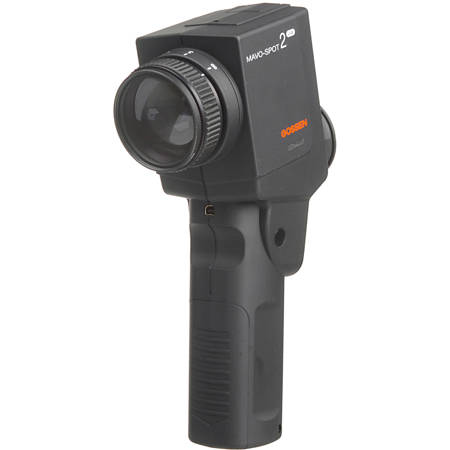
The Gossen Mavo-Spot 2 USB: Luminance 1 deg. Spot Measurement Instrument is a 1 deg. attachment that provides very precise readings for this high-end meter. From a minimum distance of 1m and out to infinity, this accessory can be used to obtain precise luminance readings for many applications involving sports venues, street lighting, museums, projection screens, desk lighting and any architectural need. It can also be used to measure luminance from monitors.
LED Compatibility
One of the most important characteristics of a luxmeter is matching to the sensitivity of the human eye is the spectral luminous efficiency of the human eye in daylight and is defined in DIN 5031. The required matching is accomplished by means of an optical filter whose quality dictates the accuracy class. Permissible deviation is specified in DIN 5032 and DIN EN 13032 for the individual classes