
See Options
Need help? Ask our experts.
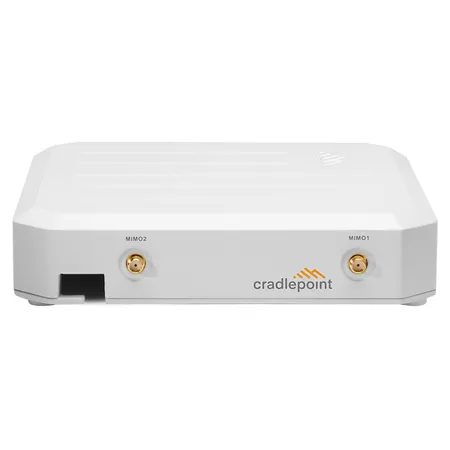
Designed for branches that require the higher performance of 5G and the flexibility of wireless, the Ericsson Cradlepoint W1850 5G wideband adapter ushers in the next generation of Wireless WAN networking. The W-Series is designed to accommodate the diverse spectrums, multiple generations, and breadth of new technologies introduced in 5G while delivering enterprise-class standards of scalability, comprehensive management, and security.
High Performance Wideband
The W1850 5G adapters are purpose-built for deployment in the high-performance low-, mid-band 5G spectrum. To address the tradeoff of lower propagation in the mid-band spectrum, Ericsson designed the W-Series adapter to be placed separately from the router for optimal signal reception. The stylized W1850 5G adapter is designated for optimal indoor placement.
Designed for Enterprise-Class Business
While the performance of 5G is top of mind, the W-Series was also designed with enterprise-class standards for high scalability, comprehensive management, and security. Representing the latest available 5G standards which are a collection of spectrum, technologies, and network infrastructure enhancements, the Ericsson 5G edge networking service and endpoints accommodate the diverse deployments of an organization with hundreds or even tens of thousands of sites.
Notable Benefits
• Increase the size and types of your WAN use cases with 5G performance
• Experience the dependability of dual connectivity with simultaneous 5G and 4G connections
• Gain carrier-class connectivity using a software-defined modem and integrated multilevel test and recovery utilities
• Deploy an enterprise-class 5G solution with greater simplicity and confidence with the wizard-based installation application
• Manage the Ericsson Cradlepoint router and 5G adapter as one entity for singular control and visibility
• Evaluate the benefits of your 5G service with value confirmation tools built into the Ericsson NetCloud platform
• Reduce truck rolls with advanced Out-of-Band Management
• Deploy within any existing networking or SD-WAN environment
Carrier-Class Connectivity
Although each network operator conforms to 3GPP standards, they implement those standards differently to gain optimal efficiency and performance from their network. Additionally, software from modem manufacturers is designed to serve multiple operators within broad markets. The W-Series uses a customized software-defined modem, pre-programmed endpoints, and multilevel integrity testing to predict vulnerable connections and deliver carrier-class connectivity.
5G Spectrum Solutions
The W-Series portfolio supports all spectrum layers ensuring that organizations have the right solution for every location. The W1850 5G adapters support low- and mid-band layers.
Support for a Full Range of Cellular Technologies
Ericsson 5G solutions support all cellular generations, from 4G LTE to Gigabit-Class LTE to 5G - with the ability to gracefully transition tens of thousands of sites between generations as technology becomes available in individual locations.
Complete Lifecycle Management
Ericsson 5G solutions help enterprises minimize complexity from installation to troubleshooting with tools and features such as the mobile installation application, the captive modem feature, 5G tools demonstrate 5G service value, and Out-of-Band Management.
Intelligent Hybrid WAN Connectivity
Ericsson 5G solutions deliver effortless wireless endpoint management in a "wired-first SD-WAN" environment and provides all-in-one capabilities (routing, embedded wireless, and foundational SD-WAN) in a "wireless-first SD-WAN" deployment.