Review Summary
2009-05-17T21:00:00
This is such a well designed camera. The controls are set up so they are right at your fingertips. The display is large and the menus are easy to read. It's a camera you can use quickly if you just need to grab it out of the bag. One feature I like the best is the selectable White balance- I use this all the time. You can choose your own Kelvin setting to achieve nice color effects. It's a great buy!
Cinesparkle
2009-04-05T21:00:00
Excellent primary camera. Meets and exceeds required needs. What can I say: it's a Nikon. Metal body a real plus. Just wish it had the larger sensor found on the D700
GREGG B.
2008-08-29T21:00:00
I use two Nikon bodies, one for my 24-70mm and one for my 70-200mm. One is a D300 and the other is my older D200. The lens I am going to use most that day goes onto my D300 because it gets far better image quality in all conditions when compared to the D200. I was shocked at this actually, because I didn't know that I needed to replace my D200. Gets great image quality for the newspaper all the way up to ISO 3200 which is the most I have had to use on one occasion (I typically use ISO 2000 in low light conditions). The D200 gets really ugly images even at ISO 800. DX formfactor gives me more reach to get closer to my subject and works in the sweetspot of my FX format lenses. I will be buying another D300 to replace the now wholly inadequate D200. I looked at the D700, but again, I prefer the DX format and the loss of quality over the D700 in low light conditions isn't really a problem because newspaper doesn't demand the highest of quality.
Photojournalist g.
2008-08-07T21:00:00
I purchased this camera for the live view and I admit I didn't do enough research. It could never be used for anything but still life! The camera has no lag time at all. I am use to the D80 and absuletely love it. It is going to take me sometime to use the 300 in my work. I just dont have the time to get use to the differences in the 2 cameras. Check out all the details you can find before buying a big camera.
sw
Single-lens reflex digital camera
CompactFlash (CF) Card (Type I and II, UDMA compliant), Microdrive
1) DX AF Nikkor: All functions
2) D-/G-type AF Nikkor (excluding IX Nikkor lenses): All functions (excluding PC Micro-Nikkor)
3) AF Nikkor other than D-/G-type (excluding lenses for F3AF): All functions except 3D-Color Matrix Metering II
4) AI-P Nikkor: All functions except Autofocus, 3D-Color Matrix Metering II
5) Non-CPU AI Nikkor: Can be used in exposure modes A and M; electronic range finder can be used if maximum aperture is f/5.6 or faster
1.5 times lens focal length
CMOS sensor, 23.6 x 15.8 mm; total pixels: 13.1 million; Nikon DX format
12.3 million
13.1 million
Exif 2.21, Compliant DCF 2.0 and DPOF
Storage System: Compressed NEF (RAW): 12-bit compression, TIFF (RGB), JPEG: JPEG baseline-compliant
4,288 x 2,848 [L], 3,216 x 2,136 [M], 2,144 x 1,424 [S]
SLR Type, fixed eye-level Pentaprism type; built-in diopter adjustment (-2.0 to +1.0 m-1)
Eyepoint: 19.5mm (-1.0m-1)
Viewfinder Frame Coverage: Approx. 100% (vertical and horizontal)
Viewfinder Magnification: Approx. 0.94x with 50mm lens at infinity; -1.0m-1
3-in", approx. 920,000-dot (VGA), 170-degree wide viewing angle, 100% frame coverage, low-temperature polysilicon TFT LCD with brightness adjustment
When CPU lens is attached, lens aperture can be stopped down to value selected by user (A and M mode) or value selected by camera (P and S mode)
Full frame 2) Thumbnail (4 or 9 segments) 3) Zoom 4) Slideshow 5) RGB histogram indication 6) Shooting data 7) Highlight point display 8) Auto image rotation
Card format, All photographs delete, Selected photographs delete
TTL phase detection, 51 focus points (15 cross-type sensors) by Nikon Multi-CAM3500DX autofocus module; Detection -1 to +19 EV (ISO 100 at 20°C/68°F); AF fine adjustment possible
Focal plane contrast [in Liveview (Tripod) mode]
Single-servo AF (S); continuous-servo AF (C); manual (M); predictive focus tracking automatically activated according to subject status in continuous-servo AF
TTL full-aperture exposure metering using 1005-pixel RGB sensor
1) 3D Color Matrix Metering II (type G and D lenses); color matrix metering II, color matrix metering
2) Center-weighted: Weight of 75% given to 6, 8, 10, or 13 mm dia. circle in center of frame
3) Spot: Meters approx. 3 mm dia. circle (about 2.0% of frame) centered on selected focus point (on center focus point when non-CPU lens is used)
1) 0 to 20 EV (3D Color Matrix or center-weighted metering)
2) 2 to 20 EV (spot metering) (ISO 100, f/1.4 lens, 20C)
1) Programmed Auto [P] with flexible program 2) Shutter-Priority Auto [S] 3) Aperture Priority Auto [A] 4) Manual [M]
ISO 200 to 3200 in steps of 1/3, 1/2 or 1 EV with additional settings of approx.0.3, 0.5, 0.7 and 1 EV (ISO 100 equivalent) under ISO 200 and approx. 0.3, 0.5, 0.7 and 1 EV (ISO 6400 equivalent) over ISO 3200
+/-5 EV in increments of 1/3, 1/2 or 1 EV
Exposure and/or flash bracketing (2 to 9 exposures in increments of 1/3, 1/2, 2/3 or 1 EV
Auto (TTL white balance with 1,005-pixel RGB sensor), seven manual modes with fine-tuning, color temperature setting, white balance bracketing possible (2 to 9 frames in increments 1-3)
Manual pop-up with button release
(ISO 200, m): approx. 17 (manual 18)
(ISO 100 equivalent, m): approx. 12 (manual 13)
1) TTL: TTL flash control by 1,005-pixel RGB sensor
Built-in Speedlight, SB-800, SB-600 or SB-400: i-TTL balanced fill-flash and standard i-TTL flash
2) AA (Auto Aperture-type) flash: Available with SB-800 used with CPU lens
3) Non-TTL Auto: Available with Speedlights such as SB-800, 28, 27, and 22S
4) Range-priority manual flash; available with SB-800
ISO 519 standard terminal
X=1/250 s; flash synchronization at up to 1/320 s (FP) adjustable with Built-in Speedlight or optional Speedlight (will reduce GN)
Single frame shooting mode - Continuous low speed (CL) shooting mode: 1 to 7 frames per second - Continuous high-speed shooting mode: 8 frames per second
Hi-Speed USB
NTSC or PAL; simultaneous playback from both the video output and on the LCD monitor available
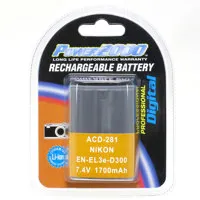
One Rechargeable Li-ion Battery EN-EL3e, Multi-Power Battery Pack MB-D10 (optional) with one Rechargeable Li-ion Battery EN-EL4a, EN-EL4 or EN-EL3e or eight R6/AA-size alkaline (LR6), Ni-MH (HR6), lithium (FR6) batteries, or nickel-manganese ZR6 batteries, AC Adapter EH-5a (optional)
(W x H x D) Approx. 147 x 114 x 74 mm (5.8 x 4.5 x 2.9 in.)
Approx. 825 g (1.82 lbs.) without battery, memory card, body cap, or monitor cover
Temperature: 0-40C/32-104F, Humidity: under 85% (no condensation)
Quick response of 0.13 sec. power-up
45 milliseconds
018208094820


DX Format way to go for photojournalists
By Photojournalist g.
I use two Nikon bodies, one for my 24-70mm and one for my 70-200mm. One is a D300 and the other is my older D200. The lens I am going to use most that day goes onto my D300 because it gets far better image quality in all conditions when compared to the D200. I was shocked at this actually, because I didn't know that I needed to replace my D200. Gets great image quality for the newspaper all the way up to ISO 3200 which is the most I have had to use on one occasion (I typically use ISO 2000 in...
View full Review
What a great Imaging Device
By Cinesparkle
This is such a well designed camera. The controls are set up so they are right at your fingertips. The display is large and the menus are easy to read. It's a camera you can use quickly if you just need to grab it out of the bag. One feature I like the best is the selectable White balance- I use this all the time. You can choose your own Kelvin setting to achieve nice color effects. It's a great buy!
Agility, speed, low noise and spectacular imaging performance converge in the Nikon D300 to create an amazingly versatile D-SLR that, with your imagination, is ready to go to work. A high-resolution 12.3-megapixel, DX-format image sensor with exclusive Nikon EXPEED digital image processing technology captures your vision at up to 6 frames per second. Add the optional MB-D10 grip to boost your speed to 8 FPS!
A fast 51-area AF system is now even smarter when teamed with Nikon's exclusive Scene Recognition System. The SRS provides additional data to Nikon's famous 1,005-pixel RGB 3D Color Matrix Metering II, assuring even more accurate exposures and white balance detection. Of course, the D300 offers precision Center-Weighted and Spot metering control.
Reliable image review and menu access now comes to life with the D300's bright, tempered-glass protected, 170-degree wide-angle, 3-inch, 920,000-dot VGA TFT LCD monitor. The high-resolution LCD is also the D300's viewfinder when either of two LiveView modes is selected, and new Picture Control settings offer precise fine-tuning of your image characteristics. Simply put, the D300 was engineered to exceed expectations.
Join VIP PRO
Earn 2X Points + Exclusive Perks!
Request a Callback
Chat one-on-one with an expert
Sell or Trade your Gear
Get started in 3 easy steps