


Orders placed during Passover Holiday (Wed 4/1 after 4PM ET – Thurs 4/9) will ship Fri 4/10. View our holiday shipping schedule.
This item is no longer available.
Review Summary
2013-10-07T21:00:00
Now discontinued, but still available with a bit of looking, the G3 is a fine picture taker with a decent if not stellar EVF and is available for dirt cheap. I bought this one as a second body. Small, low cost, low profile... What's not to like?
Mendo S.
2012-12-30T19:00:00
I cannot find anything I would change on this model!
CHRISTOPHER F.
2012-08-19T21:00:00
I am a retired photography teacher and do a little bit of everything as to pictures. The camera does a great job in automatic mode. The camera is very versatile when in PASM mode. Allows you liberty to do your own setup. I love the touch screen for pin-point focus of subject. Nice movie mode when you want it. Still not excellent in low light but much better.
NORMAN S.
2012-07-23T21:00:00
I bought the kit for the G3 body but the 14-42 lens was only $30 extra above body alone. I have Olympus EPL-1 and 8 Oly/Panny lenses and wanted eye level VF for animal, bird, and sports action pictures. I use it chiefly with my Panasonic 45-200 zoom (lens is as large as 55-200 for Nikon DSLR) and G3 body balances well with it, much better than with EPL-1. However, the G3 - although small - is bigger than Oly bodies. The kit 14-42 and all the Panasonic zooms are relatively large compared with Oly zooms. I therefore prefer the EPL-1 and Oly lenses for landscape, portrait, general, and street use. With the 14-45 kit lens, color cast is slightly magenta/bluish but acceptable. If you want DSLR type operational features in much smaller size, G3 is fine, half the price of an OMD-E5, and also smaller than the just-announced G5 body.
ROBERT G.
2012-07-15T21:00:00
This camera is my first foray into the mirrorless world. My DSLR is a Pentax K-5 that, while relatively small, can still be quite a handful. I wanted a smaller camera at a reasonable price with a reasonable selection of good lenses and a view finder. This led me first to the micro 4/3 cameras and then to the Panasonic G3 and GH2. Since I don't care about video, the G3 seemed the right camera at the right price. So far I haven't been disappointed.
blue f.
2012-06-29T21:00:00
The touch screen is intuitive--don't let this put you off. The size and weight advantages over a DSLR are huge and airlines are ready to rip you off if you have a large camera bag and a carry-on. The ability to shoot movies with the built-in viewfinder gives the G3 a major advantage over most DSLRs and the mirror system. The Panny lenses have a nice quality feel and seem better than consumer grade Nikon-Canon glass. After years of bulky and heavy Canon and Nikon digital SLRs, I am glad I made the switch--its the size and weight that was the deal maker. My only gripe is the poor battery life--buy a generic for under $20, they are just as good as the overpriced branded unit. I live in the UK and regularly buy from Adorama--5 Star store. I rated the G3 5 stars, not because it is near-perfect but because it is a great all-rounder and for the money just cannot be beaten. I am now a converted touch-screen fan.
Panasonicus
2012-04-01T21:00:00
I use this product for my photography competition
Jyow
2012-04-01T21:00:00
This camera is so versatile, easy to use at any level and is sophisticated for the professional as well. It does it all and the HD videl is surprisingly excellent. A great value...Top performance at a good price.
Tall P.
2012-02-26T19:00:00
The 4/3'rd cameras have really come a long way. I can really say this is a great little camera. I had purchased a Nikon D5100 at the same time and put the two through a side-by-side test. In really pictures, the Lumix G3 came out exactly the same (and even better at times) than the Nikon D5100. In low light, the Lumix G3 (without flash) had a better image and less noise. With flash (sorry G3) the Nikon was better. However, since the G3 did such a good job on low light, the flash was not needed as often. The big kicker here is DSLR quality picutres in a package that can still fit in your coat pocket. The touch screen thing makes it so easy to find a follow for pictures as well as for video. The only bad on the G3 is that there is not an imput for a microphone (if you are into video). However, the G3 gives high quality for the price. The ONLY thing that I didn't like about the G3 is that the shutter sound makes the camera seem cheap. However, the images speak for themselves.
VivaViva
2012-02-05T19:00:00
I've used the camera for a variety of things, some macro, some casual event, a little landscape. Does everything reasonably well with additional lenses. There's quite a lot of configurability but some modes tie config together and some don't. More granularity would be nice. A+M focus is nice but even if you are running AFS with shutter decoupled, you need to run Fn 1 as an AF drive and enable AF Lock you be able to use MF without half pressing the shutter. That's annoying.
JOHN C.
2012-02-05T19:00:00
This is my wife's camera and our second micro-four thirds camera. My other camera is a GH2. I decided to get this for my wife so I could leverage my investment in lenses. We mostly use the 20mm F/1.7 pancake lens on the G3. It's a great camera to take along on family day trips. Light-weight, portable, versatile little camera. I've used this camera with a four-thirds adapter and an Olympus 50mm f/2.0 macro. Great combination for portraits although manual focus works better for the Olympus four-thirds lens. I've used this camera with a PocketWizard to activate off camera flash. I prefer the look of the photos taken at 800 ISO and below but with a little help from Adobe Lightroom, higher ISOa are possible up to 1600. I could be mistaken but I actually think that using 1600 ISO on the G3 gives slightly better results than 1600 ISO on the GH2. I like having the built in viewfinder and the articulated screen. It's a great camera for a great price. Wish it had a little more direct control via dials and buttons to access some settings, but the Quick Menu works well and some of the buttons can be configured.
PAUL C.
2011-10-23T21:00:00
Bought this and am selling my Sony A300 (which was too big and heavy and got left behind too often). Now I have no excuse not to take a camera with me. The kit lens is good enough and combined with the 'extra zoom' (with slight loss of max pixels) has enough range 80-90% of the time. I bought the 45-200mm lens for the shots that NEED a telephoto. Even this lens does not make the camera too heavy.
KENNETH S.
2011-10-10T21:00:00
I bought this, purely as an adjunct to my large 1D Mk III and a number of quality lenses. I sometimes need a lightweight and compact camera when space dictates. I am now getting excited at the amazing range of legacy lens options available for Micro 4-3 and have bought a number of adapters for lenses I have kept for years. I would much rather Panasonic market this camera with the older 14-45 zoom lens.
DAVID M.
2011-09-03T21:00:00
At this price you have all the bells and whistles (e.g. Touch Screen, Swivel LCD screen, Viewfinder...etc) in a small package. Bought it for its viewfinder, which is about the best in its class (of course the up and coming Sony NEX-7 may prove this otherwise) and I use it to compose 90% of the time. Didn't think the touchscreen would get much use but the 'touch and shoot' funtion is more useful than I could imagine. Autofocus is fast, at least in decent light, not sure whether it is the fastest as the Olympus PEN E-P3 just seem a bit more snappy to me in comparison. Ignoring the style (some hate the mini-DSLR style, it just seems it's trying too hard to punch above its weight), the performance is very good and it is certainly very easy to use, except I don't always agree with the Auto ISO setting, where it doesn't always strike a good enough balance between shutter speed and ISO (when in Aperture Priority mode) - there are even times when both the ISO and shutter speed were automatically set far too low for the lighting condition, resulting in some very slightly underexposed shots. Some may argue that the camera allows for a lot of manual fine-tuning, this I agree and the degree of fine tuning available is appreciated, but Aperture-Priority mode is my go-to mode when I need a quick snap without having to worry about the other parameters. I also sold the kit zoom lens very shortly after I got the camera, simply because it doesn't do the camera justice. It is fine as a lens but I am sure you'll see a night and day's difference when you attach some better glass on it, sharpness and contrast in particular (e.g. The Panasonic's own 20mm F1.7 comes to mind). I also noticed that the standard kit zoom lens contributes to the poor Auto ISO performance. All in all, if you are after a competent Micro Four Third body and haven't been lured by the PEN E-P3 styling, you already have/are willing to acquire a better lens, get this and you won't regret (The Auto ISO setting knocks a mark off though).
Copo
Crisp, clear optics!!
By CHRISTOPHER F.
I cannot find anything I would change on this model!
Why buy a 4/3rds without viewfinder?
By Panasonicus
The touch screen is intuitive--don't let this put you off. The size and weight advantages over a DSLR are huge and airlines are ready to rip you off if you have a large camera bag and a carry-on. The ability to shoot movies with the built-in viewfinder gives the G3 a major advantage over most DSLRs and the mirror system. The Panny lenses have a nice quality feel and seem better than consumer grade Nikon-Canon glass. After years of bulky and heavy Canon and Nikon digital SLRs, I am glad I m...
View full Review
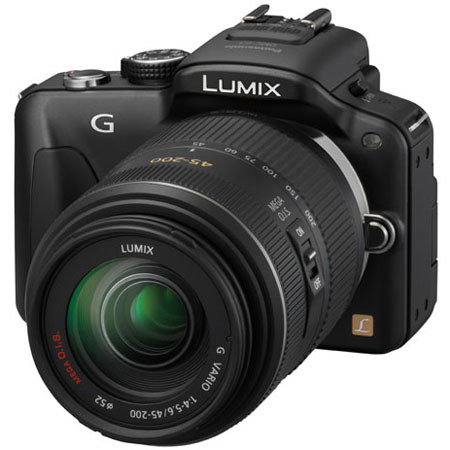
Panasonics LUMIX DMC-G3 offers the benefits of a DSLR interchangeable lens system camera with a point-and-shoot camera's compactness, light weight and simplicity. This reduction in size and weight is thanks to advancements in mirror-free viewfinder technology, and large DSLR format sensors that are more compatible with a new class of compact Micro Four Thirds (MFT) System lenses. This new class of Compact System Cameras (CSC) offers a weight and compactness not seen in traditional DSLRs, for greater portability and creative control. The DMC-G3 image resolution has been upgraded to 16.0 Megapixels from it predecessorthe DMC-G2.
Mode Dial and Hotshoe
The DMC-G3 provides a traditional DSLR-like experience with an external Mode dial for quick access to common modes like Program, Shutter and Aperture Priority, Manual. Additional dial settings include two Custom Modes, Scene Modes and the new Creative Control Mode. The DMC-G3 provides a dedicated video button that can be used to switch to video capture quickly without changing modes. Likemost DSLRs, the DMC-G3 provides a built-in flash and hotshoe for connecting optional LUMIX flashes.
Available Scene Modes: Portrait, Soft Skin, Scenery, Architecture, Sports, Peripheral Defocus, Flower, Food, Objects, Night Portrait, Night Scenery, Illuminations, Baby, Pet, Party and Sunset, which can all be controlled from the intuitive touch-enabled LCD.
Lens Options and 3D Capture
LUMIX G Series Compact System Cameras utilize the Micro Four Thirds (MFT) System mount. MFT offers greater size and weight reduction in the lens without compromising lens performance and clarity. The LUMIX G MFT System offers a selection of 11 high performance fixed focal length and variable aperture G Vario zooms, including a highly versatile 3D lens capable of capturing both 2D and 3D images at the same time. There are lens adaptors available for mounting older Leica M and Leica R lenses, including older LUMIX full Four Thirds lenses. An innovative 14-140mm HD G Vario lens provides the best of video and still-image shooting with a long 10x range and near silent high-speed focusing. When connected to the DMC-G3, ultra fast focusing and auto subject track AF can be achieved.
Many Lumix MFT lenses come with MEGA O.I.S. (Optical Image Stabilization) built-in. This feature helps prevent blurring from hand-shake. Working together with the cameras intelligent ISO Control, which reduces motions blur by adjusting the ISO sensitivity if the subject moves, you're sure to capture images that are sharp.
Dust Reduction System
As with many interchangeable lens cameras, dust on the sensor reduces image clarity. To eliminate this potential, The DMC-G3 uses a Dust Reduction System that uses a supersonic wave filter in front of the Live MOS sensor. Vibrating vertically around 50,000 time per second, the filter repels dust and other particles effectively.
Touch-Enabled LCD Screen
At the heart of the DMC-G3's improved functionality is a movable 3.0-inch LCD (460k- dot) that allows for intuitive touch control of menus and most shooting, focusing, playback and effects controls. Menus can be customized using simple drag-and-drop actions like those on most touch-enabled cell phones. This allows for a custom user interface, giving Quick Menu access to functions that can be tailored to any user's expertise level. Even the shutter can be triggered from the touch-enabled LCD by simply touching the subject you want focused and captured. Using the touch-screen operation, a user can lock onto a subject, enabling AF Tracking in both still and video modes. When you're ready to shoot, the subject will be in focus and ready to capture.
Live Viewfinder
For many, a traditional eyelevel viewfinder is still a must have. The DMC-G3 meets this demand with an eye-level electronic viewfinder that projects a high resolution 1.44m-dot image with 100% field of view (800x600, 0.7x magnification). Color breakup has been improved vs. the DMC-G2, resulting in smooth image viewing while panning.
HD Video Capture
The LUMIX DMC-G3 also shoots 1080/60i High Definition video using the AVCHD format (sensor output 30p). It offers a built-in stereo microphone and is available with Dolby Digital Stereo Creator. Advanced video sound controls include a wind-cut function that further enhances the sound as it helps reduce noise caused by background wind, and an L/R audio meter display for controlling audio levels. Captured video can be played back in High Definition via an optional HDMI mini cable directly to an HD-compatible TV, or easily played directly on Panasonic VIERA TV via the SD card. New near silent focusing features offered in several Lumix Micro Four Thirds lenses helps keep lens noise at bay while the touch-enabled LCD allows you to automatically keep active subjects in focus with touch-enabled subject AF Tracking.
Faster, Accurate Pinpoint Focusing
Contrast Detection Auto Focus technology used in point-and-shoot and new mirrorless Compact System Cameras now approaches the speedsthat were once only available from traditional professional-level DSLRs. The DMC-G3 now offers Light Speed Auto Focus (14-140mm ~0.1sec. 14-42mm ~0.18 sec., 45-200mm ~0.15 sec.). LUMIX Light Speed AF locks onto a subject quickly so you won't suffer from "shutter lag" frustration. Contrast Auto Focusing also offers greater shot accuracy due to fewer hardware components needed vs traditional DSLR phase difference systems, thus fewer pictures will suffer from system focusing errors. (e.g. the accuracy of Contrast AF is approx. 90% while Phase Difference AF is approx. 60% at F1.4).