

This item is no longer available.
Review Summary
2010-11-07T19:00:00
[...]results to date: very impressive for a sensor that is only 25mm2. For a pocket camera, the TS7's lens is very impressive and the processor results in impressive JPEGs. Not as good as my D80's images but embarrassingly comparable at times. I also find the TS7's video impressive – perhaps I'm easily pleased. It does not have the 'cinematic' quality of say a D300s but the TS7 results in very good 'footage' - of (grand)kids and family pets in my case to date. My point is that this keeps the family happy and these results are easily obtained – job done and cheaply at that.BTW: this aspect of reasonable HD video from the TS7 does have a downside. It even looks good on our Sony Bravia 40 inch screen. So much so that when my financial controller notes both the acceptable video from the TS7 and the still-excellent results from the D80, she wonders very aloud why I need a Nikon D7000 body. My problem, I guess.Thirdly – the GPS functionality: is likewise impressive for so small a part of what is already a small camera. I upgraded the firmware and (when out and about) find that the lock-on time is not far behind my Garmin Oregon 300 with Topo Australia and BirdsEye local imagery loaded. I regard the Garmin as more accurate (very good results when tested once on known trigonometric stations) but the little TS7 is only 0.1" to 0.4" of arc out with respect to the Garmin Oregon 300 – that deserves an excellent rating as well.The TS7's geotagging facility is useful for any fieldwork that requires a report – it should not replace a GPS and good field notes but it is useful confirmation – just remember that it records the camera's position which may at times be removed from the subject's position. I anticipate arriving at a field location (in my case an interesting rock outcrop), taking some geotagged 'location' photos and perhaps a video with the TS7, then writing up my observations, then finally taking 'serious' photos with my D80 (usually with the 18-200VR Nikkor). Essentially, I see my TS7 complementing my DSLR gear, not replacing it. Only a few 'Cons' to date: (1) some of the TS7's on-screen symbols are not graphically intuitive (at least to my 'Nikon-brain'): I can only wonder at the brain that designed and programmed the "Intelligent Exposure" symbol (a half-infilled semi-circle) – clearly I recommend steering clear of "Low Intelligent Exposure". Really! (2) I do miss not having the full published manual – Baby Boomers need published manuals.[...]
Roger C.
2010-06-23T21:00:00
I have only had the camera for a short time but I like that they have thought out how to get to different setting easily.
PETER H.
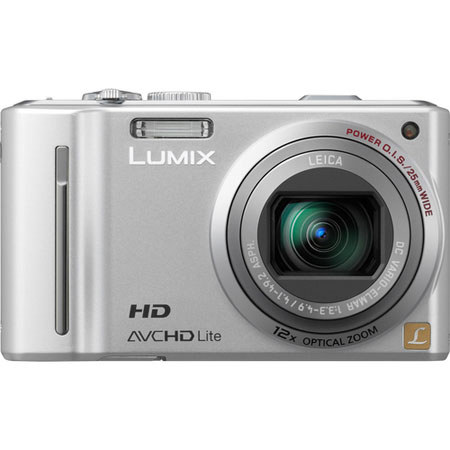
The Panasonic DMC-ZS7 features a 25mm ultra wide-angle 12x optical zoom f/3.3-4.9 LEICA DC VARIO-ELMAR lens (35mm camera equivalent: 25-300mm). Incorporating Panasonic's advanced optical technologies, this lens system is comprised of 10 elements in 8 groups, with 2 ED (Extra Low Dispersion) lenses and 2 aspherical lenses / 3 aspherical surfaces while preserving compactness.
The DMC-ZS7 features a powerful 12x optical zoom lens (35mm camera equivalent: 25-300mm). This gives you highly natural expressions from people and animals that you can't get close to. It is also available in movie recording with the mechanism designed to minimize the noise of auto focusing or zooming. And its slim, compact, pocket-sized body can easily go wherever you do - for both everyday snapshots and traveling.
The DMC-ZS7 features a large 1/2.33-inch CCD. Conventional cameras generally use almost the entire CCD area when recording an image. The DMC-ZS7, however, employs a 1/2.33-inch CCD with a total resolution of 14.5-megapixel. n addition to Motion JPEG images, the DMC-ZS7 can record high-definition motion images in AVCHD Lite. P
Join VIP PRO
Earn 2X Points + Exclusive Perks!
Request a Callback
Chat one-on-one with an expert
Sell or Trade your Gear
Get started in 3 easy steps