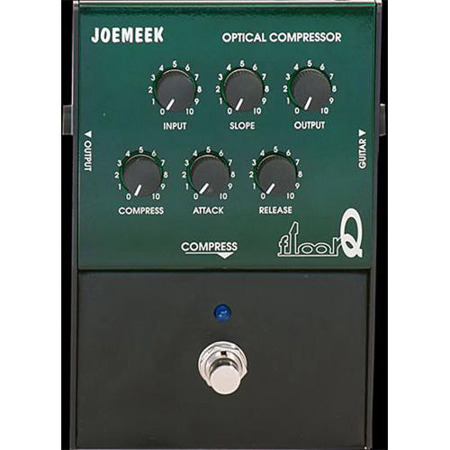
Joe Meek FloorQ Guitar and Bass Compression Pedal
SKU: JMFLOORQ
This item is no longer available.
Share:
Overview
Compare
Specs
Protection
About Joe Meek FLOORQ
The floorQ is basically a Joemeek Optical Compressor in a pedal. "We realized that a lot of guitarists and bass players were buying their studio gear such as the twinQ - just to put their guitars through" says PMI President Alan Hyatt. "They loved what the compressor did for their sound but it wasn't very practical from a live performance point of view. Actually the same circuit is in their small threeQ box but it still ain't a pedal, so they decided to give them one!" The floorQ also boasts a high impedance JFET input, Class-A preamplifier with an Input Level control, so even with the Compressor switched out, the pedal makes an excellent front end and level matcher for all types of guitar amps.
The JOEMEEK floorQ is a professional studio compressor in compact pedal format. It takes an instrument such as an electric guitar or bass guitar, amplifies it, compresses it and restores average volume after compression. floorQ give the gloss of a professional studio production to all your performances. It is equally at home both live and in the studio. Think of the floorQ as two separate items of equipment:
• A Preamplifier
• A JOEMEEK Optical Compressor
Preamp
This is the all-important front end to the floorQ. Its job is to accept any type of instrument and make it loud enough. It has a very high input impedance, making it suitable for all types of guitar pick-up, including piezo (crystal) acoustic pick-ups. There is just one control, 'INPUT', which covers a range of amplification from 0dB (unity) to 20dB. This accommodates the wide variation in levels that come from different kinds of guitars and acts as a level matcher between guitar and guitar amplifier. It is active whether or not the Compressor is turned on, so that the floorQ always sends the correct guitar volume to the power amplifier. The preamp is an extremely high quality, low noise, Class-A design that will be appreciated by audiophile musicians and engineers looking for a clean sound.
Compressor
The PhotoOptical Compressor is what gives Joemeek products their unique character. Its job is to make quiet sounds louder and loud sounds quieter or in other words to reduce the dynamic range of the programme material. It's a bit like manually riding the volume control, except the compressor does it automatically, responding far quicker and more accurately than you ever could by hand. The compressor is applied in several ways:
Make Instruments Stand Out
Because compressors make loud sounds quieter, you can boost the volume of the quiet bits without the loud bits getting even louder. That means you can raise the average level of an instrument in the mix, which has the effect of lifting it and bringing it forwards. This makes an instrument sound denser and playing seem more even, for "produced" results.
Protection
Fast response times are used to control peaks. In other words if an occasional peak sticks its head above a maximum permitted level, the compressor clobbers it; this is known as limiting and a compressor designed solely for this purpose is known as a Limiter. Limiters are used to protect recorders, loudspeakers and peoples' hearing from overload.
Modification
A compressor can change the dynamics or "envelope" of the instrument and it is here that the Joemeek Compressor excels! A common use for this is to increase sustain without adding distortion.
Types of Compressor
Most compressors work in essentially the same way: a volume-controlling element or "gain cell" is inserted into the audio signal path. The level of the signal at any given moment is measured and that information is used to control the gain cell. So if the signal gets bigger, the volume is turned down. Various types of gain cell in common use include FETs, valves (tubes), light-dependent-resistors (photoelectric - that's their digital potentiometers and voltage-controlled-amplifiers, better known as VCAs.
The floorQ Compressor is a unique recreation of the sort of photoelectric compressor used by record producer Joe Meek in the 1960's. Using modern components for consistency and reliability, it nonetheless reproduces faithfully the same punchy sound that was so characteristic of the pop records of that time.
Compression Ratio
What?? OK, it's simpler than it sounds. If the input gets 10dB louder but the output only increases by 5dB then the compression ratio is "2 to 1". If the input goes up 10dB but the output only goes up 1dB, then the compression ratio is "10 to 1". In a theoretically ideal compressor, this ratio is the same for any size of signal above the threshold but for that to be true, the gain cell and its control circuitry must be perfectly linear over a very wide range. In practice only compressors based on VCAs and digital potentiometers are likely to behave in this way.
Some compressors have a control to set the ratio anywhere between 1:1 (ie: no compression) and 20:1 (which would be regarded as a "brick wall limiter"). In the floorQ the "Slope" or "Compression Ratio" is variable from 1:1 (ie: no compression) to 10:1. However that's not all there is to it.
Variable Ratio
In the Joemeek optical compressor the compression 'threshold' is not clearly defined and the compression ratio varies with the amount of compression applied. Suppose the 'SLOPE' control is set half-way (5:1). For signals only just exceeding threshold, the ratio is little more than 1:1. As the compressor is driven harder, the ratio rises to 5:1, at least up to a point. It is a feature of the Joemeek compressor that the compression ratio actually reduces again during large transients and, adjusted correctly, this helps to retain brightness that is often lost with other types of compressor. This is why vintage compressors often sound more lively than their modern counterparts.
Compress
Sets the level of signal (the "Threshold") above which the signal starts to be compressed. Turning the compression control clockwise lowers the compression threshold and drives the compressor harder.
Slope
Sets the average compression ratio applied to signals above threshold. Lower settings (anti-clockwise) have less effect. Turning the control clockwise increases the ratio and makes the effects of compression more dramatic. At maximum (10:1) ratio the Joemeek compressor effectively becomes a limiter.
Attack
Sets how quickly the compressor reacts to peaks above threshold. Turn this control anticlockwise for a quick response. Slower (clockwise) allows the fast leading edge of percussive sounds to pass uncompressed for a moment, before the compressor reacts to control the gain. This example of "changing the envelope" of a sound makes instruments sound more percussive. Settings around mid-position are used where the compression needs to be less obvious. Faster attack times (anti-clockwise) in conjunction with large amounts of compression, result in extreme "pumping" effects.
Release
Sets how long the compressor goes on squashing the sound for, once the signal has dropped below threshold. If it stopped instantly there would be very noticeable modulation or "pumping" of the sound. Generally, the longer the Release time, the less obvious is the compression. Of course some "pumping" might actually be desirable as a special effect and that is another way in which the envelope of a sound can be modified. The floorQ Release is variable from 0.1 seconds up to 3 seconds giving a wide variety of effects.
Output
Sets a static amount of amplification, to restore the level of the signal after compression. Correctly adjusted, there will be no change in perceived volume as the footswitch is operated.