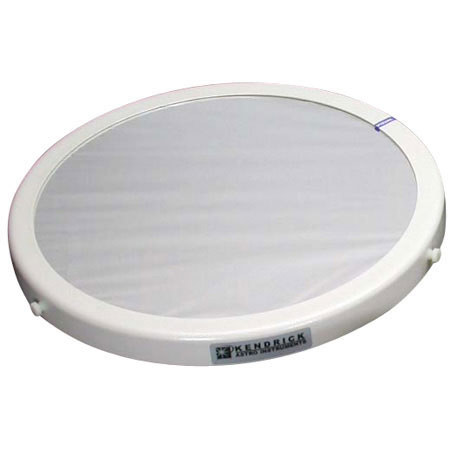
Kendrick Baader Visual & Photographic Solar Filter for Celestron 8" Dobsonian Telescope & fits Tubes with ODs 270mm to 280mm
SKU: KDSCN8DOB
This item is no longer available.
Share:
Overview
Compare
Specs
Protection
About Kendrick 6015A Baader Visual, Photographic Solar Filter
Kendrick "Baader" Astro Solar Filters are full aperture filters (some are "Off Axis" type, if indicated) for all the most commonly used telescopes in amateur astronomy.
The cells are aluminum and all have three nylon thumb screws to facilitate a secure fit on the front of your telescope. The filter material itself is the famous BAADER AstroSolar Film.
This film has set a new standard for white light filters and gives a very pleasing and high resolution image. The image color is a bluish white.
Optical quality: This highest precision film consistently produces strehl ratios of 94 to 96 percent at interferometric tests - thus it performs optically like a Fluorite Triplet Lens by Carl Zeiss or Astro Physics (Interferometric test results).
With Baader AstroSolar filters the Sun appears in it's real color - Neutral White. Other films and most glass filters produce a blurry Bluish or Reddish Solar image, thereby cutting part of the spectrum. Especially with an Orange Sun, it is very hard to see faculae regions which are visible predominantly in the Blue wing of the spectrum.
Eye safety: AstroSolar is essentially free from pinholes, since - other than with even the most expensive glass filters - it is coated on both sides, so that the chance of two pinholes overlapping each other is extremely faint. Baader AstroSolar safety film has been approved for eye safety by the National Bureau of Standards in Germany, the PTB. Unlike any other Solar Filter on the market, AstroSolar is CE-tested according to EG-Norm 89/686 and EN 169/92 ( notified body 0196). All processes connected to this product have been thoroughly tested. Coatings are inspected constantly for consistency to ensure your eye safety!
With a Baader Astro Solarfilter you are set to see the Sun's hidden grandeur at a fraction of the cost for comparable equipment. Real professional solar work was always restricted to a few dedicated amateurs who would put up the $1000 or more for a real precision 1/20 wave glass filter or 2" Herschel wedge.
The development of AstroSolar was only possible due to the incredible demand during the 1999 eclipse. Dozens of miles of film were destroyed during tests to produce the tooling and process techniques to receive an absolutely uniform molecular structure for the substrate. Not to speak of the related treatments, annealing and dual side coating that the film undergoes until it has attained the desired properties.