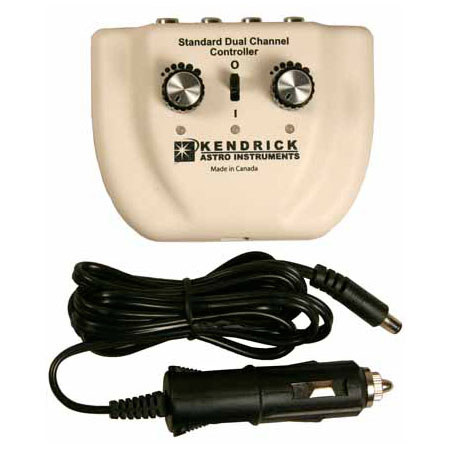
Kendrick 2001 Standard Dual Channel Controller with 4 Outputs, 14 Amps Maximum, 12VDC
SKU: KDSDCC
This item is no longer available.
Share:
Overview
Compare
Specs
Protection
About Kendrick 2001 Standard Dual Channel Controller
The Kendrick standard dual channel dew heater controller is simple, easy to use, compact and lightweight. It has four 12 VDC power outputs with a total 14 amp capacity. There are two separate control knobs, each knob controlling two outputs over a 0% to 100% power range. There is a tactile click indication at 50% power on both knobs. The sleek plastic case measures 3" long x 4" wide x 1.35" deep (1.75" counting the control knobs). There are two LED indicators, one for each channel, to show when the power is on. The controller has a fused male cigarette lighter plug on a detachable 6' long cord. This allows connection to a car's cigarette lighter plug or (preferably) a rechargeable 12V DC battery (to avoid accidentally draining your car battery and leaving you stuck at your dark sky site after a night of observing). The Kendrick standard controller is fused onboard. There are four RCA jacks on the controller into which you can plug your heater strips. With the addition of an optional RCA splitter cord or cords, 5 to 6 heaters can be attached, as long as you don't exceed the maximum output capacity of the controller. This would allow you, for example, to use heaters for the main objective of a small scope, both ends of a finder or guide scope, an eyepiece and a Telrad.
This Kendrick standard controller uses MOSFET (metal oxide semiconductor field effect transistor) transistors in the controller circuit board and each power output so there are no voltage drops. This gives you the best possible performance out of your heater strips. There is a low voltage cut-off control with an LED indicator light (a Kendrick standard) and there is an LED overcurrent indicator at both outputs. In addition, the Kendrick controller is reverse polarity protected.
The power output from the Kendrick controller can be varied from 0% to 100%. As the controller is a Pulse Width Modulation duty cycle switch, it controls the power going to your heaters by turning the power on and off many times each minute. When the controller is set to the 50% point, for example, the heaters draw the same amount of current whenever they are on, but they are on only 50% of the time. Low to medium is the recommended setting for most observing conditions. The controller is RFI (radio frequency interference) free, an absolute necessity if you are digital imager.