


This item is no longer available.
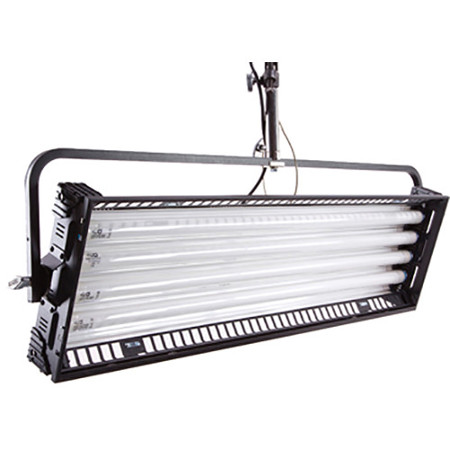
The Image 47 DMX, produces the same quality of light, with the same light control and beam spread features, but uses half the energy. The Image 47 works ideally on bluescreen and green screen stages that are no more than 15' in height.
• DMX lamp switching
• HO/Standard switching
• Individual lamp control
• Universal input 100VAC-240VAC
• Gel Frame, Louver
• Instant-on, dead quiet
• True-Match daylight and tungsten lamps
The Image 47 has distinct advantages over conventional quartz soft lights:
• Metal alloy fixture includes gel frame, louver and cardholders
• Broad, even light - ideal for blue and green screen
• Low amperage draw, energy savings
• Universal input 100VAC-240VAC
• Long lamp life, low lamp replacements, low maintenance labor
• Low operating temperature
• Low air-conditioning costs
• More efficient heat management design for stable color temperature
• Uses 5500K, 3200K and 2900K, 420nm blue and 525nm green lamps
• Mix lamps for various color temperatures
• High color rendering True Match lamps work well alongside conventional quartz lights or HMI's.
• DMX control for stable color temperature and light level control
• Color Gels do not burn out or fade due to lower heat of fixture.
• Traditional Yoke Mount with two position setting
The Image 47 is a soft, broad lighting source. The Image 47 is the same light output as the 4ft 4Bank. The advantage for some applications is that the Image 47 has a built-in, onboard ballast. It also has DMX control and Yoke Mount. So for news studios and smaller virtual studios, it is the ideal light source. Each Image 47 comes complete with Silver Louver, Gel Frame and four cardholders.
Gel Frame
The gel frame is secured to the fixture by 4 spring-loaded pins.
Applying Gel to Frame
The Gel Frame comes with Gel Clips. Cut the gel to size and use the Clips to fasten the gel to the Frame.
Louver
Place the long edge of the Louver into the lower channel containing a set of leaf springs. Press down on the Louver and slip the upper edge of the Louver into the upper channel of the fixture.
Barndoors
Barndoors are sold as accessories in sets of four (BRD-I80) or (BRD-I40). The Barndoors are designed so that they can be individually mounted.
Cardholders
Four cardholders are included with the Image 47. If a larger cutter is needed to control the light, foam core can be used and simply clipped to the cardholders.
The Kino Flo Lamps
The Image 47 DMX is the brains and the lamps are the beauty of the Image 47. The vaunted T-12 tube offers a large surface area of soft light. The wide design creates a nearly shadow less display that drops off evenly. It's important to know that the True Match daylight and tungsten 4ft tubes common on sets around the world are unique to Kino Flo because they display broad, even, color-correct light that cinematographers have come to depend on. These are the only high color rendering fluorescent lamps made for the professional film and video production. In addition, Kino Flo has developed its own line of visual effects and designer colors for Blue and Green screen and Virtual Studios.
The Image 47 DMX will operate any 4ft T-12 tube but the color will not be true and the life span will be shorter. All True Match lamps used in the Image fixture are available safety-coated. Safety-coating protects the user from broken glass if the tube breaks. Safety-coated lamps are required for Rental and Location applications. For permanent installations or Studio applications such as TV Broadcast, uncoated lamps are recommended.
Image 47 DMX Advantage
Long Lamp Life
Kino Flo uses 800ma cathodes on all its 4ft lamps to stand up to the higher output achieved by the Kino Flo ballast. Additionally, the 800ma cathodes are also designed to relieve the stress of on/off cycles, especially on DMX products. In some cases, the DMX operator may set the units on a "chase mode" or other effect that increases the on/off cycles of the lamps. All fluorescent lamps display a lumen depreciation curve. This means that over months of use the light output gradually drops and lowers in color temperature. A lamp may be rated at 10000 to 20000 hours but its useful light quality is shorter. It is realistically more in the 2000 to 2500 hour range. In a Studio environment this adds up to about one year of continuous use.
True Match lamps are formulated to correspond to the spectral distribution curves of film and television cameras as well as look correct to the eye. They are designed to match the colors from studio quartz units or daylight sources such as HMI's. This gives the lighting director the option of mixing quartz hard light sources with fluorescent soft sources. Most lighting designers want the ability to use both qualities of light to enhance the set.
Architectural lamps are designed to optimize government-mandated standards for lumens per Watt efficiencies (energy savings targets). In order to achieve these standards the lamps contain high levels of green spectrum, which our eyes don't perceive as inaccurate. Film and television cameras do record this added green. For example, this renders for a Caucasian skin tone as grayish and unattractive. The architectural lamps do not match with other studio lamps. They render colors inaccurately and make correction in post almost impossible.
Heat Management Design
For Kino Flo, heat management is a critical design element of fixture design. The physical heat of the lamp or the buildup of heat within the fixture will directly influence the color temperature, lumen performance and lamp life. The Image series fixture design addresses these requirements:
• Two special cooling chambers at opposite ends of the fixture provide ventilation
• The Reflector is ventilated near the cathodes (hottest spot) of the lamps
• The lamps are properly spaced apart to maximize light output from the reflector and minimize heat buildup
A well maintained lamp temperature extends the lumen maintenance, color temperature and life of a lamp.
Reflector Design
The Image 47 is designed as soft, broad sources. Therefore, the reflector is a shallow flat reflector to maximize the disbursement of the light coming from the T-12 Lamps. The reflector is made of aluminum with a mirror-like finish. It is also vented near the lamp cathodes to prevent the buildup of heat. Another great advantage of Kino Flo reflectors over conventional quartz soft lights is that quartz soft lights rely on white painted reflectors that yellow and affect the color temperature.
Yoke Mount
The traditional Yoke Mount was designed to allow the yoke brackets to be placed in one of two positions. The additional option is useful when hanging the units in a studio with a low ceiling. The Image 47 Yoke Mount can be mounted to a junior receiver (28mm) using MTP-I80. Another option for the Image 47 Yoke Mount is to mount to a baby pin (16mm) using MTP-I40. Both assemblies are sold separately.
DMX Control
The Image 47 can be controlled through a DMX 512/1990 digital protocol. They do not require dimmer racks. This saves capital costs as well as energy costs. Most studios are designed with dimmer racks that are regulated from a lighting board. The lighting board sends out a DMX signal to the rack that adjusts the voltage to the lamps through pulse width modulation. The more quartz lights are used, more dimmer racks need to be added. These racks generate heat and noise and require a special soundproof room.
Studios using Kino Flos can rely on a simple DMX lighting board to control the fixtures. The dimming electronics are contained in the fixture and do not require expensive dimmer racks to adjust line voltage. The DMX signal regulates the dimming levels. There is no additional noise or heat generated by this process. Small studios can use dimmer control boards.
The versatility of the Image 47 allows the user to control all lamps or individual lamps through DMX control. This is especially useful when lighting blue and green screens or achieving light effects like flickering, chasing or creating light patterns. With the additional "Auto Terminate" feature, the last fixture that does not have an XLR cable attached to the DMX "Out" port will automatically terminate. This can be a timesaver as it takes the guesswork out of knowing which DMX fixture is the last one that needs to be "closed" or "terminated" for proper DMX signals.