
This item is no longer available.
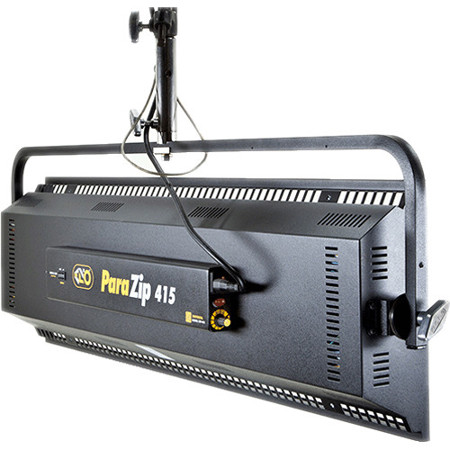
The ParaZip 415 luminaires complement the expanding line of Kino Flo soft light fixtures for television broadcast studios. The sleek ParaZips display a wide, soft beam of incandescent or daylight quality light (CRI 95) that can be dimmed up or down. The ParaZip 415 has switching and dimming controls. This fixture features an universal voltage from 100-240VAC and include auto terminate for DMX.
• DMX and manual dimming
• DMX Auto Terminate
• Universal voltage 100 to 240VAC
• Parabolic intensifying reflector
• Gel Frame
• Focusing Louver
• True Match daylight and tungsten lamps
ParaZip Highlights
• Low amperage draw, energy savings
• Long lamp life, low lamp replacements, low maintenance labor
• Low operating temperature
• Low air-conditioning costs
• More efficient heat management design for stable color temperature
• Full spectrum (CRI 95) lamps available in 3200K and 5500K
• Kino Flo 55W lamps also available in 420nm blue and 550nm green for blue and green screen applications
• High color rendering True Match lamps work well alongside conventional quartz lights or HMI's
• Universal voltage 100VAC to 240VAC
• DMX control for stable color temperature and light level control
• Auto Terminate for DMX
• Color gels do not burn out or fade due to low heat of fixture
• Traditional Yoke Mount with two position setting, Pole-Op
• Honeycomb louvers 90°, 60° and 45° reduce the need for barndoors
The ParaZip is the ParaBeam's younger Brother with many common features. The main difference with the ParaZip is that the ParaZip's lamps are stacked in a linear fashion. This gives the ParaZip a longer, more shallow profile ideal for low ceiling applications. The ParaZip is a directional softlight ideally suited for today's rigorous demands for high quality color-correct, cool lighting for HD television. With the introduction of HD broadcasts, it has become highly evident that the quality of light is more critical than ever. Every imperfection and detail of camera talent is now up for scrutiny. Traditional hard light can exaggerate those textural details. Soft light can subdue those same textures and render a more cosmetic appearance.
The ParaZips afford lighting designers the necessary light control required for a studio environment. The lamps are dimmable from 100% to 5% as well as switchable (turning on/off two lamps at a time) from a lighting board through DMX. The ParaZip fixtures run on universal voltage from 100-240VAC and can be used anywhere in the world. The instrument can be tilted and panned as well as rotated to take full advantage of the lateral beam. Varying degrees of louvers (90°, 60°, 45°) reduce the need for barndoors and help create a soft edge.
The sleek profile is well suited for a low ceiling studio environment. The parabolic louver design eliminates the necessity of adding intensifiers. In small studios a narrow design also allows other fixtures to operate within close proximity. The fixture is not encumbered with long barndoors or intensifiers. The selection of the appropriate louver 90°, 60° or 45° is more efficient than barndoors. Intensifiers are necessary in fixture designs that have inefficient reflectors and where lamps are too closely spaced. A Gel Frame is provided to hold colored gels or for standard theatrical diffusion materials. A Honeycomb 90° Louver is included with all ParaZip fixtures.
The Yoke Mount
The traditional ParaZip 415 Yoke Mount fixtures was designed to allow the yoke brackets to be placed in one of two positions. The additional option is useful when hanging the units in a studio with a low ceiling. The ParaZips with Yoke Mount can be mounted to a baby pin using (MTP-I40) Baby Receiver Assembly (16mm) or to a junior receiver using (MTP-I80) Junior Pin Assembly (28mm) (both sold separately).
ParaZip Advantage
Long Lamp Life
Lamp life of a compact fluorescent for the television and motion picture industry is determined more by its lumen maintenance than by its actual "burn time". All fluorescent lamps display a lumen depreciation curve. This means that over time the light output gradually drops and lowers in color temperature. A lamp may be rated at 10,000 to 20,000 hours but its useful light quality is shorter. It is realistically more in the 2000 to 2500 hour range. In a Studio environment this adds up to about 1 year of continuous use.
All fluorescent lamps require some "burn in" time before they operate at their rated Kelvin temperature and brightness. For dimming products, the lamps perform best after 100 hours of operation.
True Match Color-Correct Lamps
True Match lamps are formulated to correspond to the spectral distribution curves of film and television cameras as well as look correct to the eye. They are designed to match the colors from studio quartz units or daylight sources such as HMI's. This gives the lighting director the option of mixing quartz hard light sources with fluorescent soft sources. Most lighting designers want the ability to use both qualities of light to enhance the set.
Architectural lamps are designed to optimize government-mandated standards for lumens per Watt efficiencies (energy savings targets). In order to achieve these standards the lamps contain high levels of green spectrum, which our eyes don't perceive as inaccurate. Film and television cameras do record this added green. For example, green renders a Caucasian skin tone as grayish and unattractive. The architectural lamps do not match with other studio lamps. They render colors inaccurately and make correction in post almost impossible.
In 1995 Kino Flo received a technical achievement award from the Academy of Motion Picture Arts and Sciences for the development of the first color-correct lamps for film. Kino Flo continues to be a leader in the industry introducing new developments and constantly improving the efficiencies and formulations of its lamp technology.
Heat Management Design
For Kino Flo heat management is a critical design element of fixture design. The physical heat of the lamp directly influences color temperature and lumen performance and lamp life. In order to maintain a stable color performance the lamp requires:
• A cool spot at the tip of the lamp
• A horizontal orientation or a vertical orientation where the base of the lamp is above the lamp tip
The ParaZip design addresses these requirements:
• Two special cooling chambers at opposite ends of the fixture provide ventilation. This ensures that the heat from the lamp is drawn out of the fixture and away from the body of the lamp. A temperature-stabilized lamp will provide consistent color performance.
• The deep parabolic reflector further prevents the heat from lower lamps to be transmitted to the lamps above. A well maintained lamp temperature extends the lumen maintenance, color temperature and life of a lamp.
Reflector Design
The parabolic reflector design puts out a narrow lateral beam. When lighting a news set you very often are lighting two to three people at a news desk. The effective area to be lighted is a broad rectangle. With conventional lights, the lighting projection would be a large round area. Barndoors or flags would be used to remove the light from above and below the rectangular area. This constitutes tremendous loss of light and efficiency. The ParaZip puts the light where it is needed most. Barndoors or flags can still be used to eliminate spill above and below the rectangular area without reducing the efficiency of the instrument.
Another great advantage of the ParaZip over conventional quartz softlight units is the efficiency of the reflector design. Quartz soft lights rely on a white painted reflector that yellows and gathers dust. This alters the color temperature and reduces light output. The drop off is much like a bounce card. For this reason soft lights have to work close to their subject matter. The ParaZip reflector is a precision design using highly reflective material that is shaped to project a beam of soft light at a focal distance of about 16 feet (5m). This explains how 220 Watts of good design can equal 2000 Watts of inefficient design.
Reflector designs by other manufacturers of fluorescents tend to be shallow and inefficient. In order to get more light output, they add expensive and time consuming accessories called intensifiers. These are large reflector panels that attach to the four sides of the fixture. They make the fixture twice as big and add unnecessary cost.
High Efficiency Output
The ParaZip's lumens per watt out performs all other units in the market. Photometric performance is very important. It is also important to note that other manufacturers use high green-spiked lamps to artificially boost their photometric values.
DMX Control
The ParaZips can be controlled through a DMX 512 digital protocol and have an Auto Terminate feature. They do not require dimmer racks. This saves capital costs as well as energy costs.
Most studios are designed with dimmer racks that are regulated from a lighting board. The lighting board sends out a DMX signal to the rack that adjusts the voltage to the lamps through pulse width modulation. The more quartz lights are used, more dimmer racks need to be added. These racks generate heat and noise and require a special soundproof room.
Studios using Kino Flos can rely on a simple DMX lighting board to control the fixtures. The dimming electronics are contained in the fixture and do not require expensive dimm