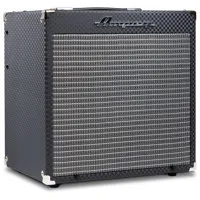
Bass amplifiers
Your choice of bass amp depends on the sound you want, where you’ll be playing, and of course your budget.
Combo amp or stack?
“Combo” amps have a single cabinet that includes both an amplifier that processes your instrument’s electrical signal and adds electrical wattage, and one or more speakers. The smallest, lowest-priced practice amps are combos, but combos can also be quite large.
You can buy separate amp “heads” as well, and they require separate speaker cabinets. These “stack” units are more interchangeable, and they’re usually larger and more powerful.
Solid-state or tube?
Whether you get a combo or a stack, you’ll need to choose between a vacuum tube or solid-state powered amp. Many players prefer tube amps for their classic, warm tones, but they can be heavier, more fragile, more expensive, and require more upkeep.
Solid-state amps use transistors instead of tubes, and are usually lighter and less expensive. Some solid-state amps can also be “modelling” amps, which use digital technology to replicate classic tube sounds and other effects.
Wattage and speaker size
Because they process longer sound wavelengths, bass amps require more watts for power than guitar amps for equivalent volume levels. Typical guitar amps are usually 100W or lower, while bass amps can range up to 400W.
Bass amps also benefit from larger speakers, because they need to push more air. Although the most basic practice amps have speakers as small as 8”, players with stacks or large combos prefer various combinations of 10”, 12”, and 15” speakers to really move with the low wavelengths.