
This item is no longer available.
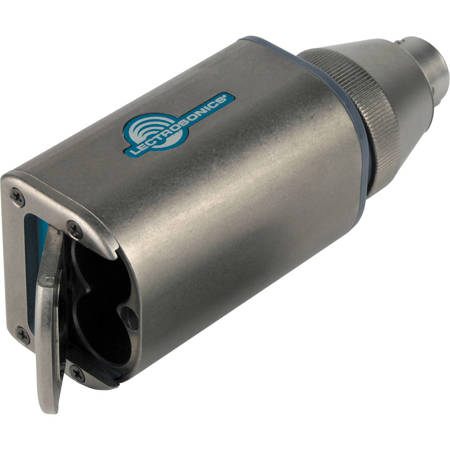
The HM plug-on transmitter features a DSP-based Digital Hybrid Wireless design that allows the transmitter to operate in its native, compandor-free hybrid mode or in compatibility modes for IFB products. The body of the transmitter is machined from a solid billet and finished in a Teflon impregnated nickel plating for the ruggedness needed in field production. A unique multi-voltage phantom power feature allows the transmitter to be used with virtually any microphone, including high-current condenser types, expanding its usefulness in high-end applications such as motion picture production.
Membrane switches and a backlit LCD are used for setup and operation. The control panel can be locked out to prevent inadvertent changes. The firmware will remember" the previous power state when the batteries are replaced and automatically return to the previous settings. The RF output circuit includes a one-way isolator to greatly reduce RF intermodulation produced when multiple transmitters are used in close proximity to one another (a meter or so apart). The isolator also provides additional RF output stage protection from static shock.
• Converts microphones with XLR jacks to wireless operation
• Backlit LCD and membrane switches
• Selectable 5, 18 and 48 volt phantom power plus off position for dynamic microphones
• Adjustable low frequency roll-off
• Powered by two AA batteries
• 256 synthesized UHF frequencies
• 50 mW output power
• Rugged machined aluminum housing
The input amplifier uses an ultra low noise op-amp, gain controlled with a DSP-based wide range, dual envelope limiter to provide over 30 dB of headroom above full modulation. A 24-bit A-D converter digitizes the audio, then filters supersonic noise above 21 kHz. The resulting signal is encoded with a proprietary algorithm to produce an analog data signal for RF transmission. The underlying RF link is an optimized FM system with +/-50 kHz deviation for a high signal to noise ratio and wide dynamic range.
The antenna is formed between the lower housing of the transmitter and the attached microphone. It functions as a dipole radiator when attached to a handheld microphone and similar to a ground plane antenna when connected into a mixer. The conical shaped collar on the input coupler is made of DuPont Delrin to improve the ERP of the antenna in the uppermost frequency blocks.
The DSP eliminates the need for fragile crystals, plus it allows a different pilot tone for each of the 256 frequencies in the tuning range of a system's frequency block. Individual pilot tones virtually eliminate squelch problems in multichannel systems where a pilot tone signal can appear in the wrong receiver via intermodulation. A DSP compatibility mode allows the HM to also be used with Lectrosonics IFB receivers for special applications. The battery compartment door is hinged to the housing and remains attached to the transmitter when opened. It securely latches in place and applies pressure to the batteries when closed. The two AA batteries are connected in series through a conductive plate on the door.
Setup and adjustments are made with the control panel membrane switches and LCD. The transmitter can be powered up with the RF output turned off to allow frequency adjustments without causing interference to other wireless systems nearby. The switches can also be bypassed to prevent accidental changes from being made. Dual color LEDs indicate audio input level. The power LED changes color and blinks to indicate a low battery condition.
Digital Hybrid Wireless
A revolutionary design that combines digital audio with an analog FM radio link to provide both outstanding audio quality and exemplary, noise-free RF performance. Using a patented algorithm to encode 24-bit digital audio information in the transmitter into an analog format, the encoded signal is then transmitted over an analog FM wireless link. At the receiver, the signal is then decoded to restore the original digital audio. This process eliminates compandor artifacts and produces an audio frequency response flat to 20 kHz.