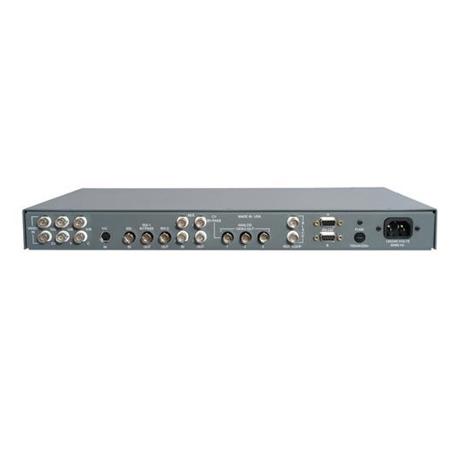
Link Electronics PFS-875 Video Frame Sync/Signal Converter
SKU: LEPFS875
This item is no longer available.
Recommended Alternatives
Share:
Overview
Compare
Specs
Protection







About Link Electronics PFS-875
There are four video input and output formats supported by the PFS-875; Composite Video, Component Analog Video (YUV), Y/C (S-VHS) and SDI. The component analog video input is YUV (SMPTE) and component output is YUV (SMPTE/Beta-cam). The analog output is on three BNC connectors which can be programmed from the front panel to output all 3 composite or composite and Y/C, YUV SMPTE or YUV BETA.
The PFS-875 provides dual standard composite and SDI correction and synchronization to an external analog reference. The synchronizer decodes multiple composite standards (NTSC, PAL). All analog inputs are sampled with 12-bit resolution and decoded using a 5 line adaptive comb filter. It also has a built-in color bar or black burst generator. The PFS-875 can also synchronize non TBC signals from VHS tapes. When input video is lost, the synchronizer freezes the video or generates a test pattern. There are three ways to freeze the video, freeze to the last known good frame, field 1 or field 2. The test patterns that can be generated are SMPTE color bar for NTSC, 75% color bar for PAL and black burst for both.
PFS-875 has the feature to embed and de-embed two channels of stereo AES audio. The De-embedded AES audio is output through 2 separate BNCs on the rear panel. Similarly, AES input for embedding can be input through 2 separate BNCs. It has the feature of choosing to embed the de-embedded audio and move the audio to another group or channels. It also has the feature of delaying the audio to match the video delay. One of the new developments to be included in this product is an all-digital composite NTSC/PAL encoder. The encoding process allows for an image quality superior to any of the off-the-shelf encoder ICs available on the market at present and also gives a superior gen-lock capability. The encoder process implements 12-bit outputs.
The PFS-875 has the feature of three built-in processing amplifiers. One "proc. amp." is for the analog output allowing you to control luma, chrominance, Sync, Burst and Set-up levels along with a black clip and hue phase adjustment. The second "proc. amp." is for the SDI output allowing you to control luma, chrominance and set-up levels along with a black clip. The third "proc. amp." is for the analog input affecting both analog and SDI outputs, which allows you to control the luma and chrominance levels along with hue phase adjustments.
After you have reviewed the PFS-875, look inside, your will be pleased to know they are using a BGA FPGA and it is made in the USA. This device provides many features to be crammed into one RU chassis. OK - the PFS-875 is envisioned as a product of the future. The unit is comprised of a 4 field TBC/frame synchronizer with full transcoding on the analog inputs and a user configurable set of triple analog outputs as well as SDI input and output. All processing is completely digital and includes a full proc amp as well as adjustable output levels and timing.
The PFS-875 is designed as a standalone gen-lock-able frame sync with a variety of both analog and digital inputs and outputs. The developmental was aimed to produce a broadcast quality unit as an initial offering and then to potentially use portions of this new platform in a variety of new products (modules for existing card frame products, digital proc amp, etc.). The PFS-875 provides dual standard composite and SDI timebase correction and synchronization to an external reference. The unit will decode multiple composite standards (NTSC, NTSC-J, PAL-B,G,H,I,N). All analog inputs are sampled with 10 bit resolution and decoded using a 3 line digital comb filter. The PFS-875 passes closed captions for 608 for NTSC and SDI. Should NTSC composite video be converted to SDI, the SDI will have closed captions present.
Link Electronics PFS-875 Features
- Input/output Select
- Menu Short-cut Button
- Looping Reference Input
- Color Bar Black Generator
- DAC & ADC 12 Bit Processing
- AES Audio Delay up to 640 mS
- User and Factory Default Settings
- Analog I/O Video Proc Amp Settings
- SDI, CV, CAV (YUV), Y/C & S-Video I/O
- Embed Audio move to a different group
- Bi-Directional Digital Analog Decoder
- Front Panel VFD Display for Function Set-Up
- PAL/NTSC
- 1 Rack Unit
- TBC Function
- Power off Bypass
- User friendly Menu System
- Two AES Stereo Channels
- Selectable Video Freeze
- SDl Video Proc Amp Settings
- Analog Video I/O Proc Amp Settings
- Infinite Horizontal and Vertical Timing
- Bi-Directional Digital Analog Transcoder
- Audio Embedding & De-embedding
- Passes 608Captions for NTSC & PAL