
This item is no longer available.
Review Summary
2021-03-04T04:14:46
I have an Azulla 3 stick. The HDMI signal was very weak, no signal was detected, even when directly plugging directly into a projector. The repeater worked like a charm. Now I can see and hear all of my content.
KENNETH R.
Accidents happen where life happens. Protect your favorite Adorama products and purchase a protection plan to stay covered from accidental damage, mechanical or electrical failure, and more.
If we can’t fix it, we’ll replace it at no additional cost.
Protect your product from drops, spills, and more.
Enjoy your gear without fear. We have you covered!
When regular use of your product over time results in mechanical or electrical failure.
We will never charge you a deductible after the purchase of a plan.
Our claims process is simple & easy and our customer service team is happy to help.
Adorama Protect powered by Extend is available for purchase to customers in the United States. Not available for purchase Internationally or in U.S. Territories.
Browse our FAQ
TMDS (HDMI/DVI-D)
HDMI Type A
+5V
TBD, 5V as the maximum current
0 to 50 deg. C (32 to 122 deg. F)
-20 to 80 deg. C (-4 to 176 deg. F)
5-90% (non-condensing)
58.22 x 27.26 x 10.80mm (2.29 x 1.07 x 0.43")
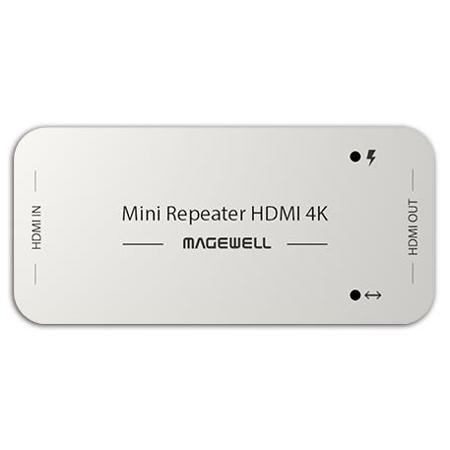
The repeater receives and equalizes an HDMI signal and outputs it to another HDMI cable. It ensures clear delivery of 4K/2K/HD signal over a longer total length of cable. When a capture card directly captures the signal and it shows black-and-white dots (random digital noise or dropout) or the Properties panel reports "no signal" or "unsupported signal", you can try using the repeater. It can fix the corrupted signal at the receiving end or generate a better signal at the sending end, so that the user can capture the image correctly.
However, if the signal is seriously corrupted, the repeater might not solve the problem. The optimum place for the repeater is typically midway between the source and the capture device. If a long cable is not delivering a stable signal, try replacing the long cable with two shorter cables, with the repeater connected in-between them.