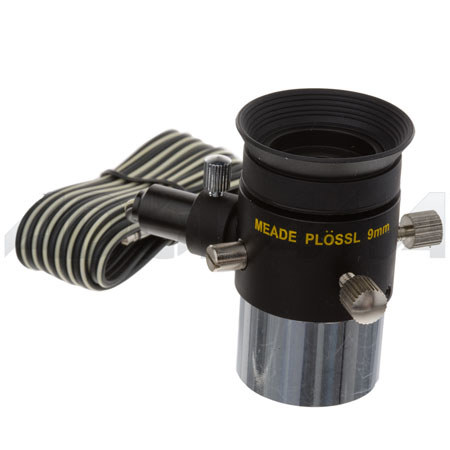
Meade Plossl 9mm Illuminated Reticle Eyepiece (1.25"), with Cord
SKU: MDIR9
This item is no longer available.
Share:
Overview
Compare
Specs
Protection
About Meade Plossl 9mm Illuminated
This 1.25" Plossl design has a detachable 6' DC power cord that plugs into the drive base of all Meade LX3, LX5, LX6, Premier, LX90 (using the #909 accessory port module), LX100, and LX200 Schmidt-Cassegrains and ED refractors. The telescope itself powers the reticle's red LED and controls its brightness.
The illuminator can not be plugged into the 9 to 12 volt auxiliary power outputs on other brand telescopes or into the 12 volt auxiliary output on the base of the Meade LX50. Such misuse will burn out the 3 volt LED of the illuminator and is not covered by warranty. The illuminator LED has an expected life of 10,000 hours of use if operated with the correct 3-volt input (zero hours if you plug it into 12 volts).
The eyepiece has a dual crosshair reticle with a pair of concentric bulls-eye circles centered on the crosshairs. There are two micro-adjustment controls in the side of the eyepiece. Turning these moves the crosshairs and their circular field stop up/down and right/left within the larger off-axis guider or photoguide telescopes field.
This allows you to more easily center the crosshairs on a guide star without having to move the telescope and disturb the photographic composition. The movable reticle does not have central detents or index marks, so returning the crosshairs precisely to the center of the field can only be done by guesswork and is usually not very accurate.
If precise centering of the crosshairs in the field is important (for centering stars using the high precision pointing sub-routine in the Meade LX200 scopes, for example), you might want to consider going to a fixed crosshair eyepiece instead of this movable crosshair version. The top of the eyepiece rotates to focus the crosshairs sharply to match your eyesight.
For guiding tolerance purposes with your particular scope, you can calculate the area of sky subtended by the small central box formed by the dual crosshairs by aiming at a star near the celestial equator. Turn off the telescope drive and count how many seconds it takes for the star to drift from one side of the box to the other. One second of time equals 15 arc seconds of sky.
The eyepiece has a soft turndown rubber eyecup for eyeglass use, but a very limited 3mm eye relief. This short eye relief will vignette a substantial portion of the field for those who wear glasses while observing. It is not a debilitating drawback, as the central crosshair box usually remains visible even with glasses and the crosshair focusing mechanism has enough range to allow most observers to remove their glasses and still focus sharply on the crosshairs