+5
more
more

See Options
Need help? Ask our experts.
Audio Performance: Superb analog audio quality
Renowned ESS Sabre32 DAC technology delivers 125 dB dynamic range and extremely low harmonic distortion. Analog performance is driven by decades of engineering expertise in audio interface technology.
Universal Connectivity: Thunderbolt and USB connectivity for Mac, PC and iOS
The 848 delivers cutting-edge Thunderbolt 4 and USB4 universal connectivity for Mac, PC and iOS. Connect your host device with the included 40 Gbps USB-C cable and the 848 negotiates the fastest possible connectivity speed, up to 40 Gbps, with backward compatibility for Thunderbolt 3, USB3 and USB2 host connections. Thunderbolt and USB4 connections deliver an astonishing 256 channels of computer I/O (128 in and 128 out) at sample rates up to 96 kHz.
Audio I/O: 60 simultaneous audio channels
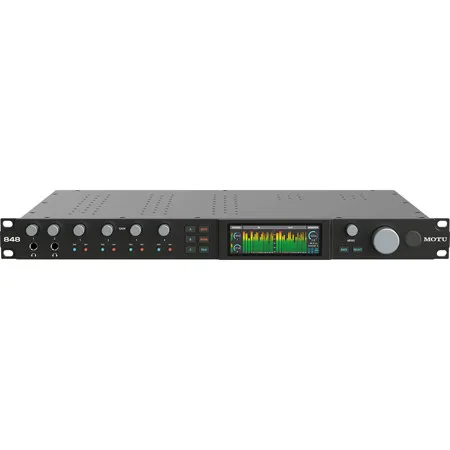
Connect all your studio gear, including monitors, headphones, microphones, guitars, synths, keyboards, drum machines, outboard processors, optical expanders, and more. All 28 inputs and 32 outputs are available simultaneously.
High Performance Driver: Ultra-low latency performance
Optimized drivers for both Mac and PC deliver renowned, ultra-low latency performance. With a high-performance DAW such as Digital Performer, the 848 delivers an astonishing round trip latency (RTL) of -1.8 ms (milliseconds) over Thunderbolt and USB at 96 kHz with a 32-sample host buffer.
Thunderbolt Technology: Plug and play ease with massive bandwidth
Daisy-chain the 848 with up to six other Thunderbolt devices, all connected to your host computer with massive 40 Gbps bandwidth to easily handle hundreds of audio channels, 8K video, terabytes of hard drive storage, and more. Thunderbolt 4-compatible USB-C cable included (length = 2 meters).
Four Mic Inputs: Transparent mic channels and hi-Z guitar inputs
Capture your recorded material in its truest, most natural form with -114 dB THD+N, 118 dB dynamic range and -129 dBu EIN performance. Each mic channel has individual preamp gain, pad, 48V phantom power and remote control from your computer or iOS device. Each combo jack alternately provides a 1/4-inch high-impedance TS guitar input for DI tracking and reamping.
Channel 3-4 Inserts: Extra line inputs when you need them
Do you work with compressors and other outboard gear? Mic inputs 3-4 each offer a dedicated analog send/return loop, allowing for both mono or stereo mic channel outboard processing via fully balanced connections. If nothing is plugged in to a mic input, its return serves as an extra line input with identical signal characteristics to all other line inputs.
Monitor Group: Control up to twelve analog outputs
Control your 5.1 or 7.1.4 Atmos surround speaker system with a single fader. The Monitor Group gives you the flexibility to choose any analog outputs you wish to control.
Control Room: A/B/C speaker select and talkback
Take control of your recording sessions with the front-panel talkback switch. Connect three sets of monitors and check your mixes instantly with front-panel A/B/C select buttons.
Mixing and Effects: 64-channel mixing with 32-bit floating point precision
The 848 is equipped with a 64-channel mixer designed just like a large format mixing console. The 64 inputs can take signal from anywhere: the physical inputs on the 848 interface itself, audio channels from host software on your computer, audio network streams, or even mixer outputs. The mixer provides 26 aux busses, plus main, reverb, monitor, and solo buses. All inputs and output buses provide 4-band double-precision parametric EQ and a compressor. Additionally, input channels include a High- Pass Filter and Gate. In essence: capable and transparent mixing.
Patchbay: Point-to-Point routing and splitting
Using intuitive, virtual patch cords, you can easily route any source signal to any destination. Sources can be analog or digital inputs on the interface, computer channels, mixer bus outputs, or audio network streams from other devices on the network. Destinations include interface outputs, host software inputs, mixer inputs, or any other device (or computer) on the network. You can even split any single source (or stereo pair) to unlimited multiple output destinations.
Routing Grid: Matrix routing, splitting and patching
For complex workflows that involve routing and splitting at scale, the Routing Grid provides a global "bird's-eye" view of all the connections in your 848 system. Manage hundreds of audio channels quickly, at a glance. Check for signal with convenient activity meters. Show and hide audio banks to customize your routing environment. Display destinations on either the right side or left side of the grid, as you prefer.
Audio Networking: Flexible system expansion
Audio networking has come of age, delivering a world of possibilities. The 848 features an integrated AVB switch with two Gigabit Ethernet ports, allowing you to daisy-chain multiple 848 and 16A units using standard network cabling. Alternatively, expand your network by connecting an external AVB switch to build a network with multiple interfaces, computers, and ultra-low network latency, even over long cable runs (hundreds of meters). Each 848 can transmit and receive 128 audio channels to and from the network. Stream hundreds of audio channels among devices and computers on the network. The 848 is compatible with previous-generation MOTU AVB devices.
Industry standard networking
Developed by the IEEE, Audio Video Bridging (AVB) is widely adopted across the pro audio industry, with no licensing fees required.
Long cable runs
A point-to-point connection can run up to 100 meters with a standard CAT-5e or CAT-6 cable, or much longer with fiber-optic cables.
Extremely low latency
AVB network latency (from point to point) is fixed at 2 ms throughout the AVB network, even through 100-meter cable runs, daisy-chained devices, and AVB switches.
Guaranteed audio streams
AVB streams are never interrupted by other network traffic to ensure continuous real-time performance.
High channel counts
AVB supports hundreds of audio channels over the network, even at high sample rates.
True plug-and-play operation
Just connect devices and go. No IT expertise required. AVB is a self-managing network protocol.
Network-wide clocking and sync
All devices resolve to a master clock with better-than-sample-accurate phase lock measured in nanoseconds.
Flexible topology
Daisy-chain up to eight devices. Add one or more AVB switches to create a network that covers facilities of any size and configuration.
Additional features
• The new 848 is AVB-compatible with all other MOTU AVB interfaces
• 256 channels of host computer I/O (128 in / 128 out) via Thunderbolt or USB3
• 16 8-channel streams for 256 channels of network audio I/O (128 in / 128 out)
• Each audio stream can be individually configured between 1-8 audio channels
• Use multiple PC hosts on the network. Each host can send/receive to all devices and other hosts
• Use existing Ethernet wiring. Just replace Ethernet switches with AVB-compatible switches
• Shared operation with standard Ethernet devices like wireless routers, switches, etc
• Supports 1722.1 for Connection Management and Control
• Supports AAF stream formats and the legacy AM8-24 format, configurable per stream
• Gigabit Ethernet speeds support many devices on the network
• Easy, one-click clock sync across all MOTU devices on the network
CueMix Pro: Control everything from your laptop, tablet and phone
CueMix Pro is the consummate app for controlling everything in the 848, including device settings, signal routing and 64-channel mixing and effects. Available for macOS, Windows, and iOS, you can run CueMix Pro on multiple devices at the same time and access the 848 wirelessly through Wi-Fi. As a 1722.1 controller, CueMix Pro can also be used to access AVB-related settings in 3rd- party devices on the network.
Wireless Control: CueMix Pro for iOS
Control all settings and mixing from your host PC or from an iPhone or iPad running the CueMix Pro app. You can even use multiple iOS devices simultaneously.
Advanced Extras
Balanced analog
The 848's balanced I/O connections are well-protected against RF interference, AC hum, and other noise- producing environmental factors.
Optical I/O and optical expansion
Two optical banks provide 16 channels of ADAT optical at 48 kHz, 8 channels of S/MUX optical I/O at 96 kHz, with optional stereo TOSLink at rates up to 96kHz. Expand your 848 with other optical gear, or use it as an optical expander.
Meter Views
Not using the optical I/O? Or any digital I/O? The 848 provides customized meter views for analog I/O only, digital I/O only and other combinations to best support your workflow.
Two headphone outputs
Each headphone output can be programmed with the same or different mixes, with independent volume control and source selection from the front-panel or CueMix Pro.
Loopback and live streaming
Easily route computer output channels - as many as you need - back to the computer, where you can mix them with live mics and/or guitar inputs from the 848 in your host software for live streaming or podcasting.
DC-coupled TRS outputs
All analog outputs are DC-coupled. This means you can use the 848 to manipulate and sequence modular synthesizers from a host DAW using control voltage (CV).