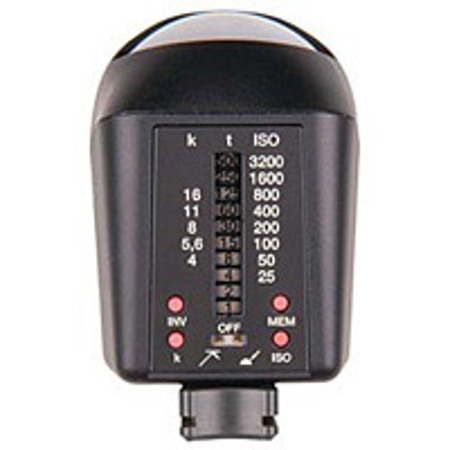
Noblex Panolux 35mm Exposure Control Module f/135S &135U
SKU: NBP135
This item is no longer available.
Share:
Overview
Compare
Specs
Protection
About Noblex Panolux 35mm Exposure Control Module f/135S &135U #PAN135
The PANOLUX is an exposure metering and control module which you can purchase in addition to your NOBLEX. The PANOLUX automatically controls the exposure time of your camera. There are two measuring methods for this: reflective metering (light metering in direction of the subject), and metering of incident light. The incident light metering offers two different methods of measuring: pure metering of incident light (metering of the light falling on the subject and/or the white diffuser independent of the reflection qualities of the subject) and subject-oriented metering of incident light (simultaneous reading with the detector cell and the diffuser which means that the reflections of the subject are taken into consideration). There are 4 measuring methods available:
Reflective reading is carried out by the front detector cell (808). The PANOLUX measures the light reflected from your subject. To avoid an overweighting of the bright sky portion, the measuring axis of the front detector cell (808) is angled down by approx. 15°. When normally holding the camera, an area approx. 18 feet in front of the camera is measured. The measuring angle is approx. 33°.
It is possible to influence the exposure time measured by reflective metering by entering correction factors. This results in a dynamic change of the shutter speed rotation during the exposure. That means when using correction factors the lens drum moves slower or faster in the corresponding parts of the exposure and different exposure times are produced during one drum rotation.
When working with the pure metering of incident light the light falling on your subject (respectively on the white diffuser (807)) is measured. The measurement does not take into account any reflected light. The incident light is measured by two light sensors oriented to the back right and to the back left under the white diffuser (807). When measuring the incident light the average value between both light sensors is determined. This average exposure time is basis for the complete exposure.
When working with the subject-oriented metering of incident light all three light sensors (807 and 808) are active. This kind of metering results in an automatic exposure compensation by different drum speeds during the exposure process. The compensation is intensified when entering positive correction factors or can be reversed when entering negative correction factors (verticals).