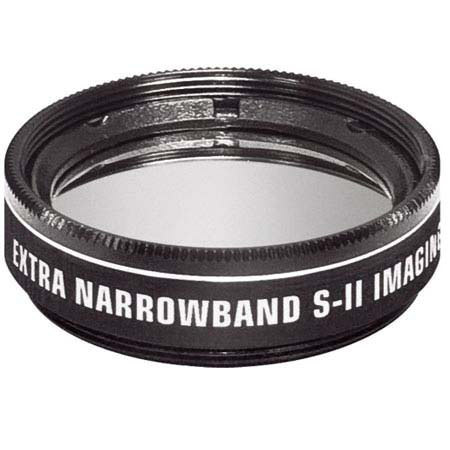
Orion 1.25" Sulfur-II Extra-Narrowband Filter with 90% Transmission
SKU: ONXNBS2
This item is no longer available.
Share:
Overview
Compare
Learn
Specs
Protection
About Orion 1.25" Sulfur-II Extra-Narrowband Filter with 90% Transmission #05579
The Orion 1.25" Sulfur-II Extra-Narrowband Filter allows to capture dramatic Hubble-like CCD images of emission nebulas from the heart of the city or under a full Moon. It transmits only the specific wavelengths of light that are important in emission nebulas, while blocking out all other light, whether artificial or natural. The result: high-contrast tricolor images from even grossly light-polluted skies.
The S-II filter passes light at the 672.4nm wavelength (the Sulfur-II line in the deep red end of the visual spectrum) with very high 90% transmission and a bandpass of 7nm. It complements the Orion H-alpha (5587) and Oxygen-III (5578) extra-narrowband filters, which together allow advanced tricolor imaging of emission nebulas with the StarShoot Deep Space Monochrome CCD Imaging Camera or other monochrome CCD cameras. This 1.25" filter is made from high-grade glass and feature vacuum-deposited dichroic interference coatings and antireflection coatings.
It is parfocal, meaning no refocusing is needed when switching among them. The filter is held in an anodized aluminum cell that is threaded to fit a standard CCD camera 1.25" nosepiece or the Orion Multiple Filter Wheel. Images taken with extra-narrowband filters typically look much different from those acquired using standard "true color" (RGB) methods. Rather than rendering an image in its "natural" color, the extra-narrowband filter provides a visual representation of the elemental makeup of a nebula, highlighting with assigned colors the areas where the light derives predominantly from either Sulfur-II, Oxygen-III, or Hydrogen-alpha ions.
This is the approach used by astronomers for many of the nebula pictures taken with the Hubble Space Telescope. The extra-narrowband "false color" images, while beautiful, also reveal much about the chemical composition of a nebula and its various features. It includes protective plastic case.