



This item is no longer available.
Central to the realization of P2 is the growing use of Information Technology (IT) elements to transform the workflow, especially for newsgathering and post-production. IT infrastructure and components have brought network connectivity and ever-larger storage especially hard disk drive storage - to what was once called broadcast.
In addition, computer memory elements are now found in consumer devices like cell phones, PDAs and digital still cameras, and with ever-wider application capacity is growing and prices falling. Taken together, one can see that these generic and ubiquitous elements can revolutionize television.
The Benefits of P2:
Because the P2 card stores audio and video as data it's capable of doing things that tape never could. For example, a P2 card can be setto continually buffer record, recording the full capacity of the card as a pre-roll buffer. This can be incredibly useful for sports, news, and event coverage.
Here's how it works: Assume there's a 4 GB P2 card installed, and the camera is shooting DVCPRO50. That card has a capacity of about 8 minutes, so with the pre-roll buffer on, the card will be holding the last 8 minutes BEFORE you press the record button!
If you were waiting for the whales to breech the surface of the water, you have the shot in memory, just push record and it will keep all that before the breech, the breech and what followed.
And because P2 is solid-state memory with no moving parts, there's no headwear, or spinning parts and no reason not to take advantage of features such as continuous recording. Silent operation is probably one of the first things a new user notices.
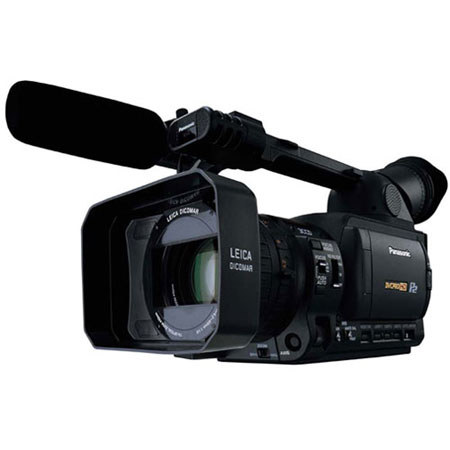
The higher capacity the tape drive in a camera, and the more heads in the tape mechanism (as well as the faster the heads spin and the tape moves), the more noise a camera makes. But with the P2 camera recording to P2 memory, there are no moving parts the camera is utterly silent.
Then there's reliability P2 is a solid-state, basically indestructible memory card. It's practically impervious to temperature, weather, condensation, dew, heat, vibration, magnets, x-rays, dust, dirt, or any of the other potential hazards that can affect tape (or hard disk or optical disk) recording methods.
A P2 recording will never have a dropout, dropped frames, or media errors, a claim that no hard disk, no tape, and no optical disk recording mechanism can make. Infinite record times become possible with P2 as well. Because P2 cards are hot swappable, and because all P2 cameras include multiple card slots, one could theoretically record perpetually on a P2 camera.
As cards are filled, they can be pulled out, empty cards can be inserted and recording continues. The camera knows to roll over from a full card to an empty one and the Metadata links the footage together so that it can be reassembled into one long continuous clip in the edit bay. This is something that tape could never do.