
This item is no longer available.
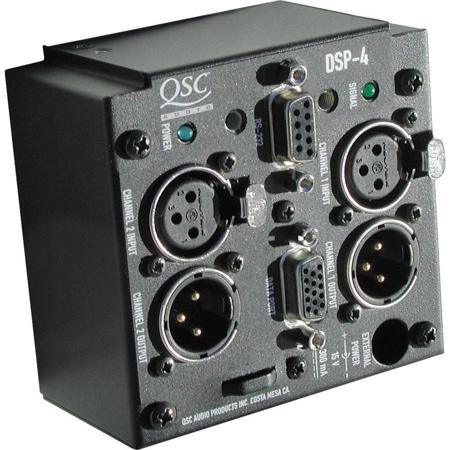
The QSC DSP-4 Digital Signal Processor offers two channels of independent DSP and attaches to the back of most 2-channel DataPort equipped QSC amplifiers without occupying any additional rack space. The second-generation DSP-4 provides several enhancements in functionality and performance while also incorporating the universally popular XLR balanced connectors. These enhancements include new A/D and D/A converters for improved signal-to-noise performance and upgraded software that significantly increases the unit's operational characteristics.
Powerful
Simple to install, compact and featuring set-and-forget" convenience, the DSP-4's powerful processor enables you to perform a wide range of signal processing functions; and with its new A/D and D/A converters, its noise floor improves. Whether you need speaker crossovers, EQ, signal delay or infrasonic filters, the DSP-4 is as flexible as your system's needs. Each channel includes crossover filtering, compression and limiting, multiple parametric eqs, precision attenuation, shelf filtering, mixing, multiple delays (up to 910 ms), tone and noise generation.
Configurable
The DSP-4's processing horsepower is dynamically assignable so you are not limited by a fixed signal chain. Simply use QSC's powerful PC based Signal Manager software to easily configure multiple processing functions and signal flow with drag-and-drop" tools.
Cost-effective
The power and flexibility of the DSP-4 eliminates the need for expensive outboard processing gear, reducing cost and installation time for almost any application. The compact DSP-4 also plugs directly into the back of most QSC DataPort-equipped amplifiers for use in systems where rack space is a premium.
Signal Processing Functions
Multiple Parametric Filters (Assignable Anywhere in the Signal Chain)
•Variable Frequency
•Variable Gain
•Variable Q
•Bypass one EQ
•Bypass all EQs
•Add EQ
•Delete EQ
•Show Response
Multiple Delays (Assignable Anywhere in the Signal Chain)
•20.83 Musec incremental
•910 msec maximum (total of all delays)
Compressor (Assignable Anywhere in the Signal Chain)
•Gain
•Threshold
•Ratio
•Attack Time
•Release Time
•Show Response
•Bypass
Output Peak Limiter (Assignable Anywhere in the Signal Chain)
• Gain
•Threshold
•Attack
•Release Time
•Show Response
•Bypass
High and Low-Pass Crossover Filters (Assignable Anywhere in the Signal Chain)
•Butterworth 6, 12, 18, 24 dB per octave slope
•Bessel 6, 12, 18, 24 dB per octave slope
•Linkwitz-Riley 12 and 24 dB per octave slope
•Bypass one EQ
•Bypass all EQ's
•Add EQ
•Delete EQ
•Show Response
•Cutoff Frequency
High and Low-Pass Shelf Filters, (Assignable Anywhere in the Signal Chain)
•Variable Corner Frequency •Variable Gain
•Variable Q
•Bypass one EQ
•Bypass all EQs
•Add EQ
•Delete EQ
•Show Response
Hardware
•Two independent channels of DSP
•48 kHz, 24-bit converters
•No turn on pops or zipper" noise
•If the memory or hardware fails, unit turns on muted to prevent driver damage
• Host interface via RS-232 or QS Control Audio Network System via CM16a Amplifier Network Monitor
•Electronically balanced inputs
•Contact closure to trigger preset changes
•Post DSP output signal for daisy chaining
• Selectable input sensitivity: 1.5, 4, 9, 13 Vrms; 6, 14.5, 21.5, 24.5 3.5, 12, 19, 22.2 dBV
Software
• Drag-and-drop" configuration software
• DSP processing power and memory is dynamically assigned to signal processing functions -eliminating the limitations imposed by fixed signal chain designs
•Graphical representation of DSP resources
•Firmware upgrades via RS-232
• Hard copy printout of signal flow layout or parameter settings
Additional Features
•Signal Mute
•Attenuation 0.1 dB steps
•Mix Post Crossover Audio (2 to 1 Mixer)
•Signal Splitter
•Built-in Noise Generator (Pink & White)
•Built-in Variable Frequency Tone Generator
•Signal Polarity Reversa
•Frequency Response
•Clip and Protect Indication of the amplifier's output
•Predictive Delay Feature - produces less signal distortion than analog compressor/limiters - especially for fast attack times.