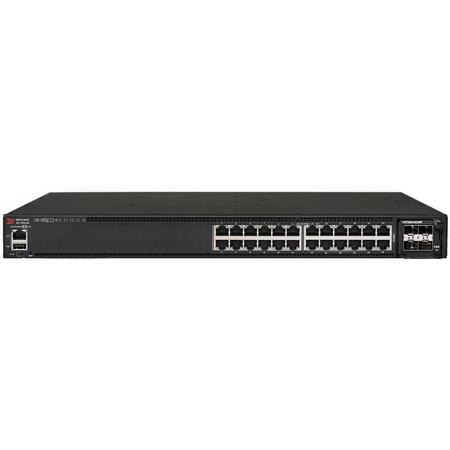
Ruckus ICX 7450 24-Port 1GbE Enterprise-Class Stackable Access Switch with Three Modular Slots for Optional Uplink/Stacking Ports, No Power Supply
SKU: RKCX745024
This item is no longer available.
Share:
Overview
Compare
Specs
Protection
About Ruckus ICX 7450
Enterprise Stackable Switch Delivers Premium Capabilities and Ultimate Flexibility
The Ruckus ICX 7450 switch delivers the performance, flexibility and scalability required for enterprise Gigabit Ethernet (GbE) access deployment. It offers market leading stacking density with up to 12 switches (576x 1 GbE and 144x 1/10 GbE ports) per stack and combines chassis-level performance with "pay as you grow" scalability of a stackable solution. The mid-market stackable switch is one of the first in its class to offer 40 GbE uplinks, enabling enterprises to dramatically increase their network capacity while using their existing optical wire infrastructure. In addition, the Ruckus ICX 7450 is the industry's first stackable switching solution to leverage the advantages of site-to-site IPsec VPN security to ensure end-to-end data integrity without the need for dedicated encryption appliances.
The modular design of the switch provides three slots for scaling up to 12 1/10 GbE SFP/SFP+ ports, 12 10GBASE-T ports or up to three 40 GbE QSFP+ ports for uplink or stacking. Organizations can initially deploy 1 GbE or 10 GbE uplink ports and easily upgrade to 40 GbE ports on-demand with a new, high-speed module. As a result, Ruckus ICX 7450 delivers high performance across all ports for flawless support of latency-sensitive applications.
System-level high-availability features, such as dual hot-swappable, load-sharing and redundant power supplies and hot-swappable fan trays offer another level of availability for the campus wiring closet, all in a 1 RU form factor. The switch is an ideal network solution for campus network 1 GbE and 2.5 GbE access or small aggregation deployment with 10 GbE or 40 GbE uplinks to the core. The switch is also suitable for a data center Top-of-Rack (ToR) solution, providing a mix of 1 GbE and 10 GbE server connectivity ports with 10 GbE or 40 GbE uplinks to the data center aggregation or core. Deployed as a standalone switch, a stack or a network fabric, organizations reap the benefits of a flexible platform and the assurance that their investments are protected.
Integrated High-Performance IPSec Service
Ruckus offers an industry-first stackable switching solution that delivers encryption from the wiring closet, providing a cost-effective way to ensure data security and integrity across the premises without needing to purchase dedicated encryption appliances. The Ruckus ICX 7450 switch with the integrated IPsec VPN service module consolidates network switching and encryption to provide unprecedented VPN deployment flexibility and cost savings. By initiating an IPsec tunnel from the switch for transporting selected traffic, organizations save the time and reduce the costs from having to install and manage encryption software on individual computers or deploy purpose built encryption appliances.
The Ruckus ICX 7450 Service Module provides hardware-based acceleration for IPsec VPNs using Advanced Encryption Standards (AES). It leverages programmable hardware technology to future-proof data protection, enabling more capabilities to be added as business needs evolve.
EEE Power Savings
The Ruckus ICX 7450 Switch supports the IEEE 802.3az standard for Energy Efficient Ethernet (EEE), reducing power consumption during periods of low utilization. Ports are placed into a low power mode when no data is being transmitted.
Data Center Top-of-Rack Switch
With class-leading 10 GbE and 40 GbE port count, the Ruckus ICX 7450 is a great solution as a Top-of-Rack (ToR) switch in a mixed 1 GbE/10 GbE server connectivity environment. It is designed to fit in server racks, consuming only one rack unit and offering dual integrated power supplies and fan assemblies with front-to-back or back-to-front airflow for flexible cooling options. In data center environments where most servers have 1 GbE and some 10 GbE network interfaces, the 1RU switch provides a cost-effective 1 GbE/10 GbE ToR switch. In this configuration some of the 10 GbE or 40 GbE ports can be used to connect to the data center aggregation switches.
Ruckus ICX 7450 Product Family
All Ruckus ICX 7450 models offer three modular slots for interchangeable uplink/stacking modules (one in the front, two in the back), dual power supply slots, dual fan trays, one RJ-45 network management port, one mini USB serial management port and one USB storage port on the front panel.
Enterprise-Class Features Across All Ruckus ICX Switches
The Ruckus ICX 7450 is one of the ICX switch families delivering the enterprise class features for flexibility, scalability and simplified management. Ruckus Campus Fabric technology delivers unmatched flexibility, scalability and simplified management for campus network deployments. Incorporating all of the ICX 7000 switch families with up to 1800 ports in a single logical domain, Campus Fabric allows customers the benefits of a traditional chassis, with the flexibility of stackable switches at a dramatically reduced Total Cost of Ownership (TCO).
• On-boarding and security policies across ICX switches and wireless networks
• Open Flow 1.3 protocol support in hybrid mode allows user to deploy traditional Layer 2/3 forwarding with Open Flow on the same port for Software Defined Network (SDN) enabled programmatic control of the network
Advanced stacking goes beyond traditional stacking with capabilities that take flexibility, ease of management and cost effectiveness to then next level, including
• Stacking on standard Ethernet ports
• Long-distance stacking
• No hardware module require for stacking
• In Service Software Upgrade (ISSU) to minimize downtime
• Superior scalability with the industry-leading number of switches per stack
• Stacking at the access, aggregation and core layers
Enterprise-Class Availability to improve resiliency and minimize downtime, including
• Hitless stack failover
• Hot-insertion/removal of stack members
• Redundant power supplies
• In Service Software Upgrades for switch stacks
Open Standards based management, monitoring and authentication
• sFlow-based network monitoring to help analyze traffic statistics and trends on every link and overcome unexpected network congestion
• Open-standards management includes Command Line Interface (CLI), Secure Shell (SSHv2), Secure Copy (SCP) and SNMPv3
• Support for Access Controller Access Control System (TACACS/TACACS+) and RADIUS authentication helps ensure secure operator access
• LLDP and LLDP-MED protocol support for configuring, discovering and managing network infrastructure such as QoS, security policies, VLAN assignments, PoE power levels and service priorities
Benefits
Flexible Path to Ultimate Performance
• Dual purpose for premium access or aggregation switch
• IPSec VPN security ensures compliance and data confidentiality
Modular Design for Cost-Effective Upgradeability
• 3 ports of 40 GbE
• 12 ports of 10 GbE
Market-Leading Stacking Scalability
• Up to 12 switches per stack
• Up to 10 km using standard optics or cables
Advanced L3 Routing Delivers Network Design Flexibility
• BGP, OSPF, VRRP, PIM, PBR
Campus Fabric Reduces Cost of Operations, Increases Flexibility
• Delivers the benefits of a chassis with the flexibility of stackables
• Scales to over 1800 ports
Energy Efficient Design
• Supports IEEE 802.3az standard
Layer 2 switching
• 802.1s Multiple Spanning Tree
• 802.1x Authentication
• Auto MDI/MDIX
• BPDU Guard, Root Guard
• Dual-Mode VLANs
• MAC-based VLANs, Dynamic MAC-based VLAN activation
• Dynamic VLAN Assignment
• Dynamic Voice VLAN Assignment
• Fast Port Span
• GVRP: GARP VLAN Registration Protocol
• IGMP Snooping (v1/v2/v3)
• IGMP Proxy for Static Groups
• IGMP v2/v3 Fast Leave
• Inter-Packet Gap (IPG) adjustment
• Link Fault Signaling (LFS)
• MAC-Address Filtering
• MAC Learning Disable
• MLD Snooping (v1/v2)
• Multi-device Authentication
• Per-VLAN Spanning Tree (PVST/PVST+/PVRST)
• Mirroring-Port-based, ACL-based, MAC Filter-based and VLAN-based
• PIM-SM v2 Snooping
• Port Loop Detection
• Private VLAN
• Remote Fault Notification (RFN)
• Single-instance Spanning Tree
• Trunk Groups (static, LACP)
• Uni-Directional Link Detection (UDLD)
• Metro-Ring Protocol MRP (v1, v2)
• Virtual Switch Redundancy Protocol (VSRP)
• Topology Groups
• Q-in-Q
Base Layer 3 IP routing
• IPv4 and IPv6 static routes
• ECMP
• Port-based Access Control Lists
• Layer 3/Layer 4 ACLs
• Host routes
• Virtual interfaces
• Routed interfaces
• Route-only support
• Routing between directly connected subnets
Quality of Service (QoS)
• ACL Mapping and Marking of ToS/DSCP (CoS)
• ACL Mapping and Marking of 802.1p
• ACL Mapping to Priority Queue
• Classifying and Limiting Flows Based on TCP Flags
• DiffServ Support
• Honoring DSCP and 802.1p (CoS)
• MAC Address Mapping to Priority Queue
• Priority Queue Management using Weighted Round Robin (WRR), Strict Priority (SP) and a combination of WRR and SP
• Priority Flow Control
Traffic management
• ACL-based inbound rate limiting and traffic policies
• Broadcast, multicast a