
This item is no longer available.
Front Panel
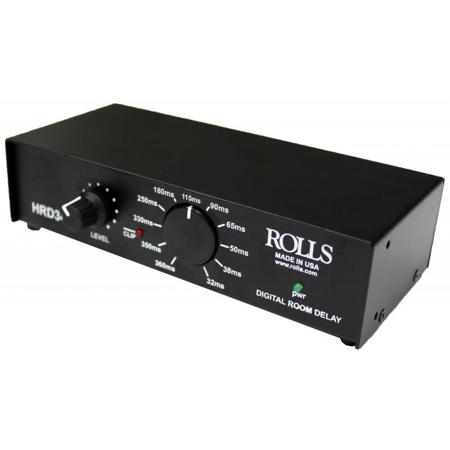
The HRD342 Digital Delay is used for speaker distance delay. The Rolls HRD342 is intended for low cost, simple, time alignment of speakers in larger rooms or outdoors. The delay dial is shown in milliseconds to make setup . The 32 to 360 ms shown on the dial will correlate to roughly the same in feet (32 ms = 32 ft). The Rolls HRD342 is inserted between the main console output and the amplifiers supplying the delayed speaker signal.
• Clip LED: Indicates that the amount of signal is above a normal operating level
• Level: Adjusts the amount of input signal
• Delay Time Knob: Sets the delay time from 32ms to 360ms
• PWR: Indicates that the HRD342 has power
Rear Panel
• RCA input and output: RCA line level
• XLR output: Balanced line level output
• XLR input: Balanced line level input
• VDC: For connection to the supplied Rolls PS27s adapter
Setting the delay time
In a large space with a complicated layout, making a speaker design for even sound is challenging. These venues require the use of delay speakers to ensure high quality sound for all listeners. A big challenge is where to place them and the next design problem is that the speakers are properly delayed. The sign of a job well done is when audience members complain the speakers are not working. One of the underlying principles of all speaker system designs is an effect discovered in 1949 by Helmut Has, in which whatever source of sound listeners hear fi rst will be the one that catches their attention.
This means that for an acoustically pleasant experience, audiences should hear sound coming from the stage before they hear it in a delay speaker.To ensure this is the case, many sound designers set delay speakers as far as 15 or 30 milliseconds behind. However, in a well-calibrated design, just one or two milliseconds of delay time can be enough, as this design will make the speakers invisible. A common rule of thumb is 1 foot = approx. 1 millisecond.